
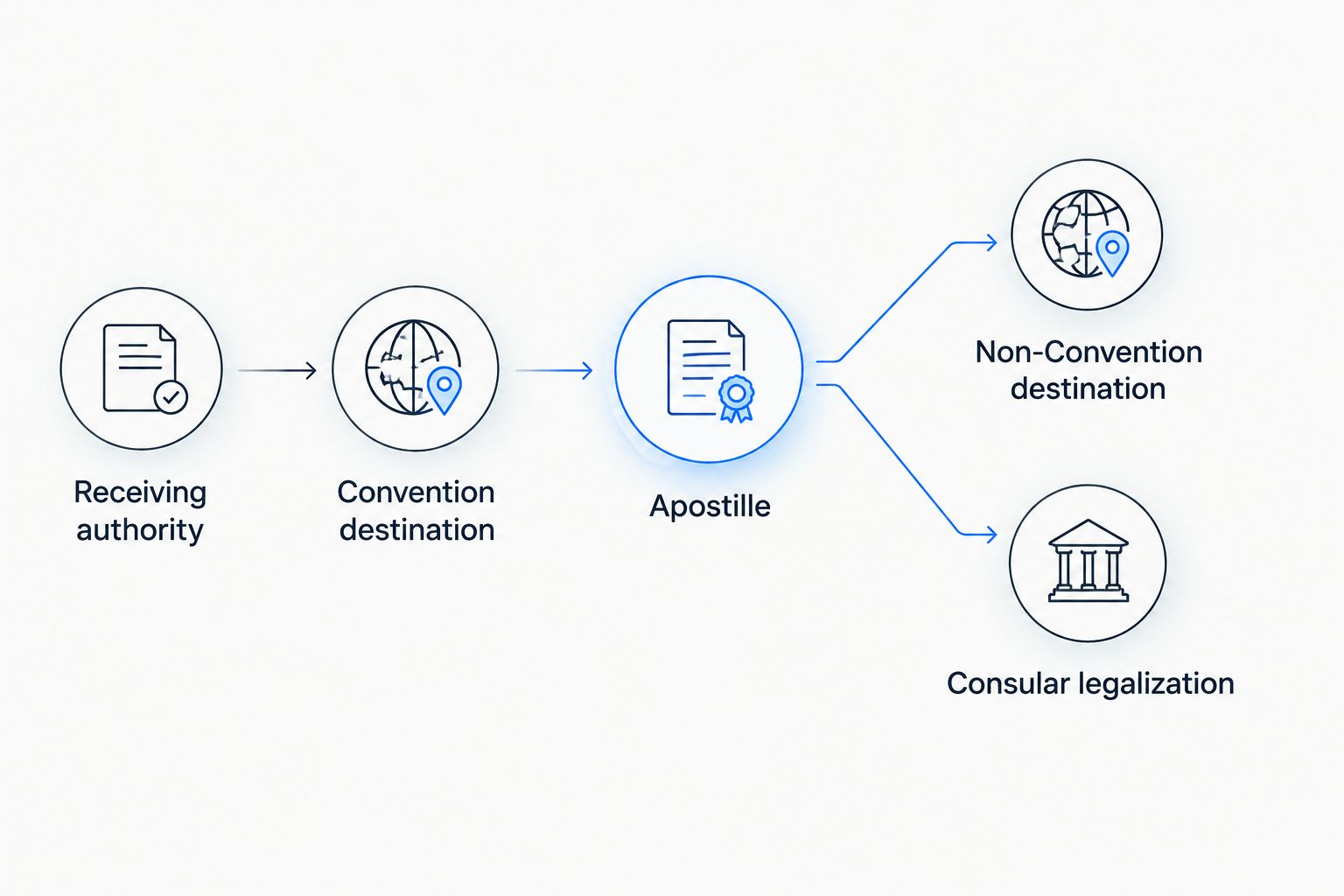
Instead of sending an apostilled document to an embassy automatically, confirm the receiving authority’s requirements first. The 2026 apostille embassy legalization workflow branches at that decision: an apostille is generally the final authentication step for a document used in another Hague Apostille Convention country, while a non-Convention destination generally requires a separate authentication and consular legalization route.
- The apostille embassy legalization workflow starts with the receiving authority’s written requirements, not an embassy appointment.
- For Hague Apostille Convention destinations, an apostille generally replaces embassy legalization of the document’s origin.
- For non-Convention destinations, confirm the required authentication chain with the destination’s embassy or consulate.
- Signature on Demand is best for Clark County residents who need document preparation or notarization before the authentication process.
Why this matters
An apostille and embassy legalization address a similar problem: helping an authority abroad assess where a public document came from. They are not interchangeable steps in a universal sequence. If you submit the wrong certificate, use the wrong issuing office, or send an original before confirming instructions, you create another round of paperwork.
An apostille is generally the end of the authentication chain for a Convention destination, not a routine stop before embassy legalization. The receiving institution can still set rules for translations, document age, format, and submission. Those rules come from the authority that will actually use your document.
Signature on Demand provides Nevada document preparation, mobile and remote online notary services, and apostille services in the Las Vegas area. If the document still needs preparation or notarization, start with Signature on Demand rather than treating embassy requirements as a notary question. The service can address document-preparation and notarization needs; the receiving authority determines what it will accept.
Before you start
- Get the receiving authority’s instructions. Identify the country, the institution receiving the document, its exact document requirements, and whether it asks for an apostille, an authentication certificate, consular legalization, a translation, or a combination.
- Identify the issuing source and document type. A Nevada notarized document, a state-issued vital record, and a federal document do not necessarily go to the same authentication office. Have the original or the form of certified copy the receiving authority requires.
- Check the non-obvious gotcha before mailing anything. A request for embassy legalization does not prove an embassy will legalize a document that already has an apostille. Ask the relevant embassy or consulate whether it accepts an apostilled document for further legalization and what preceding certifications it requires.
For a 2026 deadline, keep the receiving authority’s written response with your document checklist. An instruction for a different document type or destination does not settle your case.
Confirm the destination route
The first configuration choice is the route, not the courier. Use the country where the document will be presented and the receiving institution’s current instructions to decide what to request.
- Name the receiving authority. Write down the government office, school, employer, bank, or other institution that will receive the document. Ask it which authentication it requires for your document type.
- Check the destination’s Convention status. Confirm whether the destination participates in the Hague Apostille Convention and whether the Convention applies between the document’s issuing country and its destination. Do not rely on an old country list.
- Confirm the requested end state. Ask whether the authority wants an apostille, consular legalization, a translation, or another document-specific step. If its instructions say both apostille and embassy legalization, request clarification before ordering either.
Expected result: You have a written requirement tied to your document, issuing jurisdiction, destination, and receiving institution. In 2026, that written requirement is more useful than a generic legalization checklist.
| Route | Best for | What it does | Limitation |
|---|---|---|---|
| Apostille | A document going to a receiving authority in a Convention destination that accepts an apostille | Certifies the origin of a qualifying public document through the competent authority | Does not certify that the document’s statements are true or replace translation requirements |
| Authentication and consular legalization | A receiving authority in a non-Convention destination that requires consular legalization | Builds the certification chain the destination’s embassy or consulate requires | Offices and document prerequisites vary by destination |
| Apostille followed by an additional step | A receiving authority that expressly requests both for this document | Follows a specific written instruction rather than a standard route | An embassy might not process an apostilled document; confirm before submission |
For a Nevada document, the receiving authority’s written requirement decides the route. Neither the presence of a notary seal nor the phrase for international use tells you which certificate to obtain.
Verify the document source
The office that issued or notarized the document affects the next step. Sort the document before completing an application or sending an original.
- Identify the document category. Note whether you have a Nevada-issued record, a document notarized in Nevada, a record issued by another state, or a federal document. Do not assume a Nevada office can authenticate a record issued elsewhere.
- Check the document’s accepted form. Ask the receiving authority whether it needs an original, a certified copy, or a newly issued record. Confirm its rules for translations and any required order of authentication and translation.
- Check the signature that needs authentication. For a notarized document, confirm that the required notarial act is complete. For an official record, confirm that you have the issuing authority’s required certified version rather than an ordinary photocopy.
- Match the issuing authority to the request. Use the appropriate state or federal authentication instructions for the document in hand. An apostille does not turn an unofficial copy into an official record.
Expected result: Your checklist names the document’s issuer, its required form, the signature or seal to be authenticated, and the office responsible for the next certificate. That check prevents a 2026 request from stalling because the wrong version was submitted.
A notary verifies a notarial act; a document preparation service helps prepare documents within its authorized scope. Neither role can decide whether a foreign institution must accept the finished document. Signature on Demand is a practical fit when a Clark County document needs preparation or notarization before you follow the destination’s authentication instructions, but the service is not a substitute for those instructions.
Prepare the authentication request
Once the route and document source match, complete the request using the responsible authority’s current instructions. There is no universal application screen or shared embassy form for this workflow.
- Select the correct certificate request. Follow the responsible office’s instructions for an apostille or for an authentication certificate, as required by the confirmed route. Check that the destination and document category match the request.
- Include the required document version. Submit only the original or certified version specified by that office. Keep a copy for your records if the receiving institution allows it.
- Follow that office’s submission and return instructions. Check its current application, identification, mailing, and payment requirements directly. Do not transfer instructions from another state, a federal office, or an embassy to this request.
- Inspect the returned packet. Confirm that the certificate is attached to or associated with the intended document and that the names and identifying details match what you submitted. Do not detach a certificate from the document it authenticates.
Expected result: You have the document and the certificate required for the route you confirmed. For a Convention destination, stop and check the receiving authority’s submission and translation rules before adding any embassy step.
If you are choosing help for a Las Vegas apostille request, compare the scope of the document-preparation and authentication assistance you need in this guide to apostille services in Las Vegas. Confirm each provider’s current scope directly rather than assuming notarization, authentication, translation, and consular submission are the same service.
Complete consular legalization when required
Use this unit only when the destination’s requirements call for embassy or consular legalization. In 2026, treat the relevant embassy or consulate’s current document-specific instructions as the controlling submission checklist.
- Find the appropriate consular office. Confirm which embassy or consulate handles documents issued in your jurisdiction and whether it processes your document category.
- Confirm the required preceding certifications. Ask which state or federal authentications must appear before consular submission. If your document already bears an apostille, ask explicitly whether the consular office will accept it.
- Prepare the consular packet. Follow the office’s current instructions for the document, request form, identification, translation, submission method, and return arrangements. Use its stated order of operations.
- Check the returned document. Verify that the consular legalization is present on the correct document and that the packet still meets the receiving authority’s requirements.
Expected result: The document has the authentication chain the receiving authority requested, including consular legalization where required. A consular stamp confirms the applicable authentication step; it does not approve the document’s contents or guarantee acceptance for every purpose.
Check your Nevada document needs
Identify the preparation or notarization needed before an authentication request.
When an apostilled document is sent to an embassy
This 2026 variant applies when you already have an apostille but the receiving authority later asks for embassy legalization. Do not start over or send the document blindly. Establish whether the instruction applies to your exact document and whether the consulate will process an apostilled original.
- Send the receiving authority the relevant details. Identify the document type, issuing jurisdiction, destination, and certificate already attached. Ask it to confirm in writing what additional action it requires.
- Ask the embassy or consulate about its intake rule. State that the document already has an apostille. Ask whether it accepts that certificate, requires a different authentication chain, or does not provide legalization for this document.
- Follow the confirmed correction. If the authority accepts the apostilled document as it stands, submit it under its instructions. If it requires a different chain, obtain the specified document version and certifications before consular submission.
Expected result: You know whether the existing apostille completes the request, remains usable with an additional step, or must be replaced by another route. The answer comes from the offices handling your document, not from the appearance of its certificate.
Troubleshooting
- The receiving authority says “legalize” but does not name a certificate. Ask whether it means an apostille under the Hague Apostille Convention or consular legalization. Include the document type and issuing jurisdiction in the question.
- The issuing office rejects the document. Check whether you supplied an ordinary copy instead of the required original or certified record, or sent a document to an office that cannot authenticate its issuing signature.
- The embassy will not accept an apostille. Stop the consular submission. Ask for its required preceding authentication chain and confirm the revised route with the receiving authority before obtaining another certificate.
- A translation is requested after authentication. Ask which document must be translated and whether the translation itself needs certification or notarization. The receiving authority sets that requirement; do not assume the apostille covers the translation.
- The document is accepted for one purpose but rejected for another. Request the new receiving authority’s own written requirements. Acceptance by a different institution does not settle its document-format or translation rules.
Customize your workflow
For a 2026 household filing, make a separate checklist for each document rather than sending everything through the same chain. A Nevada notarized power of attorney and a record issued by another state have different sources, even if the same person will present both abroad. List the destination, receiving authority, document source, required certificate, translation rule, and final submission method for each item.
If notarization is still outstanding, decide whether an in-person mobile notary or remote online notarization fits the document and the receiving authority’s rules. Remote notarization is not a shortcut around a foreign recipient’s format requirements. Signature on Demand serves Clark County residents with mobile and remote online notary services; confirm the recipient’s acceptance requirements before choosing how to notarize a document intended for use abroad.
For a document that is not yet prepared, settle its content and required signing method before requesting authentication. Replacing a signed page later can mean the existing certificate no longer accompanies the version you need to submit. Signature on Demand provides Nevada document preparation and apostille services, but only the receiving authority can confirm the final packet it will accept.
FAQ
What is the apostille embassy legalization workflow in 2026?
Start with the receiving authority’s document-specific requirements, then obtain an apostille for an applicable Convention route or follow the required authentication and consular legalization chain. Embassy legalization is not a routine step after every apostille.
Does an apostilled document need embassy legalization?
Generally, an apostille replaces embassy legalization of the document’s origin for use between countries where the Hague Apostille Convention applies. Confirm the receiving authority’s rules for your document, including any translation or format requirements.
Can an embassy legalize a document that already has an apostille?
The relevant embassy or consulate determines whether it will process an already-apostilled document. Ask that office and the receiving authority before sending the original or requesting another certificate.
Where do I get an apostille for a Nevada notarized document?
Follow the Nevada Secretary of State’s current apostille instructions for an eligible Nevada notarized document. Check the document’s notarial act and the receiving authority’s requirements before submitting it.
Can a Nevada apostille authenticate a document issued by another state?
A Nevada apostille is not the route for authenticating another state’s issuing official. Identify the document’s issuing jurisdiction and follow the appropriate authority’s instructions.
Does an apostille certify that a document’s contents are true?
No. An apostille authenticates the origin of a qualifying public document, not the truth of every statement it contains or its acceptance for a particular use.
Can remote online notarization be used before an apostille?
The notarization method must meet the applicable issuing authority’s rules, and the receiving authority must accept the resulting document format. Confirm both requirements before choosing remote online notarization for international use.
One last thing
The most useful 2026 question is not where to get an apostille; it is who will receive the document and what that office will accept. Ask it before anyone notarizes, translates, or mails the original. That answer determines whether the apostille embassy legalization workflow ends with an apostille or follows a different consular route.


