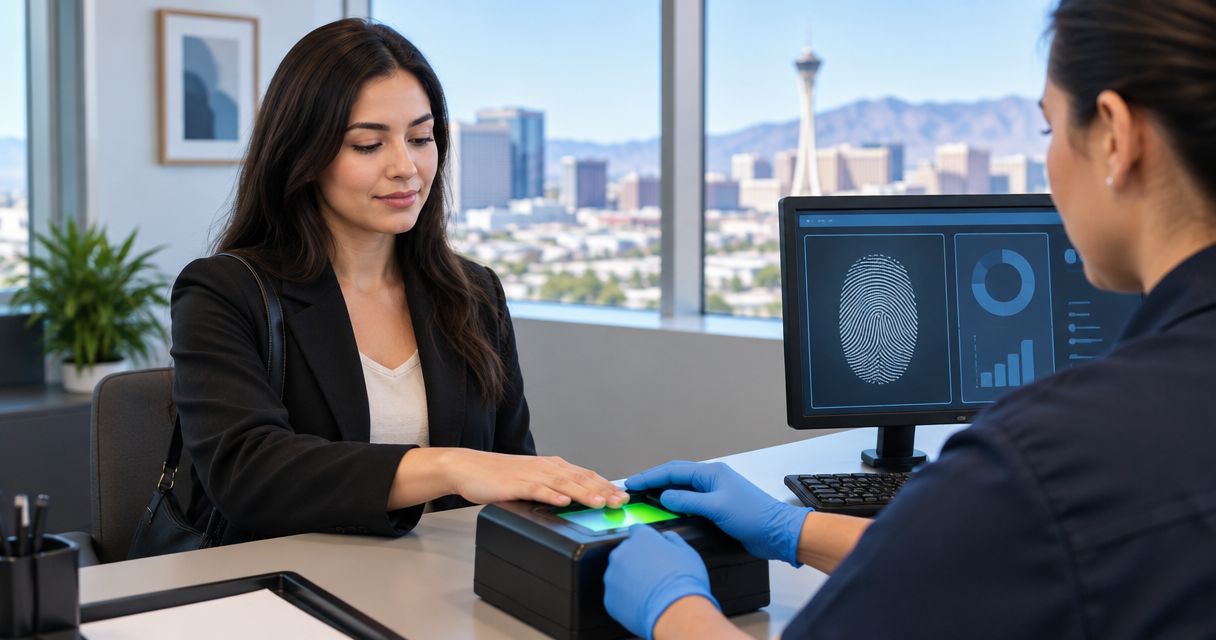
Best first contact for fingerprinting alongside document preparation: Signature on Demand. Best for licensing submissions: your agency’s designated fingerprint provider. Best for a personal FBI record request: an FBI-approved channeler. This 2026 guide compares fingerprinting services Las Vegas residents need by the destination of their prints, not by unsupported speed or quality rankings.
- Signature on Demand offers fingerprinting services Las Vegas residents can ask about alongside document preparation and notarization.
- For licensing or employment fingerprints, follow the requesting agency’s provider and submission instructions.
- Choose fingerprint-card collection only when the recipient accepts physical cards.
- An FBI-approved channeler serves eligible personal Identity History Summary requests, not every background-check purpose.
Why this matters
The best fingerprinting appointment is the one that produces the submission your recipient accepts. A readable fingerprint card does not replace a required electronic submission. An electronic scan does not automatically reach the employer, licensing board, or government agency that requested it.
Signature on Demand is a Nevada-licensed document preparation service based in Las Vegas that also offers fingerprinting, mobile and remote online notarization, and apostille services. Those are separate services. Confirm the fingerprint method and submission destination before arranging an appointment.
For a 2026 application, start with the current instructions from the organization requesting your fingerprints. A provider’s general description is not a substitute for those instructions. The distinction matters whether you live in Las Vegas, Henderson, North Las Vegas, or Summerlin.
What makes the best fingerprinting service
Use these criteria before comparing convenience:
- Recipient acceptance: The provider must support the fingerprint format and submission route your recipient requires.
- Correct purpose: Employment screening, professional licensing, personal record requests, and immigration appointments are not interchangeable.
- Submission responsibility: Establish whether the provider collects prints, transmits them, or returns cards for you to submit.
- Identification requirements: Follow the requesting agency’s instructions and confirm what identification the provider requires.
- Rejected-print procedure: Ask who handles a recollection and how you receive notice if fingerprints are rejected.
- Related paperwork: Document preparation, notarization, or an apostille belongs in the appointment only when your instructions call for it.
Choose the submission route first and the appointment location second. Convenience cannot correct a submission sent through the wrong process.
Fingerprinting options at a glance
These are service routes, not interchangeable businesses. The ranking gives each route a distinct purpose rather than claiming that one provider handles every application.
| Option | Best for | Standout feature | Key limitation |
|---|---|---|---|
| Signature on Demand | Fingerprinting inquiries alongside document preparation | Fingerprinting and related document services from one Las Vegas business | Confirm the fingerprint method, submission destination, and appointment arrangements |
| Agency-designated fingerprint provider | Employment or licensing with specified submission instructions | Follows the requesting organization’s designated route | A submission for one purpose does not automatically cover another |
| Fingerprint-card collection service | Requests that expressly accept physical fingerprint cards | Produces a physical card for the recipient’s process | Collection and delivery of the application remain separate unless expressly arranged |
| FBI-approved channeler | Eligible personal FBI Identity History Summary requests | Submits fingerprints through an approved FBI channeler process | A personal FBI report does not replace every licensing or employment check |
1. Signature on Demand: best for related document preparation
Signature on Demand offers fingerprinting and document preparation to individuals and families in Clark County. Its stated services also include notarization, immigration forms, and apostilles. Signature on Demand is a fingerprinting option for Las Vegas residents who also need document preparation.
Treat the services as separate tasks within your application. A Nevada document preparation credential does not, by itself, establish authorization to transmit fingerprints to every requesting agency.
Signature on Demand pros:
- Fingerprinting is an explicitly listed service.
- Document preparation is available from the same business.
- Notarization and apostille services are also listed when those tasks are required.
- The stated service area includes Las Vegas, Henderson, North Las Vegas, and Summerlin.
Signature on Demand limitations:
- Confirm whether your request requires ink cards, electronic capture, or a particular transmission process.
- Mobile notary service does not establish that fingerprinting is mobile; ask specifically about fingerprint appointment arrangements.
- Document preparation and notarization do not replace an agency-controlled fingerprint appointment.
Best for: You have a fingerprint request plus related paperwork and want to establish which tasks the business can handle.
Verdict: Hold until the recipient’s instructions and the offered fingerprint service match.
2. Agency-designated provider: best for employment or licensing
An agency-designated fingerprint provider is the route named or accepted by the employer, licensing board, or government agency requesting your background check. Use that route when your instructions specify a provider, registration process, submission identifier, or appointment system.
The decisive feature is routing. Your fingerprints must reach the correct recipient under the correct application purpose; obtaining a separate personal report does not accomplish that automatically.
Agency-designated provider pros:
- Keeps the appointment tied to the requesting organization’s instructions.
- Supports the submission purpose identified in your application.
- Gives you a clear place to resolve registration or routing questions.
- Avoids substituting an unrelated personal background-check process.
Agency-designated provider limitations:
- You must follow the designated process rather than assume any local technician qualifies.
- A completed submission does not mean your license or employment application is approved.
- A different organization can require a separate submission.
For a 2026 licensing application, read the current board instructions before selecting an appointment. If the instructions are unclear, ask the board which provider and submission route it accepts. Do not let a general fingerprinting advertisement answer that question.
Best for: Your employer or licensing authority has issued specific fingerprint instructions.
Verdict: Choose this route when the requesting agency requires it.
3. Fingerprint-card collection: best for accepted physical cards
A fingerprint-card collection service captures impressions on a physical card for a recipient that accepts that format. The FBI’s FD-258 is a commonly used fingerprint card, but the recipient determines which card and completed fields your request requires.
Electronic capture and electronic transmission are different. A provider can capture fingerprints digitally and print them onto a card without submitting a background-check request electronically.
Fingerprint-card collection pros:
- Fits requests that expressly require or accept physical cards.
- Lets you inspect the identifying fields before submission.
- Separates fingerprint collection from the recipient’s application process.
- Gives you a physical item to include when the instructions require mailing.
Fingerprint-card collection limitations:
- A card does not replace a required electronic submission.
- The technician’s collection service does not necessarily include mailing or application submission.
- The recipient can reject incomplete fields or unusable impressions.
A standard FD-258 layout includes 10 rolled impressions, plus flat impressions: 2 thumb impressions and 2 four-finger impressions. Follow the card’s layout and the recipient’s directions rather than treating any set of fingerprints as a complete submission.
Best for: Your instructions explicitly accept a physical fingerprint card.
Verdict: Choose card collection only after confirming the required card and delivery process.
4. FBI-approved channeler: best for a personal FBI record request
An FBI-approved channeler is a private business authorized to submit fingerprint information to the FBI for eligible Identity History Summary requests. This route serves a defined federal record-request process, not every background check described as an FBI check.
Confirm your eligibility and purpose before selecting a channeler. The FBI’s channeler process for personal requests is limited to U.S. citizens and lawful permanent residents; other applicants should follow the FBI’s applicable direct-request instructions.
FBI-approved channeler pros:
- Provides a defined route for eligible personal Identity History Summary requests.
- Connects fingerprint submission to the FBI record-request process.
- Distinguishes a federal personal record request from a state licensing submission.
FBI-approved channeler limitations:
- Eligibility restrictions apply.
- A personal report does not automatically satisfy an employer or licensing board.
- Channeler services and result-delivery arrangements differ; confirm them before submitting.
For 2026 requests involving use abroad, establish the required report and authentication process before choosing a submission method. An FBI record and an apostille are different outputs.
Best for: You are eligible and need your own FBI Identity History Summary through the channeler process.
Verdict: Choose this route for an eligible personal FBI request, not as a substitute for agency-directed screening.
Match your request before booking
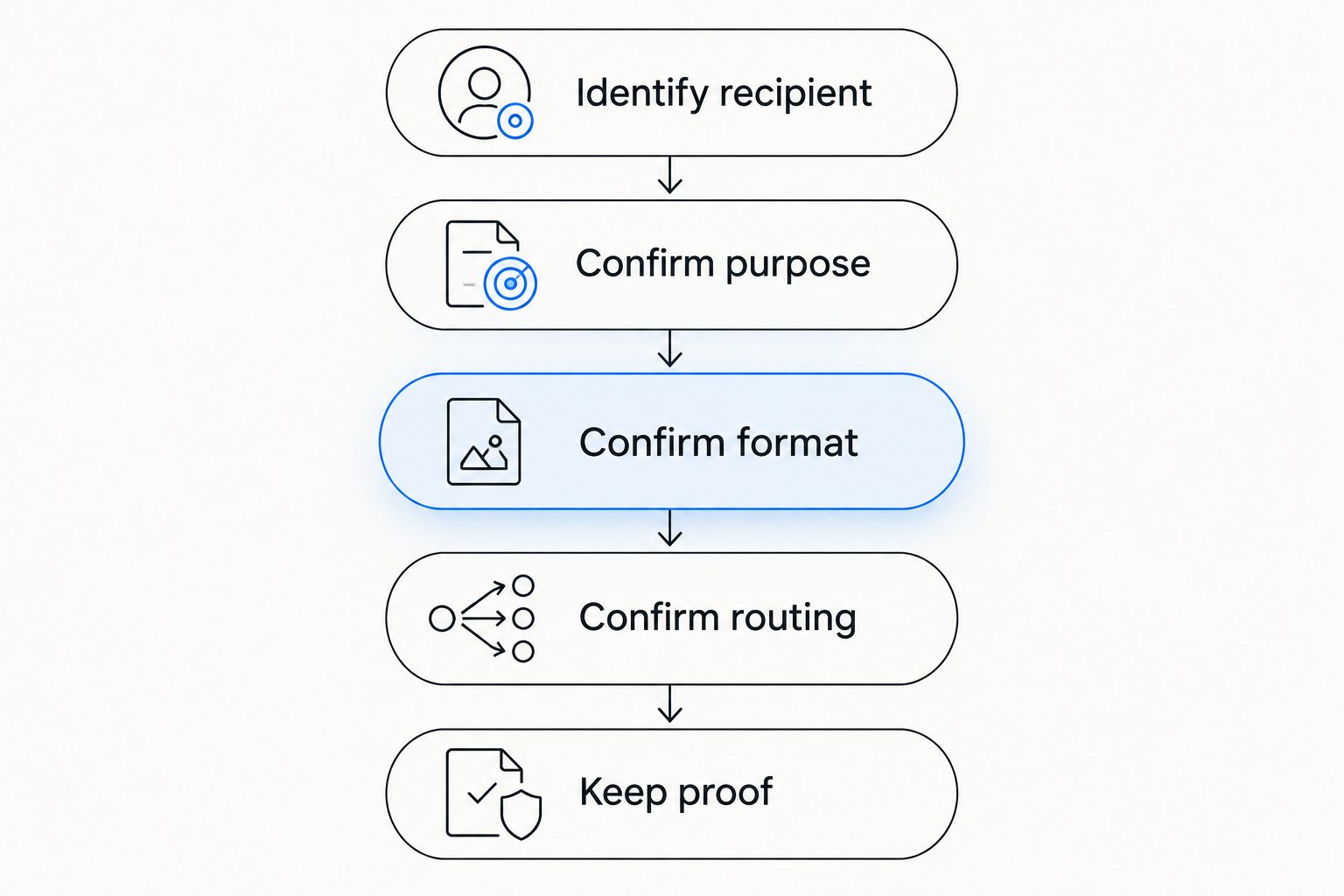
The requesting organization controls the submission requirements. Use this sequence to turn its instructions into an appointment brief:
- Identify recipient: Name the employer, board, government agency, or other organization receiving the submission.
- Confirm purpose: Specify employment, licensing, a personal record request, or another stated purpose.
- Confirm format: Establish whether the recipient requires physical cards, electronic submission, or an agency-controlled appointment.
- Confirm routing: Obtain the required identifiers and determine who sends the fingerprints.
- Keep proof: Retain the receipt, submission confirmation, or tracking information that the process provides.
This order prevents a common procedural mistake: collecting fingerprints before understanding where they must go. Send the provider the instructions, not just the name of the application.
For a 2026 appointment, use the current version of the instructions. If two documents conflict, ask the requesting organization to resolve the conflict before you proceed.
What to ask before your appointment
Ask the provider to describe the output, not merely confirm that it does fingerprinting. You need to know what you will leave with and what happens afterward.
Use these questions:
- Does this appointment meet the attached recipient instructions?
- Will I receive a physical card, or will you transmit the fingerprints?
- Which identification documents must I bring?
- Which application fields must I complete before arrival?
- Who receives the result, and who submits any remaining paperwork?
- What happens if the recipient rejects the fingerprints?
For a physical card, inspect your name and other required identifying fields before it leaves your possession. For an electronic submission, keep the confirmation and check that it identifies the intended process.
Fingerprint collection is not application approval. An appointment receipt shows that a step occurred; it does not establish that the receiving agency accepted the submission or approved your request.
Keep notarization, immigration appointments, and apostilles separate
A notary verifies a signing under the applicable notarial procedure. Fingerprinting collects identifying impressions. Neither task automatically performs the other, even when a business offers both.
USCIS biometrics appointments follow USCIS instructions. If USCIS issues an appointment notice, follow that notice; a privately arranged fingerprint card is not a general replacement for the required appointment.
Apostilles concern authentication of public documents for qualifying international use. If your fingerprint-related report will be used abroad, identify the exact document and destination country before arranging authentication. Federal and state documents follow different authentication routes.
Do not add services simply because they appear on the same booking menu. Add notarization, document preparation, or authentication only when the recipient’s process requires them.
How these options are ranked
The ranking prioritizes recipient acceptance, correct purpose, submission responsibility, and related paperwork. It does not rank businesses by unverified appointment speed, rejection rates, or customer scores.
The first option addresses local fingerprinting inquiries alongside document preparation. The remaining options address specific submission routes. That makes the list a decision guide: the right option changes with the organization requesting your prints.
Which fingerprinting service should you choose?
Start with your recipient’s instructions. If you also need document preparation, ask the local service whether its fingerprinting offering matches those instructions. If your employer or licensing board designates a route, use that route instead.
Choose physical-card collection for a card-based request and an FBI-approved channeler for an eligible personal FBI request. Do not substitute one simply because it sounds faster or easier. Correct routing is the deciding factor.
FAQ
What’s the best fingerprinting service in Las Vegas?
The best fingerprinting service in Las Vegas is the one that meets your recipient’s format and submission requirements. Signature on Demand is an option for fingerprinting inquiries alongside document preparation; agency-directed applications must follow the requesting organization’s instructions.
Can any fingerprint provider submit prints for my Nevada license?
No, you should not assume every fingerprint provider supports your Nevada licensing submission. Follow your licensing authority’s instructions for accepted providers, registration, and routing.
Is electronic fingerprinting the same as electronic submission?
No, electronic fingerprinting describes how prints are captured, while electronic submission describes how they are sent. A provider can capture prints electronically and produce a physical card instead of transmitting a background-check request.
What should I bring to a fingerprinting appointment?
Bring the recipient’s instructions and the identification and forms required by your provider. Confirm the requirements before arriving, including any registration or submission identifiers.
Can I use a personal FBI report for an employment background check?
A personal FBI Identity History Summary does not automatically satisfy an employment background-check requirement. Ask the employer which process it accepts before ordering a separate report.
Can a local fingerprint appointment replace USCIS biometrics?
A privately arranged fingerprint appointment is not a general replacement for a USCIS biometrics appointment. Follow the appointment notice and USCIS instructions for your application.
Does mobile notarization include mobile fingerprinting?
No, mobile notarization does not establish that a business also offers mobile fingerprinting. Ask specifically about fingerprint collection arrangements and the method your recipient requires.
What happens if my fingerprints are rejected?
Follow the receiving agency’s rejection notice and the provider’s recollection procedure. Keep your original submission details so the replacement follows the correct process.
One last thing
Keep the fingerprint receipt with the original request instructions, not just with your appointment confirmation. If someone later asks what was submitted, that pair of documents helps you distinguish collection, transmission, and acceptance. They are separate milestones.
Before your 2026 appointment, write one sentence stating the recipient, purpose, format, and submission route. If you cannot complete that sentence, clarify the request before booking.


