
Yes. A mobile notary can meet a signer at a Las Vegas hospital if the hospital permits the visit and the signer can participate in the notarization. Before arranging the visit, confirm the hospital’s access rules, the document’s requirements and whether the signer has acceptable identification. A notary cannot sign for a patient or notarize a signature from someone who cannot communicate with the notary.
- A mobile notary for hospital Las Vegas visits can meet a signer on-site when access and signing requirements are met.
- Confirm hospital access, identification, the document and any witness requirements before scheduling.
- Signature on Demand is best for Las Vegas families seeking mobile notarization alongside Nevada document preparation; confirm hospital availability directly.
- A notary verifies a signing; the notary does not decide medical capacity or provide legal advice.
Why this matters
A hospital visit adds questions that do not arise when someone signs at a desk: Who can enter the room? Can the patient speak with the notary? Is the document complete, and does it need separate witnesses? Answer those questions before anyone travels. A mobile appointment saves a trip for the signer, but it does not remove the rules that apply to the document or the notarization.
For families arranging paperwork in 2026, Signature on Demand offers mobile notary and Nevada document preparation services. Contact the service to confirm whether a hospital visit is available for your location and document; the fact that a service is mobile does not confirm access to a particular patient or facility.
Can a mobile notary come to a hospital in Las Vegas?
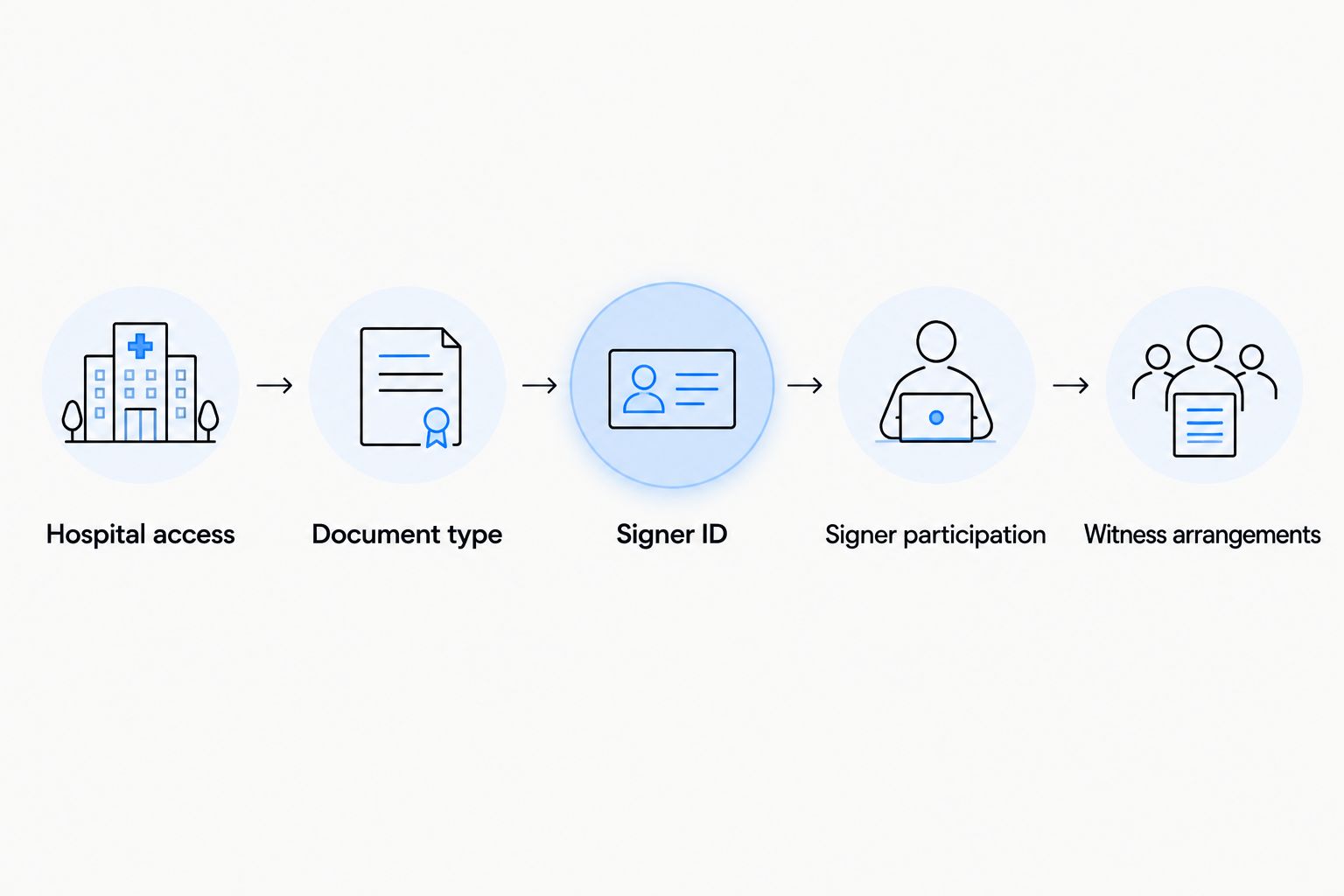
Yes, provided the notary can reach the signer and complete a valid notarization. Use this sequence before setting a time:
- Ask the hospital about access. Give the hospital the name and purpose of the visitor. Check the rules that apply to the patient’s room or care area rather than assuming a visitor can enter.
- Identify the document. Tell the notary what is being signed and whether the document has an acknowledgment, a jurat or instructions for witnesses. Do not sign in advance if the required notarial act calls for signing in the notary’s presence.
- Check the signer’s identification. Ask the notary which identification methods are acceptable for this appointment. Tell the notary before the visit if the signer does not have their usual ID.
- Confirm the signer can participate. The notary must interact with the person whose signature is being notarized. A relative’s assurance cannot replace that interaction.
- Confirm any witness arrangements. A notary and a document witness do not automatically perform the same role. Read the document’s instructions and arrange separate witnesses if they are required.
Do not wait until the notary arrives to raise an ID problem, a witness requirement or an access restriction. Those issues determine whether the appointment can proceed at all.
What should you tell the notary when you call?
State that the appointment is at a Las Vegas hospital, name the document and explain who will sign it. Say whether the signer has ID, whether the document mentions witnesses and whether the hospital has confirmed visitor access. If the document is incomplete, ask what the notary needs to see before travel rather than guessing which blanks can be left open.
Keep medical details limited to what affects the appointment. The practical question is whether the signer can communicate and take part in the requested notarial act; a notary is not there to review a diagnosis or approve treatment.
Mobile hospital visit or remote online notarization?
Signature on Demand lists both mobile and remote online notary services. They solve different access problems. Choose an in-person visit when the signer can meet the notary at the hospital and the document’s requirements permit it. Consider remote online notarization only after confirming that the signer can use the required process and the receiving party will accept the resulting document.
| Option | Best for | Advantage | Limitation to check |
|---|---|---|---|
| Mobile hospital visit | A signer who can meet a notary in person but cannot travel | The notary goes to the signer’s location | Hospital access, signer participation, ID and witnesses still matter |
| Remote online notarization | A signer who can use an online session and has a document accepted in that format | The signer and notary do not need to meet physically | The signer must complete the online process, and the receiving party must accept the document |
Neither option is a shortcut around the signer’s participation. If a patient cannot communicate with a notary, changing the appointment from bedside to online does not solve that problem. If the document is intended for a hospital, court or another recipient, check that recipient’s instructions before choosing the format.
What changes whether a hospital notarization can happen?
The answer depends on the circumstances of the signer and the document, not just the notary’s willingness to travel. These are the checks that matter for a 2026 hospital appointment:
- Hospital access: The facility controls who can enter the relevant care area. Confirm the visit with the hospital before booking a mobile appointment.
- Signer participation: The signer must be able to communicate with the notary and take part in the act being requested. A family member cannot give the notary answers on the signer’s behalf.
- Identification: Tell the notary exactly what ID the signer has available. Do not assume a hospital wristband is enough for notarization.
- Document instructions: Different documents call for different signatures, notarial acts or witnesses. Read the instructions before the visit.
- Witness availability: If the document requires witnesses in addition to notarization, establish who will serve in that role. Do not assume hospital staff can do so.
- Recipient requirements: The person or organization receiving the document determines what it will accept. Confirm its requirements before choosing an in-person or remote process.
If any answer is unclear, resolve it before the patient is asked to sign. That is more useful than asking a notary to assess a document’s legal effect at the bedside; a standard notary does not provide legal advice.
Ask about a hospital visit
Confirm mobile notary availability and document requirements for your Las Vegas appointment.
Does a power of attorney need more than a notary?
A power of attorney can have requirements beyond a notary’s stamp. Follow the instructions for the specific Nevada document and its intended use, including any signing or witness directions. Notarization does not turn an unsuitable or incomplete form into the right authorization for a family’s situation.
The term power of attorney also covers different decisions. A document for financial matters is not interchangeable with one addressing healthcare decisions. If you are arranging paperwork during a hospital stay in 2026, identify the decision the document is meant to address before arranging the signing. Signature on Demand provides Nevada document preparation services, including powers of attorney; document preparation and notarization are distinct services.
A notary’s task is limited to the requested notarial act. The notary does not choose who should act as an agent, decide what powers the agent should receive or determine whether a patient needs a power of attorney. Those are separate questions to settle before the appointment.
Can a family member arrange the appointment?
Yes. A family member can coordinate access, tell the notary which document needs attention and make sure the signer has ID ready. The patient still has to participate in their own notarization. Arranging the appointment does not authorize someone else to sign as the patient.
Ask the signer what they want to do before making plans around their signature. If the signer cannot communicate with the notary when the appointment takes place, the notary cannot treat the family’s description of the signer’s wishes as a substitute. Make a separate plan for any document witnesses; their presence does not replace the signer’s interaction with the notary either.
For a hospital visit, give the notary enough logistical information to reach the signer, but verify access with the facility directly. A scheduled appointment and permission to enter a care area are separate matters.
What if the patient cannot sign the document?
Tell the notary what the signer can and cannot do before scheduling. Do not assume a family member can sign the patient’s name or that a notary can complete the act without communicating with the patient. The next step depends on the document and the person’s circumstances; a standard notary cannot select a legal alternative for the family.
Keep the issues separate: difficulty physically making a signature is not the same as inability to communicate a decision. Nor does a hospital stay, by itself, answer whether a person can sign. The notary needs to address the requirements of the particular notarial act with the signer, rather than rely on a broad assumption about the patient’s condition.
If the document is time-sensitive in 2026, explain the signing concern when you first contact the provider. That lets you learn whether the requested appointment is feasible before coordinating visitors and witnesses.
Does the notary bring the document?
Do not assume so. A mobile notary visit and document preparation are separate services, even when one business offers both. Confirm who is providing the final document before scheduling the notarization. If you already have a form, check that it is complete and that you understand the receiving party’s instructions.
Signature on Demand offers both Nevada document preparation and mobile notarization. Ask which service you need: preparation of a document, notarization of an existing document or both. That distinction matters for a hospital appointment because the signer should not be asked to choose document terms while a notary waits to perform a notarial act.
A notarial certificate is not a review of the document’s medical or legal consequences. If you need advice about the document’s effect, resolve that question with an appropriate professional before signing.
FAQ
Can a mobile notary visit a Las Vegas hospital in 2026?
Yes, if the hospital permits access and the signer can complete the required notarial act. Confirm the location, ID, document and any witness requirements before scheduling.
Can a hospital patient sign a power of attorney with a mobile notary?
A hospital patient can sign a power of attorney with a mobile notary when the signer can participate and the document’s signing requirements are met. Confirm which power of attorney is needed and whether separate witnesses are required.
Can a family member sign for a patient during notarization?
A family member cannot simply substitute their signature for the patient’s in a notarization of the patient’s signature. Ask about the specific document and signing issue before booking an appointment.
Is a hospital wristband enough identification for a notary?
Do not assume a hospital wristband is acceptable identification for notarization. Tell the notary what identification the signer has and ask what is required for the appointment.
Can hospital staff act as witnesses?
Do not assume hospital staff are available or permitted to act as document witnesses. Check the document’s witness requirements and make separate arrangements before the visit.
Can remote online notarization replace a hospital visit?
Remote online notarization is an option only when the signer can complete the online process and the receiving party accepts the document. It does not remove the need for the signer to participate.
Does a mobile notary prepare the document too?
Not automatically; mobile notarization and document preparation are separate services. Signature on Demand offers both, so specify whether you need a document prepared, notarized or both.
One last thing
Check witness requirements before you book the notary, not at the bedside. A notary’s arrival cannot supply a missing witness or override the hospital’s access rules. For a 2026 appointment, confirm the document, signer ID, visitor access and everyone who must be present in a single conversation before setting the visit.


