
Yes. A Nevada notary can refuse to notarize a document when the notary cannot verify the signer’s identity, confirm that the signer is acting willingly, or complete the requested notarial act lawfully. A refusal does not necessarily mean the document is invalid; it means the notarization cannot proceed under the circumstances presented.
- Yes, a notary can refuse to notarize a document in Nevada when a required signing safeguard is missing.
- Bring acceptable identification, the complete document, and any instructions from the receiving party.
- Mobile and remote notarization change where signing happens, not the need to verify identity and willingness.
- Signature on Demand is best for Clark County residents who need notarization alongside document preparation, not legal advice.
Why this matters: A refusal can delay a filing, a real estate transaction, or an estate-planning document. Before arranging another appointment, identify the reason for the refusal. Signature on Demand provides mobile and remote online notary services and Nevada document preparation for Clark County residents, but neither service removes a notary’s duty to check the signing requirements.
Can a notary refuse to notarize a document in Nevada?
Yes. The deciding issue is whether the notary can perform the specific notarial act properly, not whether the document matters to you. Nevada notaries operate under NRS Chapter 240. The notary checks the signer and completes the notarial certificate; the notary does not approve the document’s legal terms.
| Situation | Why the notarization can stop | What you should do |
|---|---|---|
| The notary cannot establish your identity | The notary cannot reliably connect the person appearing to the name being notarized. | Ask what identification or other method permitted under Nevada law the notary can accept before rescheduling. |
| The signer is not present for the notarial act | The notary must deal with the person whose signature is being notarized. Remote online notarization has its own live-session process; sending a signature image is not a substitute. | Arrange an in-person, mobile, or eligible remote online session with the signer. |
| The signer appears unwilling or unable to understand the act | The notary cannot treat a signature as voluntary and informed without a reasonable basis to do so. | Stop the appointment and address the concern before requesting notarization again. |
| The document or notarial instructions are unclear | The notary cannot choose a legal outcome for you or invent the certificate the receiving party needs. | Ask the receiving party or a Nevada attorney which notarial act is required. |
| The notary has a conflict or cannot act impartially | A notary must remain an impartial witness to the notarial act. | Use a different notary and check the applicable Nevada requirements if the relationship is unclear. |
A refusal should lead to a specific next step. Ask whether the obstacle concerns identification, the signer’s presence, willingness, the requested certificate, or the notary’s ability to act impartially. Those problems call for different fixes; booking another notary without identifying the obstacle can repeat the delay.
Refusal does not settle whether the document is valid
A notarization and a document’s legal effect are separate questions. A notary can verify a signature without deciding whether a will, power of attorney, deed, or filing accomplishes what you intend. Conversely, a document can be carefully prepared and still lack what the notary needs to complete the requested act.
If someone rejects a document after it has been notarized, ask that person what requirement was not met. The answer might concern the document or the filing instructions rather than the notary’s work. A second notarization will not automatically fix a document-preparation problem.
Why a Nevada notary’s answer varies
The answer depends on the signer, the requested act, and how the appointment is conducted. These are the factors to check before you travel or set up a remote session:
- Identity: The notary needs a way to establish that the person appearing is the named signer under Nevada’s rules. Having a document with your name on it does not, by itself, establish identity.
- Presence: An in-person or mobile appointment requires the signer to appear before the notary. A remote online notarization uses a live electronic process rather than an emailed signature.
- Willingness and awareness: The notary must be able to assess whether the signer is participating voluntarily and understands the act taking place. Pressure from another person is a reason to stop, not a detail to overlook.
- Certificate instructions: The notary needs to know what notarial act to perform. An acknowledgment and a jurat involve different steps, so do not ask a notary to select one based on a guess about your legal needs.
- Document condition: Missing pages, conflicting names, or unclear instructions can prevent the notary from accurately completing the certificate. A blank space is not automatically disqualifying in every document, but you should ask the receiving party how it must be handled.
- Impartiality: A notary who cannot act as an impartial witness should not complete the act simply because the appointment is urgent.
The practical rule for 2026 is to fix the reason for refusal, not shop for a notary who will ignore it. If the issue is a missing instruction from a lender, court, agency, or document recipient, get that instruction from the source. A notary is not a substitute for the person or organization deciding what it will accept.
What should you do if a notary refuses?
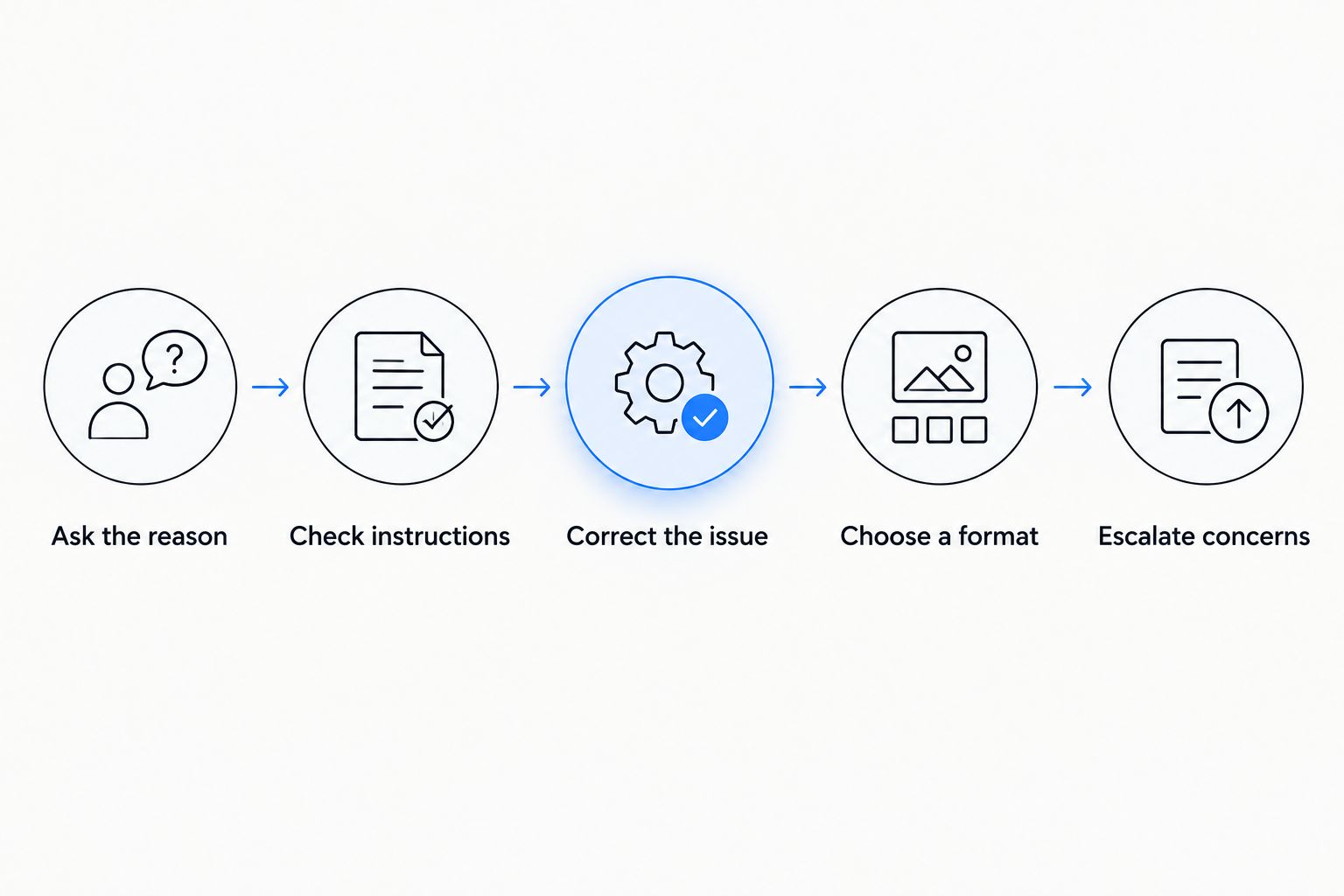
Use the refusal to narrow the problem before scheduling another appointment. This sequence works whether the document concerns a family matter, a real estate filing, or another transaction in Nevada.
- Ask for the specific reason. Request a plain explanation of what the notary could not verify or complete. Do not assume the notary rejected the document’s purpose when the issue was identification or the certificate.
- Check the receiving party’s instructions. Find out whether it requires an acknowledgment, a jurat, witnesses, a particular form, or another step. The receiving party or a Nevada attorney should answer questions about legal requirements.
- Correct what you can before rebooking. Gather suitable identification, confirm that every signer can participate, and bring the complete document. If the wording or document itself needs a decision, get the appropriate guidance rather than asking the notary to make it.
- Choose an appointment format that fits the act. In-person, mobile, and remote online notarization are different ways to meet with a notary. Confirm that the document and receiving party accept the format you plan to use.
- Escalate unresolved concerns. If you disagree with the explanation, consult the Nevada Secretary of State’s notary guidance or a Nevada attorney. A refusal involving suspected coercion deserves more attention than a routine scheduling change.
For a 2026 appointment, tell the notary what kind of document you have and what instructions came with it, without asking the notary to interpret those instructions as legal advice. That distinction can save a second appointment while keeping responsibility for legal decisions with the right person.
Can a notary refuse because your ID has expired?
Yes, if the notary cannot establish your identity using a method permitted under Nevada law. Do not assume that an expired card will be accepted or rejected in every circumstance. Tell the notary what identification you have and ask what the notary can use for the requested act.
The name on your identification and the name in the document also deserve attention. A difference does not tell you, by itself, whether the document must be rewritten. Ask the receiving party how it wants the signer identified, then confirm that the notary can complete the act with the identification available.
Can a notary refuse if you already signed the document?
Yes, depending on the notarial act requested and what the notary must witness. For an acknowledgment, the signer appears and acknowledges the signature; for a jurat, the signer signs in the notary’s presence and takes an oath or affirmation. Do not add a replacement signature or alter the document until you know which act the receiving party requires.
This distinction matters for documents that arrive with a signature line but no clear instructions. The notary can explain the steps of each notarial act, but choosing the act to satisfy a filing requirement is a separate decision. Confirm it with the receiving party or a Nevada attorney.
Can a notary refuse a power of attorney or will?
Yes. A power of attorney or will does not bypass the usual identity, presence, willingness, and notarial-act checks. Estate-planning documents can also have execution requirements beyond notarization. Ask the document preparer or a Nevada attorney what the specific document requires before arranging signatures.
In 2026, treat document preparation and notarization as separate tasks even when you arrange them together. Preparation concerns the document you intend to sign. Notarization concerns the particular act the notary performs with the signer. Completing one task does not prove that the other was done correctly.
When does Signature on Demand fit?
Signature on Demand is best for Clark County residents who need mobile or remote notarization alongside Nevada document preparation; it is not a replacement for legal advice. Its stated services cover notarization and preparation of documents such as powers of attorney, wills, trusts, divorce filings, and real estate filings. The benefit is having a service that addresses both document preparation and notarization; the limit is that a notary cannot decide your legal rights or choose legal terms for you.
If the refusal stems from an appointment format or a document-preparation issue, explain that issue before arranging another signing. If the question is whether a power of attorney, deed, or court filing achieves your intended legal result, ask a Nevada attorney. A properly completed notarial certificate cannot answer that question.
Discuss your notarization needs
Explain the document and the reason an earlier notarization stopped.
FAQ
Can a notary refuse to notarize a document in Nevada?
Yes. A Nevada notary can refuse when the notary cannot establish identity, confirm voluntary participation, or perform the requested notarial act properly. Ask for the specific reason before arranging another appointment.
Can a Nevada notary refuse because I do not have identification?
Yes, if the notary cannot establish your identity through a method permitted under Nevada law. Ask what identification or other permitted method the notary can accept before you rebook.
Can I send a signed document to a notary instead of appearing?
No, sending a signed document alone does not replace the signer’s appearance for a notarial act. Ask whether an in-person, mobile, or eligible remote online session fits the document and the receiving party’s instructions.
Can a notary tell me which certificate my document needs?
A notary can explain notarial procedures but should not choose a certificate by giving legal advice. Ask the receiving party or a Nevada attorney whether it requires an acknowledgment, jurat, or another act.
Does a notary’s refusal mean my document is invalid?
No. A refusal means the notary did not complete the requested act under the circumstances presented. Whether the underlying document is legally effective is a separate question.
Can I try another notary after a refusal?
Yes, but first identify and address the reason for the refusal. Another notary still needs to meet Nevada’s requirements for identity, presence, willingness, and the requested act.
Can I use remote online notarization after an in-person refusal?
Remote online notarization is an option only when the document and receiving party accept it and the required remote process can be completed. It does not remove identity or willingness checks.
One last thing
A notary’s refusal can protect the person signing, especially when willingness or awareness is in doubt. In 2026, do not treat that concern as an inconvenience to work around. Resolve it before anyone asks the signer to try again.


