
Nevada independent contractor document preparation is the process of organizing business, client, tax, and signing documents with the aim of keeping paid work clearly documented. For a contractor in Clark County, the right paperwork depends on the work, the client, and whether a document needs notarization—not on a single standard packet.
- For document preparation for independent contractors Nevada, start with licensing, a written agreement, and tax records—not notarization.
- Signature on Demand is best for Clark County contractors who need document preparation or mobile/remote notarization, not worker-classification advice.
- A notary verifies a signing; a lawyer advises on contract terms and classification.
- Keep the signed agreement and changes together so you can find the terms that apply to each job.
Why document preparation matters for Nevada independent contractors
An independent contractor can be asked for a business license, a completed Form W-9, proof of insurance, and a signed agreement before work begins. Those requests serve different purposes. A W-9 gives a payer tax-identification information; an agreement records what the parties expect; a notarial certificate addresses a signing. Completing one does not replace the others.
Nevada contractors also face a location question that generic templates miss: state and local business requirements are not the same thing. Check the Nevada Secretary of State's business licensing information and the licensing office for every jurisdiction where your work requires a local license. Do this before treating a downloaded contract as the last step.
If you need help preparing a document or arranging a signing in Clark County, Signature on Demand offers Nevada document preparation and mobile or remote online notary services. Those services do not decide whether a client has correctly classified you as an independent contractor. A lawyer handles legal advice about that question.
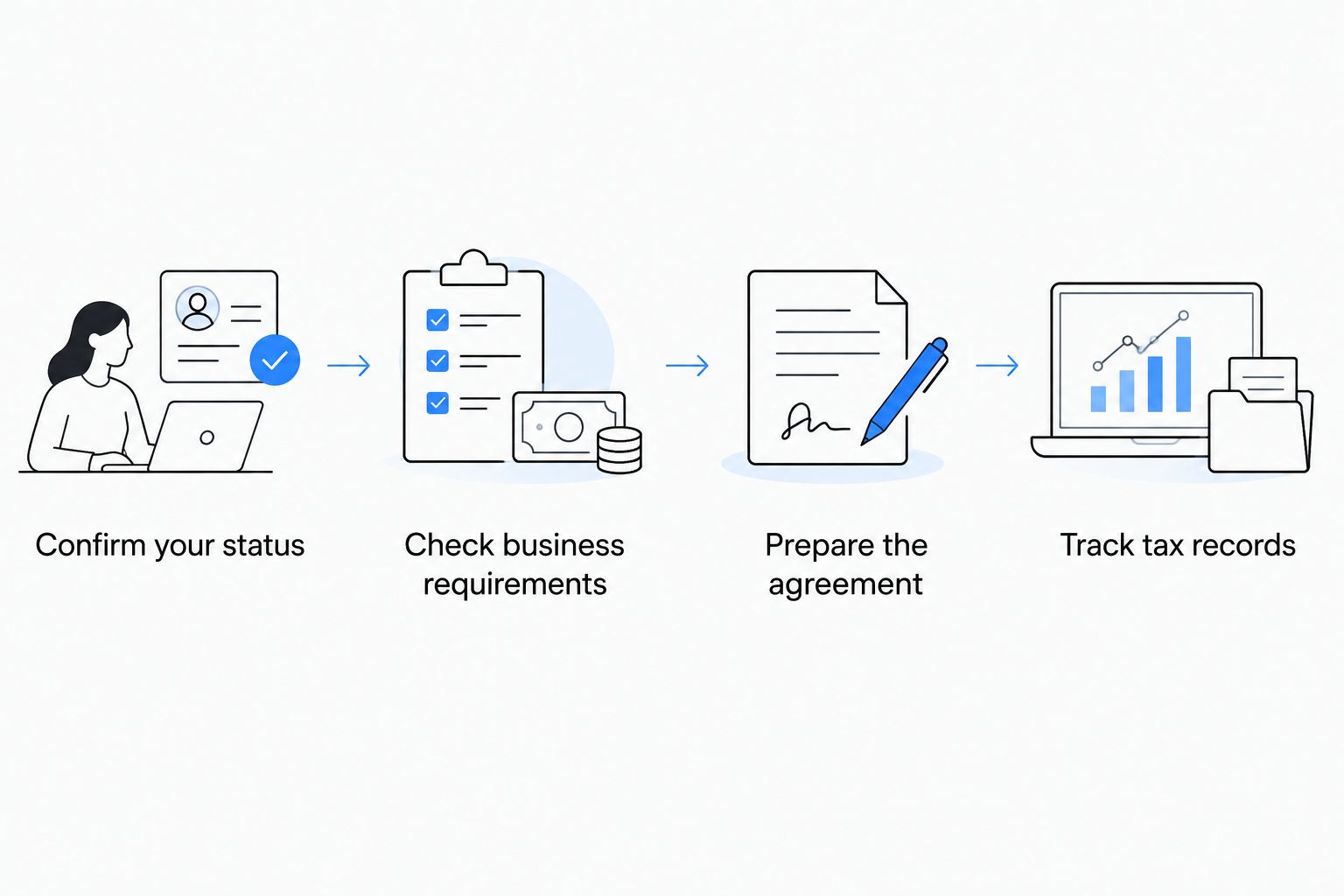
How to prepare your contractor documents in 2026
Use this sequence for each new client relationship. Some records come from you, some come from the client, and some come from a government office. Keep their purposes separate so you do not pay to notarize a document that needs no notarial act—or sign an agreement before reading the terms.
Confirm your status
A contract headed independent contractor agreement does not, by itself, make the working relationship independent contracting. The IRS examines the actual relationship, including behavioral control, financial control, and the parties' relationship. Nevada requirements can raise separate questions. If the client controls how the work is done or the arrangement looks unlike the written agreement, get classification advice before signing.
Do not ask a notary to decide your status. Notarization addresses a signature or statement under the notarial act requested; it is not approval of the contract's legal effect. For a 2026 job, start by writing down what you will do and how the client will direct the work.
- Describe the work you will perform and who sets the work methods.
- Identify who supplies tools, materials, and workspace.
- Record whether you serve other clients under the arrangement.
- Ask an employment lawyer or qualified tax professional about uncertain classification.
Check business requirements
Check licensing before sending a client a form that says you are properly licensed. Nevada state business licensing and local licensing are separate checks. The applicable local office depends on where and how you operate; a Las Vegas mailing address alone does not settle the question.
Some work has occupation-specific rules or insurance requirements. Do not copy another contractor's license statement into your agreement. In 2026, verify your own status with the relevant issuing office, then use the name and identifying details that office has on record.
- Check Nevada Secretary of State business licensing information.
- Check the city or county office responsible for your work location.
- Review any occupation-specific requirements for the services you provide.
- Save current license records where you can retrieve them for a client request.
Prepare the agreement
Write down the scope before work begins. A useful draft identifies the parties, the work, deliverables, changes, payment terms, and how the relationship ends. A template can help you identify missing fields, but a template cannot judge whether a clause fits your work or protects your interests.
Start with your own outline and the client's proposed terms. If you need a custom legal clause, a dispute reviewed, or advice about signing rights, use a Nevada attorney. Signature on Demand provides Nevada document preparation; document preparation is not legal advice. A 2026 agreement should reflect the job you actually accepted, not an earlier client's scope.
- Enter the correct names of the contractor and client.
- Define deliverables and how the client accepts them.
- State how changes to scope or timing are approved.
- Review payment, termination, and ownership terms before signing.
- Take disputed or unclear legal terms to a Nevada attorney.
Complete client onboarding records
A client can require forms that are separate from the services agreement. IRS Form W-9 is a common request from a U.S. payer because it supplies your taxpayer identification number. An employer identification number, when you have one, is a 9-digit identifier issued by the IRS; it does not establish that every client relationship is correctly classified.
Ask the client which records it requires and how to submit sensitive information securely. Do not add identification numbers to a contract just because you found an example online. Keep the version you submitted and the client's instructions together with the agreement for that job.
- Complete the current IRS Form W-9 when a client requests it.
- Use your correct legal name and taxpayer identification information.
- Provide license or insurance records only when applicable and requested.
- Save client onboarding instructions with the signed agreement.
Arrange the right signing
Read the signature instructions before booking a notary. Many contractor agreements need signatures but do not require notarization. If a client, receiving institution, or specific document calls for a notarial act, confirm what is required and whether every signer can use the proposed signing method.
For Clark County contractors in 2026, Signature on Demand offers mobile and remote online notary services. Best for: a signer who needs an available notarial service alongside document preparation. Limitation: a notary cannot turn an unsuitable agreement into sound legal advice, and remote notarization must fit the document and recipient's requirements. Confirm acceptance with the recipient before arranging a remote signing.
- Ask whether the document requires notarization at all.
- Confirm the requested notarial act with the document's recipient.
- Check whether the recipient accepts remote online notarization.
- Have the document and required identification ready for the appointment.
- Retain the completed document in the client file.
Track tax records and changes
Once work starts, your recordkeeping job continues. Keep the executed agreement, approved scope changes, invoices, payment records, and expense records together. If a project changes, put the change in writing rather than relying on an old scope and a conversation.
For 2026 federal tax planning, follow IRS record-retention guidance rather than deleting files when a client pays. The IRS generally says to keep records for 3 years from the date you filed an original return, with longer periods for certain situations; employment tax records have a separate 4-year rule. Ask a tax professional which rule applies to your records. Nevada does not impose an individual state income tax, but that does not remove federal filing duties.
- File signed agreements and approved amendments by client.
- Match invoices and payments to the relevant work.
- Keep receipts that support business expense entries.
- Review IRS retention rules before deleting tax records.
- Ask a qualified tax professional about filing and estimated taxes.
Get help with your documents
Check Nevada document preparation and notary services for your signing needs.
Compare your document-preparation options
Choose help by the decision you need made. Drafting from known information, verifying a signature, reviewing legal rights, and handling taxes are different jobs. There is no single provider who automatically performs all of them for a Nevada independent contractor.
| Option | Best for | Key limitation |
|---|---|---|
| Do it yourself with government forms and a client draft | Organizing straightforward records and checking requirements at the source | You must identify missing terms and resolve questions yourself. |
| Nevada document preparation service | Preparing documents from the information you provide | It does not provide legal advice or decide worker classification. |
| Mobile or remote online notary | Completing a required notarial act without treating it as a legal review | It cannot correct contract terms; remote use depends on recipient acceptance. |
| Nevada attorney | Advice on contract terms, disputes, and classification concerns | Legal review is a separate service from routine document preparation. |
| Qualified tax professional | Federal tax questions and recordkeeping decisions | Tax guidance does not replace contract review or notarization. |
For a contractor whose terms are already settled, preparing the paperwork yourself can be the direct route. Signature on Demand document preparation fits when you need help with Nevada documents; its mobile or remote notary service fits when a signing also requires a notarial act. Neither service replaces an attorney or a tax professional. Compare the task you need done before choosing a provider.
Common mistakes Nevada independent contractors make
Treating a signed contract as proof of classification
A signature proves that parties signed a document; it does not settle how a working relationship is classified. Compare the written terms with the actual work. Get legal or tax advice when the two conflict, especially before accepting a 2026 arrangement that changes who directs your day-to-day work.
Checking state licensing but skipping local rules
A Nevada state business record does not answer every local or occupation-specific licensing question. Check the offices responsible for your work before stating in an agreement that you meet all applicable requirements. Keep the response or license record with your business documents.
Using notarization as a substitute for review
A notary is not there to rewrite an unfavorable termination clause or explain ownership of completed work. Review those provisions before the appointment. If you need advice on their effect, speak with a Nevada attorney; then arrange notarization only if the final document requires it.
Losing track of revised work
The original agreement becomes difficult to use when deliverables change without a written update. Record the new scope, who approved it, and which terms still apply. Keep the update beside the signed agreement so your invoices and records reflect the same job.
FAQ
What documents does a Nevada independent contractor need in 2026?
A Nevada independent contractor should start with applicable licensing records, a written client agreement, requested tax forms, and records of work and payment. The precise set depends on the services, location, and client's onboarding requirements.
Does a Nevada independent contractor agreement need notarization?
Not every Nevada independent contractor agreement needs notarization. Check the document and the receiving party's instructions before arranging a notarial act; a signature requirement alone does not establish a notarization requirement.
Can Signature on Demand review my independent contractor agreement?
Signature on Demand provides Nevada document preparation and notary services, not legal advice about contract terms or worker classification. Ask a Nevada attorney to assess legal risks or revise a disputed clause.
Is a W-9 the same as a contractor agreement?
No. IRS Form W-9 supplies taxpayer identification information to a requester, while a contractor agreement records the parties' work terms. Keep both when a client requires them.
Do I need both a Nevada state and a local business license?
Check Nevada state requirements and the applicable local licensing office separately. The answer depends on where and how you work and whether your occupation has additional requirements.
Can I use remote online notarization for a contractor document?
Remote online notarization is an option only when the document and its recipient accept that method. Confirm the requested notarial act and recipient requirements before booking a remote signing.
Who should answer questions about contractor taxes or classification?
Use a qualified tax professional for tax questions and a Nevada attorney for legal questions about contract terms or classification. Document preparation and notarization do not replace either form of advice.
One last thing
Before paying for a notary appointment in 2026, ask the recipient one direct question: Does this document require notarization, or only signatures? That answer determines whether you need a notarial act at all. It also keeps document preparation, legal review, and signing in the right order.


