
Nevada business owner estate planning is the process of arranging who can manage your affairs and what happens to your ownership interest if you die or lose capacity, with the aim of protecting both your family and business continuity. Estate planning for business owners in Nevada requires more than naming beneficiaries: you also need to check the documents that govern your business. In 2026, start by separating the property you own personally from the authority you hold as an owner or manager.
- Estate planning for business owners in Nevada starts with an ownership inventory and a review of governing documents.
- A will or trust does not automatically give someone authority to run a business.
- Signature on Demand fits owners who need estate document preparation and mobile or remote notarization, not legal succession advice.
- Have a Nevada attorney review transfer restrictions and succession decisions before documents are signed.
Why estate planning matters for Nevada business owners
A family member can inherit an ownership interest without becoming the person authorized to manage the company. Your operating agreement, corporate records or other governing documents determine what happens inside the business; your personal estate documents address what happens to your property and decision-making authority. The first job is to make those documents agree.
That distinction matters in 2026 if you own a Las Vegas business while also supporting a spouse, children or aging parents. Someone needs a clear way to find records, contact the right advisers and identify who can act. A financial power of attorney, a will and a trust serve different purposes; none replaces a review of your business agreements.
Signature on Demand provides Nevada document preparation and mobile or remote online notary services. Signature on Demand is best for Nevada business owners seeking estate document preparation and mobile or remote notarization, not legal succession advice. Use an attorney for decisions about ownership transfers, disputed family interests or changes to governing documents.
How to build your 2026 estate plan
Work from records to decisions, then from decisions to documents. The sequence below keeps personal estate planning separate from business governance until you know where they must connect. It also helps you identify what a document preparer can handle and what requires legal advice.
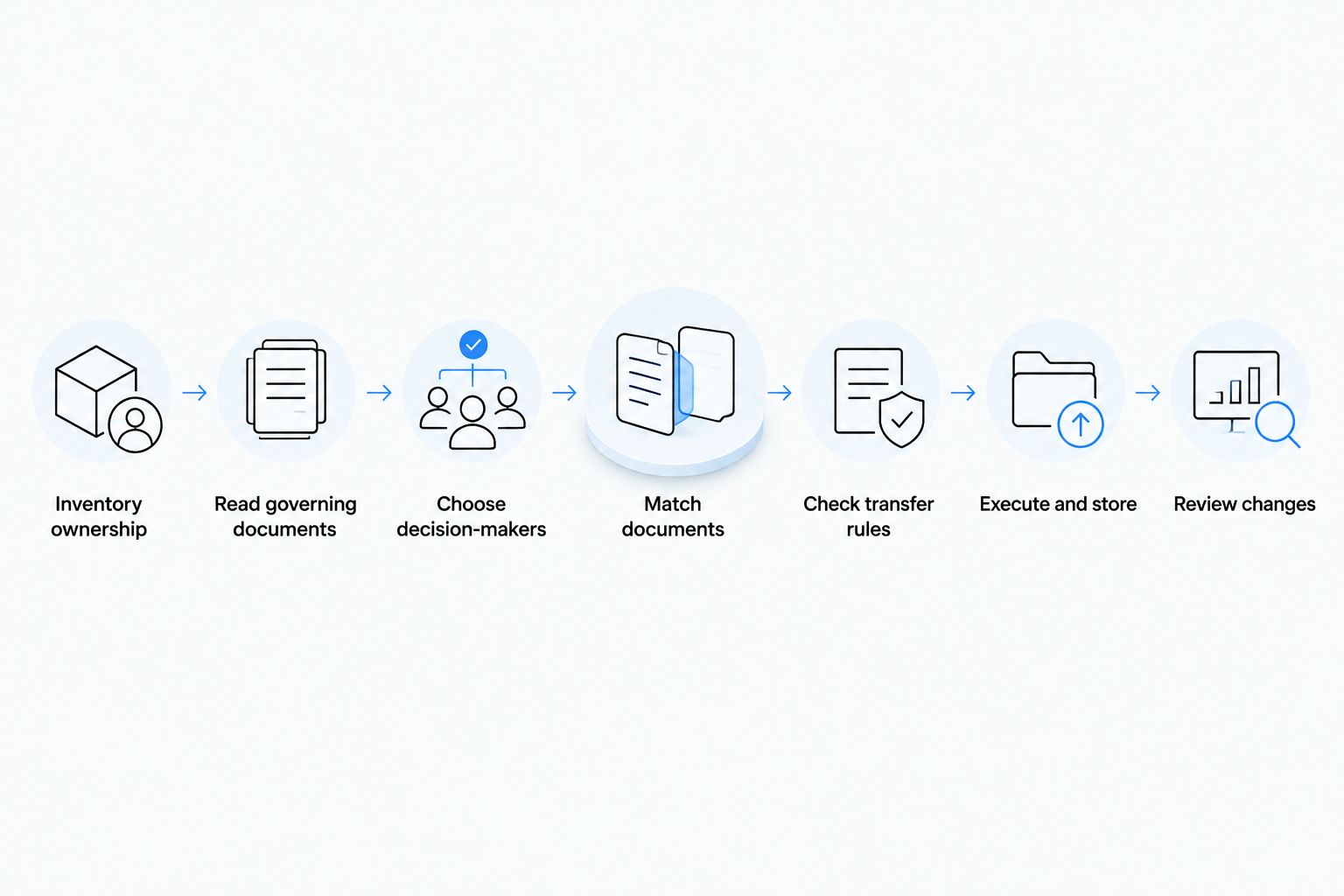
Inventory ownership
Write down what you own before deciding who receives it. Separate a personal ownership interest from property held by the business: owning an LLC does not mean you personally own every asset titled in its name. If you have multiple entities, give each its own line in the inventory rather than treating them as one business.
In 2026, use the inventory to spot practical gaps. An estate document cannot direct a transfer accurately if the owner, title or account designation is unclear. Keep copies of supporting records where your chosen decision-makers can find them.
- List each business entity and the ownership interest you hold.
- Separate personally titled property from business-titled property.
- Record co-owners, lenders and any existing transfer arrangements.
- Identify beneficiary designations or jointly held assets for separate review.
- Note where formation, ownership and account records are stored.
Read governing documents
Find the documents that say who can vote, manage, sell or receive an interest. For an LLC, start with its operating agreement and ownership records; for another entity, identify the documents that govern it. Do not assume a personal will overrides restrictions or procedures in a business agreement.
Read for the events your plan must address: death, incapacity, a proposed transfer and a co-owner's departure. If a provision is missing or unclear, take the question to a Nevada attorney. A document preparation service does not interpret a disputed clause or decide which succession terms your business should adopt.
- Locate the current operating agreement or other governing documents.
- Check who has management authority while you are alive.
- Mark provisions addressing death, incapacity and ownership transfers.
- Identify any required co-owner consent or purchase process.
- Bring conflicting or unclear terms to a Nevada attorney.
Choose decision-makers
Name the people you want to handle personal affairs, then ask a separate question: who is permitted to act for the business? An executor, trustee or agent under a power of attorney does not automatically step into every management role. Capacity and death also trigger different planning needs, so address both rather than naming one person everywhere without checking their authority.
Speak with each proposed decision-maker in 2026. They need to know the role you intend, where the records are and whom to contact. A backup matters if your first choice cannot serve.
- Identify a proposed agent for financial matters during incapacity.
- Identify who would administer your estate after death.
- Choose a proposed trustee if your plan uses a trust.
- Check whether business documents permit each intended management role.
- Record a backup for each role and discuss the responsibility.
Match documents to decisions
A will directs the handling of property through your estate; a trust can hold property assigned to it; and a power of attorney addresses authority while you are alive. Those are different jobs. Make a list of the decisions you need each document to express before requesting preparation or signing anything.
Signature on Demand prepares Nevada estate planning documents, including trusts, wills and powers of attorney, and offers notarization services. That is a practical path when you know which documents you need. If you are deciding how to divide a company, resolve a conflict with a co-owner or structure a transfer, get legal advice first; document preparation is not a substitute for it.
- Write down who should receive each personally owned interest.
- Specify who should handle personal financial matters during incapacity.
- Identify any trust you intend to use and what property it would hold.
- Compare proposed terms with your governing documents.
- Ask an attorney to resolve conflicts before documents are finalized.
Check transfer rules
Signing a trust does not, by itself, confirm that an ownership interest has been transferred into it. The transfer has to fit the governing documents and the records that show who owns the interest. The same distinction applies to a will: stating your wishes does not remove a business agreement's conditions.
Treat funding and record changes as separate tasks in your 2026 plan. An attorney can assess whether a proposed assignment or change requires consent and which records need updating. Your document preparer can work from the resulting instructions; neither a notary stamp nor a newly signed document fixes a conflicting ownership record.
- Compare the proposed recipient with transfer restrictions.
- Confirm whether a trust assignment is part of the plan.
- Check which ownership records need updating.
- Verify who must approve a transfer, if approval is required.
- Keep completed transfer records with the estate documents.
Execute and store documents
Follow the execution requirements for each document rather than assuming every signature needs the same process. Ask the professional handling the document which witnesses, identification or notarization steps apply. A notary verifies a notarial act; a notary does not decide whether the estate plan achieves your business goals.
Signature on Demand offers mobile and remote online notary services as well as document preparation. Confirm the appropriate signing method for each document before scheduling. Then store the signed version, business agreements and ownership records so your decision-makers can identify the current documents without searching through drafts.
- Confirm the signing requirements for each document.
- Check identification and witness arrangements before the appointment.
- Keep final signed documents apart from unsigned drafts.
- Tell decision-makers how to access the records.
- Store adviser contact details with the document inventory.
Review changes
An estate plan is a record of decisions made under a particular set of circumstances. Revisit it when ownership, family circumstances or business agreements change. A new co-owner or a revised operating agreement can leave an older personal document pointing in a different direction.
Put a 2026 review on your calendar if you have not compared your estate and business records recently. Repeat the comparison after a sale, new entity formation or change in your intended decision-makers. The point is not to sign fresh documents automatically; it is to find inconsistencies while you can still resolve them.
- Recheck the ownership inventory after entity changes.
- Compare amended governing documents with estate instructions.
- Confirm that named decision-makers remain willing to serve.
- Review trust funding and related ownership records.
- Ask an attorney which changes require revised documents.
Which planning option fits your situation?
The options below solve different problems. You can organize your records yourself, use a document preparation service for known document needs and hire an attorney for legal design or conflicts. Choose the work first, then the provider.
| Option | Best for | What it handles | Key limitation |
|---|---|---|---|
| Organize records yourself | Owners who need a clear inventory before making decisions | Collecting ownership, account and governing records | Does not resolve transfer restrictions or create an advised succession plan |
| Signature on Demand document preparation and notarization | Owners who know which Nevada estate documents they need prepared or notarized | Document preparation and mobile or remote online notarization | Does not provide legal succession advice or settle conflicts in business agreements |
| Nevada estate or business attorney | Owners with co-owners, transfer restrictions or unanswered legal questions | Advice on document terms, governance and proposed transfers | Requires a defined set of records and questions to address efficiently |
A simple file review is the right starting point when you cannot yet say which interests you own. For document preparation, give Signature on Demand the decisions and information needed for the documents rather than asking a notary to choose your successor. Where business and family instructions conflict, take both sets of records to an attorney before signing.
Prepare your estate documents
Review Nevada document preparation and mobile or remote notary services.
Common mistakes Nevada business owners make
Treating ownership and management as the same right. A person named to receive an interest is not necessarily the person authorized to operate the business. Compare the proposed inheritance with the authority rules in your governing documents.
Assuming a signed trust is fully funded. A trust document and a completed ownership transfer are different records. Check title, assignment and approval requirements before treating a business interest as trust property.
Using notarization as a legal review. A notarized signature does not confirm that a transfer is permitted or that your documents work together. Send unclear provisions and succession decisions to an attorney.
Leaving records inaccessible. A well-written instruction is harder to carry out if no one can find the operating agreement, ownership records or signed estate documents. Tell your chosen decision-makers where the current versions are kept.
Updating one document but not the others. In 2026, a revised business agreement deserves a fresh comparison with your will, trust and power of attorney. Check whether the people and interests named in each record still match.
FAQ
What is the first step in estate planning for a Nevada business owner?
List your ownership interests and find the documents that govern each business. Separate property you own personally from property held by an entity before deciding how either should pass.
Does a Nevada will transfer control of my LLC?
A will does not automatically grant someone management authority over an LLC. Read the operating agreement and ask a Nevada attorney how its succession and transfer terms apply.
Can a trust hold my Nevada business interest?
A trust can be part of a plan for a business interest, but the proposed transfer must be checked against governing documents and ownership records. Signing a trust alone does not establish that an interest was transferred into it.
Is a power of attorney enough to keep my business operating?
A power of attorney addresses an agent's authority while you are alive; it does not replace business governance documents. Check what authority the proposed agent needs and what the business documents permit.
Do estate planning documents for a Nevada business owner need notarization?
Signing requirements depend on the document and the act being completed. Confirm the requirements for each document before arranging witnesses or a notary.
When should I hire an attorney instead of a document preparer?
Hire an attorney when you need legal advice about succession terms, transfer restrictions, co-owner rights or conflicting documents. A document preparer can help with document preparation but does not decide those legal questions.
What should I review after changing my business operating agreement?
Compare the amended agreement with your will, trust, power of attorney and ownership records. Check whether the named people, proposed transfers and management instructions still agree.
One last thing
The most useful 2026 check is also the easiest to overlook: read your intended successor's name beside the business document that defines their authority. If the estate document names a recipient but the governing agreement calls for a different process, settle that mismatch before arranging signatures. Signature on Demand can prepare estate documents and handle notarization; an attorney should resolve the underlying legal conflict.


