
Yes. Remote online notarization is legal in Nevada in 2026 when a Nevada-authorized electronic notary performs the act under the state’s requirements for remote communication and identity verification. A video call or an electronic signature by itself is not a notarization, and you should confirm that the organization receiving the document accepts it electronically.
- Remote online notary service is legal in Nevada in 2026 when an authorized electronic notary follows state requirements.
- A video call or electronic signature alone does not notarize a document.
- Signature on Demand is best for Clark County residents who need Nevada document preparation alongside remote or mobile notarization.
- Ask the receiving organization whether it accepts an electronically notarized document before you sign.
Is remote online notarization legal in Nevada?
Yes, but the notary must be authorized to perform the remote electronic act. Nevada permits electronic notarization under NRS Chapter 240. Remote online notarization adds an approved remote-communication process so the signer and notary do not have to meet in the same room. The notary still has to identify the signer, witness the required action, and complete the notarial certificate as required for that act.
| Approach | What happens | Best for | Limitation to check |
|---|---|---|---|
| Remote online notarization | An authorized electronic notary meets the signer through a remote session and notarizes an electronic document. | A signer who needs to complete an eligible document without an in-person meeting. | The receiving organization must accept the resulting electronic document. |
| Mobile notarization | A notary meets the signer in person at an agreed location. | A signer who needs an in-person notarization without traveling to a notary office. | The signer and document must be ready when the notary arrives. |
| Electronic signature only | A person signs a document electronically without a notarial act. | A document that requires a signature but not notarization. | It does not meet a requirement for a notarized signature. |
The key distinction is not where you sign; it is whether a qualified notary completes a valid notarial act. If your paperwork also needs preparation, Signature on Demand provides Nevada document preparation and remote and mobile notary services for individuals and families in Clark County. Document preparation and notarization are separate services: neither turns an electronic-signature tool into a notary.
Why this matters
A document can be signed correctly and still fail a receiving organization’s instructions. A bank, recorder, court, or other recipient can specify the form it needs and how it will accept delivery. Before choosing remote online notarization in 2026, ask the recipient whether it accepts an electronically notarized version of your specific document and whether it needs a paper original instead.
The question matters most when someone else controls the next step. You can complete a remote session without a trip across Las Vegas, then learn that the intended recipient requires a different submission format. Confirm acceptance first; it is more useful than comparing appointment methods after the document has already been signed.
What makes an online notarization valid in Nevada?
Remote notarization is a notarial act, not a video meeting with a signature added afterward. Use this sequence before you sign:
- Confirm authorization. Ask whether the notary is authorized in Nevada to perform the remote electronic notarization you need. An ordinary notary commission alone does not answer that question.
- Check the document. Give the notary the document type and ask the receiving organization whether an electronically notarized copy is acceptable. Do not assume that acceptance of electronic signatures means acceptance of remote notarization.
- Prepare for identity checks. Have the identification and equipment required for the session ready. The notary must follow the applicable identity-verification process; a familiar face on a video call is not a substitute.
- Complete the notarial act. Sign as directed during the session and allow the notary to complete the required electronic notarial record and certificate. Do not sign early if the notary’s instructions require you to sign in the notary’s presence.
- Send the right version. Follow the receiving organization’s instructions for submitting the completed document. Printing an electronic document is not automatically the same as delivering the electronically notarized original.
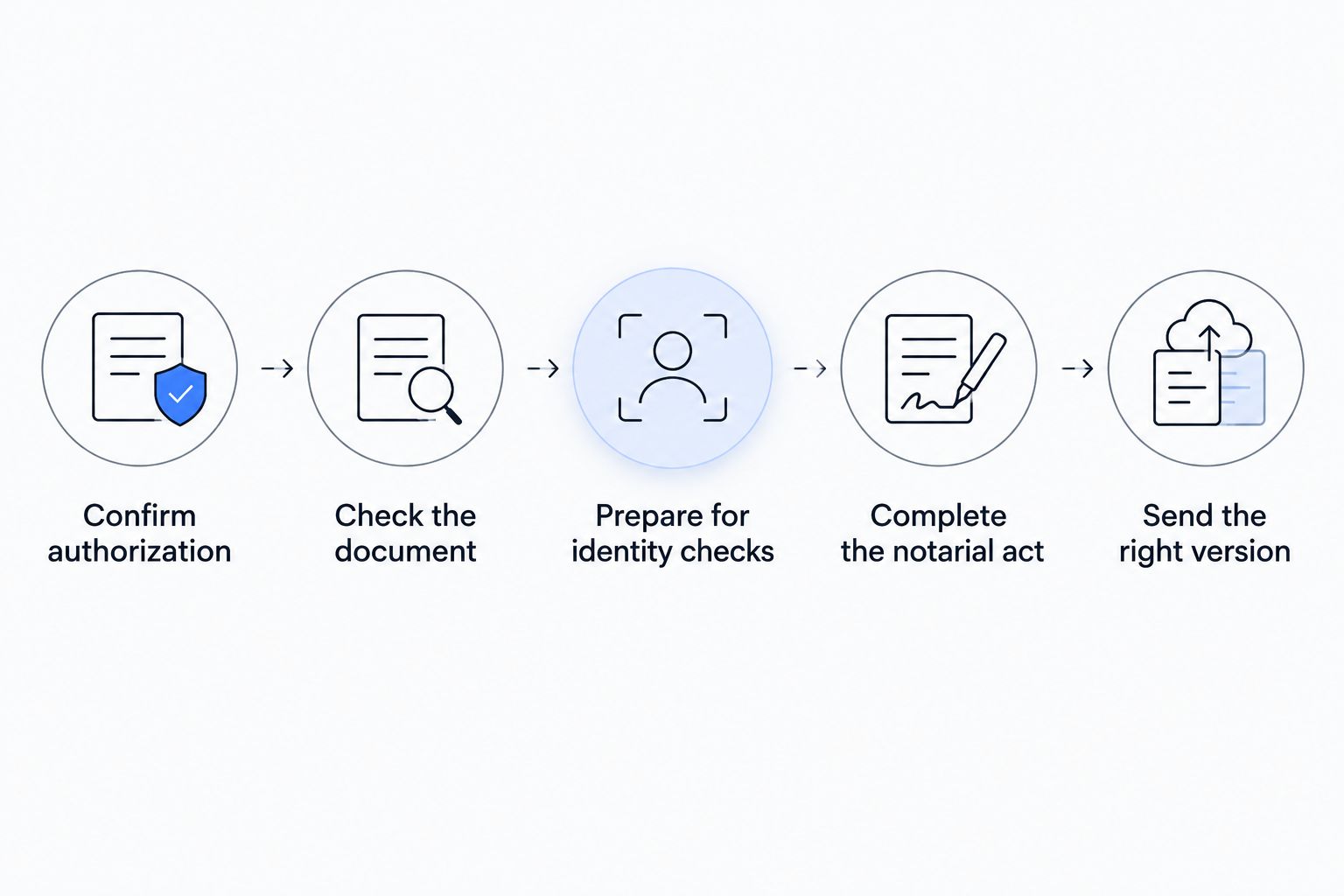
Each step answers a different question. The notary’s authorization concerns who performs the act; recipient acceptance concerns what happens to the finished document. Passing the first check does not guarantee the second, so ask both questions in 2026.
How does remote online notarization differ from a mobile notary?
A remote online notary works with an electronic document through a remote session. A mobile notary comes to the signer for an in-person act. Both involve a notary; an electronic-signature tool alone does not. Choose based on the document and the recipient’s instructions, not just which appointment is easier to arrange.
| If you need... | Start with... | Check before booking |
|---|---|---|
| An electronically notarized document accepted by its recipient | Remote online notarization | Whether the notary is authorized for the act and the recipient accepts electronic notarization. |
| An in-person signature witnessed at your location | Mobile notarization | Whether the notary can perform the required act on the document presented. |
| A signature with no notarial requirement | Electronic signing, if the recipient permits it | Whether notarization is actually required. |
Best for remote online notarization: a signer whose recipient accepts the electronic result and who can complete the required identity checks. The advantage is avoiding an in-person meeting; the drawback is that a remote session is the wrong route when the recipient needs a paper original or does not accept the electronic document.
Best for a mobile notary: a signer who needs an in-person act but does not want to travel to a notary office. The advantage is a face-to-face appointment at an agreed location; the drawback is that the signer and notary still have to meet. Signature on Demand’s mobile notary service is a relevant option for Clark County residents choosing that route in 2026.
Best for electronic signing alone: a document whose instructions call for a signature but not notarization. It removes the notary step; it cannot replace one. If the form includes a notarial certificate or the recipient specifically asks for notarization, verify what act is required before you sign.
Why does the right choice vary by document?
No single appointment method fits every form. These factors determine whether remote online notarization is the right route:
- Recipient instructions. The organization using the document decides what form of submission it accepts. Get its answer for the exact document rather than relying on a general statement about electronic records.
- Required notarial act. A document might require an acknowledgment or another notarial act. Tell the notary what the document requests; do not ask the notary to choose the document’s legal effect for you.
- Document format. An electronic notarization produces an electronic record. If the recipient requires a particular paper document, resolve that conflict before the session.
- Signer identity. Remote sessions require the notary to verify identity through the applicable process. Confirm what you need to present before the appointment.
- Signer readiness. The signer must participate in the required session and complete the act as directed. A signature placed on the document ahead of time can interfere with an act that requires signing in the notary’s presence.
- Separate preparation needs. Notarizing an estate, divorce, or real estate document does not prepare or review its contents. If you also need Nevada document preparation, identify that need separately.
That last distinction prevents a common mistake: treating the notary appointment as a check that a form says what you intend. A notary verifies and performs the requested notarial act; notarization does not establish that the document is right for your situation. Nevada document preparation is a different service governed separately under NRS Chapter 240A.
Can I use a Nevada remote notary for a power of attorney?
Yes, remote notarization is an option to check for a Nevada power of attorney in 2026, but the document and recipient determine whether it fits. Ask whoever will rely on the power of attorney whether an electronically notarized version is acceptable, then confirm the notary can perform the act the document requires. If the form itself needs preparation, handle that separately from the notarization.
A power of attorney can be intended for financial or health-related decisions, and the person who will use it needs the document in a form they accept. Do not wait until the remote session to ask about that form. The notary’s completion of a certificate does not make the recipient change its document-submission rules.
Can I use remote notarization for real estate paperwork?
Nevada permits remote online notarization in 2026, but a real estate document is not automatically suitable for remote completion. Confirm the requirements with the party receiving or recording that particular document before booking. A lender, title professional, or recorder’s instructions can determine which format you need to deliver.
Keep document preparation, signing, notarization, and submission distinct. The party coordinating a transaction can tell you which document version and notarial act it requires. The remote notary can then address the notarial step; the notary appointment does not replace the other instructions.
Is a video call enough to notarize my signature?
No. A video call alone is not remote online notarization in Nevada in 2026. The act requires an authorized electronic notary following the applicable remote-notarization process, including identity verification and completion of the notarial record. Likewise, typing your name into a document or using electronic-signature software does not by itself create a notarization.
If someone sends you a meeting link and says a notary will be present, ask who will perform the act and what completed document you will receive. That keeps the distinction clear before you disclose identification or sign. The useful question is whether the session meets Nevada’s notarial requirements, not whether it has live video.
FAQ
Is remote online notary legal in Nevada in 2026?
Yes. Nevada allows remote online notarization when an authorized electronic notary follows the applicable requirements. Check that the intended recipient accepts the completed electronic document.
Does an electronic signature count as notarization in Nevada?
No. An electronic signature alone is not a notarial act. A notary must complete the required notarization process and certificate.
Do I have to meet a remote online notary in person?
No. A qualifying remote online notarization takes place through a remote session rather than an in-person meeting. A mobile notarization, by contrast, involves the notary meeting you in person.
Will every organization accept a remotely notarized document?
No. Confirm acceptance with the organization receiving your specific document before the session. Ask which electronic format and submission method it requires.
Can a Nevada notary prepare my document during notarization?
Notarization and document preparation are separate services. If you need a form prepared, arrange that separately rather than assuming the notarial act includes it.
Should I sign before a remote notary session?
Follow the notary’s instructions rather than signing early. The required notarial act determines whether the notary must witness the signature during the session.
What should I check before booking a Nevada remote notary?
Confirm the notary’s authorization, the document’s required act, the identity-check process, and the recipient’s acceptance of an electronically notarized document. Resolve those points before signing.
One last thing
Ask the recipient what it will accept before asking a notary what it can do. A valid remote notarization and an acceptable submission are different questions. In 2026, that order is the simplest way to avoid completing the right notarial act in the wrong document format. Signature on Demand offers remote and mobile notary services alongside Nevada document preparation, but the receiving organization’s instructions should still decide which route you take.


