
Instead of taking a notarized power of attorney to a bank and expecting immediate account access, confirm the bank’s requirements first, sign the right document, then submit it for review. In 2026, notarization verifies a signature; it does not make the bank accept the agent’s authority.
- Notarized power of attorney bank account access requires bank review; a notary’s seal alone does not grant access.
- Ask the bank which powers, identification and submission steps it requires before the principal signs.
- Signature on Demand is best for Clark County families who need Nevada power of attorney document preparation and notarization, not bank approval.
- Keep the bank’s acceptance confirmation before the agent attempts a transaction.
Why this matters
A power of attorney names a person, called the agent, to act for another person, called the principal. A financial power of attorney can authorize account-related actions, but the bank must determine whether the document and the requested action meet its requirements. A notarized signature is not a bank access credential.
That distinction changes the order of work. If you prepare and sign first, you risk learning afterward that the bank wants different wording, an additional form or a particular submission method. If you ask first, you can address those requirements while the principal can still review and sign the document.
Signature on Demand provides Nevada document preparation and mobile or remote online notarization. For Clark County families, the useful starting point is to contact Signature on Demand about the document and signing method after confirming what the bank needs. The service can help with preparation and notarization; the bank decides whether to recognize the agent for its accounts.
Before you start
- Identify the principal, proposed agent and bank. Have the account information needed to identify the relationship when you speak with the bank. Ask the bank how it wants that information provided; do not send account credentials to a document preparer or notary.
- Ask the bank for its power of attorney intake requirements. Confirm whether it accepts an existing document, requires its own form, wants an original or copy, and needs the agent to appear or complete identity verification. Record the bank’s answer before arranging a signing.
- Check the authority the principal actually wants to give. The document must address the relevant financial actions, not just name an agent. The easily missed obstacle is scope: a validly notarized document can still fail to authorize the specific transaction the agent requests.
If the principal cannot understand or sign the proposed document, stop the setup and seek qualified legal guidance. Do not ask a notary to decide whether the principal has legal capacity or whether an older document remains effective; those are not notarization decisions.
Confirm the account and requested authority
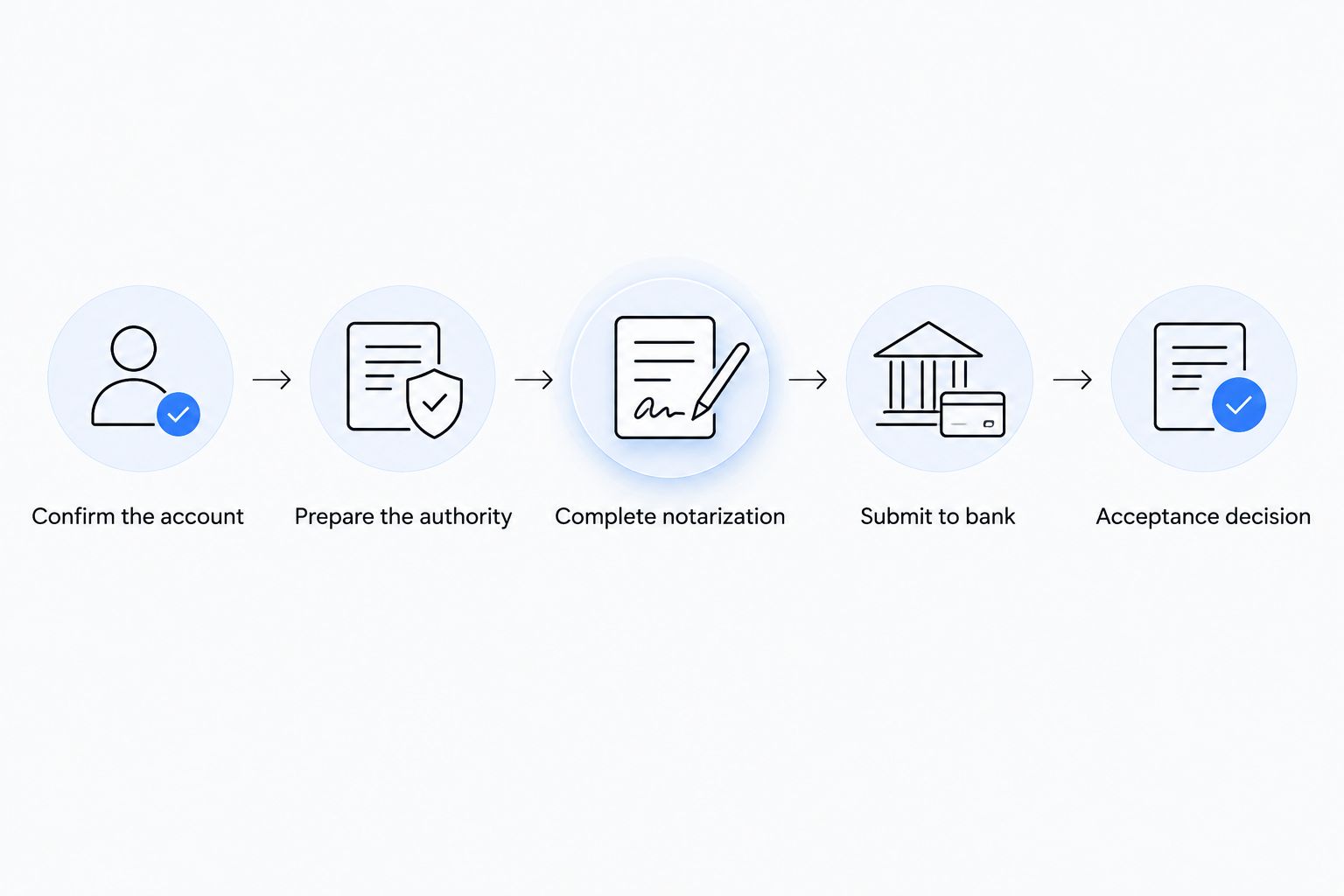
1. Ask the bank which department reviews powers of attorney. Tell the representative that the principal wants an agent to handle a named account and describe the intended action, such as obtaining account information or paying bills. Ask where to submit the document and how the bank communicates acceptance. Do not treat a branch employee’s general description of the process as approval of a document the bank has not reviewed.
2. Separate access from ownership. Ask whether the proposed agent needs authority to obtain information, make transactions or both. Being an agent under a power of attorney is not the same as becoming an account owner. If the requested action concerns a beneficiary designation, account closure or ownership change, ask the bank to identify its requirements for that action specifically.
3. Write down the bank’s document checklist. Note its requested form, identification, submission channel and any instructions about originals or copies. Use the bank’s own labels when completing its forms; institutions do not share one universal power of attorney screen or button.
Expected result: You have a bank-specific checklist and a defined set of actions the proposed agent needs to perform. If the bank cannot confirm its requirements by phone, ask how to get the document reviewed before relying on it for a time-sensitive task.
Prepare the financial power of attorney
4. Match the document to the principal’s instructions. Identify the principal and agent and specify the financial authority the principal intends to grant. Confirm whether the authority should take effect when signed or only after a stated condition. A condition that must be proven later adds a separate acceptance question for the bank.
5. Review the draft against the bank’s checklist. Check names and the requested account-related powers before signing. If the bank supplied its own form, determine whether it needs that form in addition to a separate Nevada power of attorney. Do not copy language into a legal document without understanding the authority it grants; get legal advice when the scope is uncertain.
6. Set aside the version the bank will receive. Keep an unsigned signing copy until the principal is ready to execute it, and plan how the bank will receive the completed version. If the bank asks for an original, a scan alone does not satisfy that request. If it accepts a copy, confirm whether its agent-registration process still requires another step.
Expected result: The principal has a document ready for signing that addresses the intended financial tasks, and you know how it will reach the bank. The Nevada power of attorney guide for aging parents covers the broader family planning decision; this workflow focuses on getting a bank to review a particular document.
Complete the signing and notarization
7. Confirm the signing method before the appointment. Ask the bank whether it accepts a remotely notarized document if the principal plans to use remote online notarization. If the bank’s requirements call for a paper original or leave remote notarization unclear, resolve that issue before choosing a method.
8. Have the principal sign through the chosen process. The principal, not the agent, grants the authority. The notary handles the notarial act and identity checks required for that act; the notary does not approve the powers in the document or promise that a bank will accept it.
9. Check the completed document before submission. Confirm that the intended pages are present and that the signing and notarial sections are complete. Keep the completed document and a separate reference copy. Do not alter a signed document to fix a missing power; a substantive change calls for a properly reviewed and executed document.
Expected result: You have a completed document in the format you plan to submit, not an assumption that the agent can already use the account. Signature on Demand is best for Clark County families who need Nevada power of attorney document preparation and notarization, not bank approval.
For a 2026 signing, the choice between mobile notarization and remote online notarization turns on where the principal can participate and what the bank will accept. Neither method bypasses bank review.
| Signing option | Best for | Advantage | Limitation |
|---|---|---|---|
| Mobile notarization | A principal who needs an in-person notarial appointment | The signing occurs with the notary physically present | The bank still reviews the completed document separately |
| Remote online notarization | A principal who can use a remote signing process and has confirmed the bank’s document requirements | The principal and notary can complete the notarial process remotely | Do not assume the bank accepts the resulting document without asking |
Submit the document to the bank
10. Use the bank’s stated submission channel. Provide the completed power of attorney and any bank-required forms through the route its review department gave you. If the bank needs agent identification, follow its instructions rather than sending sensitive documents to an unverified address.
11. Ask for an acceptance decision. Confirm whether the bank has recorded the agent’s authority and which accounts and actions it covers. If review is still open, the agent should not treat possession of the notarized document as permission to transact.
12. Retain the bank’s response. Keep the accepted document, any bank correspondence and the name of the department handling later questions. Before requesting a transaction, the agent should confirm that the requested action falls within both the document’s authority and the bank’s recorded access.
Expected result: The bank has communicated whether it recognizes the agent for the requested account actions. That confirmation, not the notarial seal by itself, completes the access workflow in 2026.
If the power of attorney is already signed
You do not need to start with a new signing merely because the bank has not seen the document. Start with the same bank checklist: ask whether it will review the existing power of attorney, what format it accepts and whether it needs its own agent form. Submit the existing document for review before asking the principal to sign a replacement.
If the bank identifies a missing power, an unclear effective date or another document issue, get the reason in writing. A notary cannot add authority to an already signed document. If the principal wants to change the agent or the powers, have the new instructions reflected in a new document and ask for legal guidance about how it relates to the earlier one.
Best for an existing document: bank review first. Best for a changed set of instructions: prepare a new document before scheduling notarization. In either case, the bank must review what the agent will actually present in 2026.
Troubleshooting bank access
- The bank says the document is notarized but insufficient. Ask which requested transaction lacks authority and whether the issue is the document’s wording, an internal form or identity verification. Address that specific issue; another notarial seal does not add missing powers.
- The bank wants its own form. Request the form and ask who signs it, whether it supplements the existing power of attorney, and where to send both documents. Do not assume the bank form replaces the principal’s broader instructions.
- The principal signed remotely, but the bank asks for an original. Clarify what the bank means by original for the completed document and whether it accepts the remote notarization format. Resolve the format question with the review department rather than resubmitting the same file repeatedly.
- The agent is identified but a transaction is declined. Ask whether the bank accepted the agent for that account and that action. Acceptance for account information does not, by itself, establish authority for every transaction.
- The bank has not responded. Contact the department that received the submission, confirm receipt and ask what remains outstanding. Until the bank communicates a decision, plan as though access is not active.
Customize your workflow
Make a separate checklist for each institution. A document that one bank accepts does not establish another bank’s intake procedure. If the principal has accounts at more than one bank, ask each institution where it wants the document and how it records agent authority.
Keep the task narrow. A financial power of attorney concerns financial decisions; do not assume it also covers healthcare decisions. Likewise, do not confuse an agent’s ability to act for the principal with becoming a joint owner or beneficiary. Those are different questions to raise with the relevant institution or a qualified attorney.
Signature on Demand can support the Nevada document preparation and notarial parts of this process for Las Vegas-area families. In 2026, schedule those parts after you know the bank’s document and signing requirements. That order prevents a completed notarization from becoming the first time you discover a bank-specific obstacle.
Prepare for the bank’s review
Confirm the bank’s requirements, then discuss Nevada document preparation and notarization.
FAQ
Does a notarized power of attorney give immediate bank account access in 2026?
No. The bank reviews the document, the agent’s identity and the requested account actions before recognizing access. Notarization alone does not complete that review.
What should I ask the bank before preparing a power of attorney?
Ask which powers the agent needs, whether the bank requires its own form, what identification it requests and how it accepts the completed document. Confirm whether it accepts remote online notarization before choosing that signing method.
Can an agent use a power of attorney to view an account without making transactions?
That depends on the authority in the document and what the bank recognizes. Tell the bank whether the agent needs information, transaction authority or both so it can review the relevant powers.
Does the bank have to accept a power of attorney because it has a notary seal?
A notary seal does not by itself establish bank acceptance. Ask the bank’s review department for its decision and the reason for any objection so you can address the actual issue.
Can I submit an existing power of attorney instead of signing a new one?
Yes, start by asking the bank to review the existing document and explain its submission requirements. Do not replace a signed document before you know what, if anything, the bank finds insufficient.
Is a healthcare power of attorney enough for bank account access?
Do not use a healthcare power of attorney as a substitute for financial authority. Ask the bank what financial powers it needs to recognize the agent’s proposed account actions.
Can Signature on Demand approve an agent for a bank account?
No. Signature on Demand provides Nevada document preparation and mobile or remote online notarization; the bank decides whether to recognize the agent for an account.
One last thing
In 2026, ask the bank what the agent must be able to do before drafting the authority, not after notarization. The most useful question is specific: will this document let this agent perform this action on this account? A clear answer gives the principal a document to review and gives the bank a defined request to evaluate.


