
Instead of treating a signed closing package as permission to release funds, route it from the notary to the title company for document review, lender clearance when required, and a separate funding confirmation. For notary signing to title company funding in Las Vegas, the 2026 rule is simple: a completed notarization is one checkpoint, not the funding decision.
- In 2026, notary signing to title company funding in Las Vegas requires package review before funding is confirmed.
- Signature on Demand is a fit for Las Vegas borrowers who need a mobile or remote online notarization, not a funding decision.
- Confirm the title company's delivery instructions and whether paper originals or remote online notarization are accepted before signing.
- A signed package does not prove that the lender cleared the loan or that funds were released.
Why this matters
A closing can feel finished when the last signature is on the page. It is not necessarily funded. The notary handles the signing and applicable notarizations; the title company checks what it receives against closing instructions, and the lender controls its own funding approval when a lender is involved. The title company, not the notary, tells the parties when funding is confirmed.
Signature on Demand is a fit for Las Vegas borrowers who need mobile or remote online notarization; the title company remains the source of funding status. That division of responsibility helps you ask the right person the right question instead of waiting for the notary to confirm something outside the notary's role. You can review Signature on Demand when choosing a signing format, then confirm the transaction's requirements with your title company.
This guide follows a financed real estate closing from signed documents to a funding update in 2026. A cash transaction has no lender funding decision, so the lender-clearance steps below do not apply to every closing.
Before you start
- Get the correct closing package and instructions. Ask the title company which version to sign, which documents require notarization, where completed documents must go, and who can answer package questions. Do not use an earlier package simply because it is already in your inbox.
- Confirm signer access and identification. Each signer needs the identification and signing method the notary and transaction require. If a signer cannot appear in person or meet the remote session's identification requirements, resolve that before scheduling the signing.
- Settle the delivery-format question before the appointment. A remote online notarization does not automatically replace wet-ink signatures or paper originals. Ask the title company whether its instructions and the lender's requirements accept the proposed format; otherwise, a completed session can still leave the package unusable for this closing.
The document names and delivery method vary by transaction. Your title company's current instructions control what gets returned; this guide does not substitute for them.
Confirm the signing instructions
- Identify the package owner. Ask the title company who issued the current documents and where signing questions must be sent. If the lender has issued revised documents, have the title company identify the version to use before anyone signs.
- Check the signing format. State whether you plan an in-person mobile signing or remote online notarization. Ask which documents, if any, must be signed on paper and whether originals must be returned. Do not assume that approval for one notarized document applies to the entire package.
- Confirm the return route. Get the title company's instructions for delivering the signed package and for sending any required originals. Keep the title company's contact details available during the appointment so an unexpected document question does not turn into a guess.
- Ask who gives funding updates. The person arranging the notary appointment is not necessarily the person who can confirm receipt, approval, or disbursement. Record the title company's designated contact for those updates.
Expected result: you know which package to sign, how it must be signed, and where it must go. In a 2026 Las Vegas closing, those answers matter more than choosing a signing format solely for convenience. For a closer look at the signing role, see loan signing agents for real estate closings in Las Vegas.
Complete the signing and notarizations
- Present the required identification. Follow the notary's identity-verification process for the approved signing format. If identification cannot be completed, stop rather than treating an unsigned or improperly notarized document as finished.
- Match each signer to the documents. Check that the names and signing capacity presented at the appointment match the package instructions. Refer discrepancies to the title company before signatures are added.
- Sign where instructed. Review each document for the requested signatures, initials, and dates. Do not fill a blank by guessing what the lender or title company intended; send the question to the party responsible for the document.
- Complete the required notarial acts. The notary performs the applicable act for documents that require notarization. A notary cannot decide whether the loan terms are correct, interpret legal consequences for you, or approve funding.
- Check for omissions before the session ends. Identify missed signatures, initials, dates, and incomplete notarial certificates while the signer is still available. If a document needs correction, follow the title company's directions rather than altering it without authorization.
Expected result: the documents are signed and notarized as instructed, ready for the title company's review. They are not automatically approved for funding. Signature on Demand provides mobile and remote online notary services; its signing role should not be confused with the title company's review or the lender's decision.
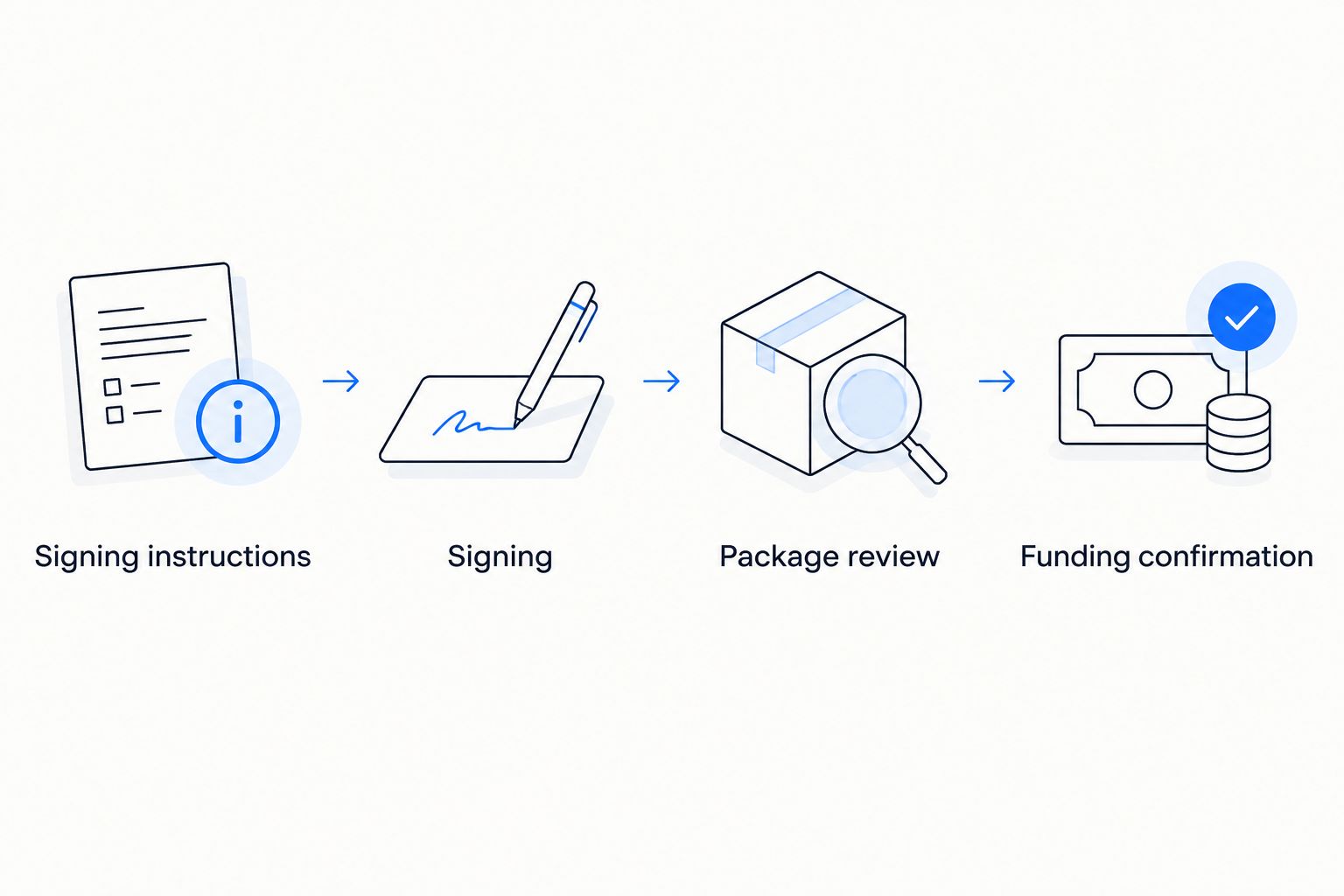
The handoff is easier to understand as separate checkpoints. A signature completes a signer action. Package delivery makes the documents available for review. Funding confirmation comes from the parties responsible for the transaction, not from the presence of a notary seal.
Deliver the package for review
- Follow the stated delivery route. Send or return the completed documents exactly as the title company directed. An informal copy to another participant is not a substitute for delivering the package to its designated recipient.
- Account for paper originals. If the closing requires originals, confirm how they will reach the title company. An electronic image can help someone check for missing pages, but it does not replace originals when the transaction requires them.
- Confirm receipt, not just dispatch. A sent package and a received package are different states. Ask the title company to confirm that it has what it needs for review, including any required originals.
- Resolve exceptions with the right party. If the title company identifies a missing page, inconsistent signature, or incorrect notarial certificate, ask it what correction it requires. A new signature or notarization may need another appointment; do not represent a corrected package as complete until the recipient confirms receipt.
Expected result: the title company has the package it requested and can report whether review found an issue. Receipt is a useful update, but it is not a funding notice. In 2026, ask specifically whether the documents have cleared review instead of asking only whether they were delivered.
Confirm funding with the title company
- Ask whether package review is complete. The title company checks the returned documents against the instructions for that closing. If a correction is needed, obtain the exact request from the title company before arranging another signing.
- Ask whether lender clearance is still pending. In a financed transaction, the lender may have conditions beyond collecting signatures. Only the lender and title company can explain the status of those conditions for your loan.
- Get an explicit funding update. Ask the title company whether funding has been confirmed. Do not infer it from a completed appointment, a delivery confirmation, or a scheduled closing date.
- Keep recording and possession questions separate. Funding, deed recording, and the right to receive keys are distinct matters. Ask the title company or your real estate representative which event controls the next step in your transaction.
Expected result: you have a status from the title company rather than an assumption based on the signing. For the 2026 notary signing to title company funding workflow in Las Vegas, wait for explicit funding confirmation before treating the closing as funded.
Use remote online notarization when the closing accepts it
Remote online notarization changes how an eligible notarial act takes place; it does not remove the title company's review or the lender's funding decision. It is useful when the signer cannot meet a mobile notary in person and the parties responsible for the closing accept the format required for the documents.
| Signing option | Best for | Advantage | Limitation to resolve first |
|---|---|---|---|
| Mobile in-person notary | Signers whose closing requires an in-person appointment or paper documents | Lets the signer and notary complete the approved in-person signing | You still need a plan for returning any required originals |
| Remote online notarization | Signers whose documents and closing instructions expressly permit it | Allows an approved notarization without an in-person meeting | The lender, title company, or document requirements can rule it out for this package |
For a remote version of the workflow, take these actions in order:
- Get format approval from the title company. Identify which documents can be handled remotely and whether any still require paper signatures or originals.
- Confirm the signer's access. Make sure the signer can complete the remote notary's identity-verification process and attend the session using the required device and connection.
- Complete only the approved remote acts. Route any documents outside that approval through the method specified by the title company. Do not assume one remote notarization converts the rest of the closing package.
- Confirm delivery and review. Ask the title company to acknowledge receipt of the completed documents and identify any outstanding paper items. Then use the same funding-confirmation step as an in-person closing.
Expected result: the title company receives documents in an accepted format and can continue its review. Signature on Demand offers remote online notary services, but acceptance for a particular closing must come from the parties handling that transaction. The same distinction applies in 2026: remote signing can complete a notarization; it cannot announce funding.
Troubleshoot the handoff
- The notary finished, but the title company says the package is missing. Check the title company's delivery instructions and confirm where the documents were sent. Ask for receipt confirmation before treating the package as under review.
- The title company found a missing signature or initial. Request its specific correction instructions. Arrange access to the signer if a new signing is required; do not add a mark on someone else's behalf.
- An original is required after an electronic copy was sent. Confirm the required return method with the title company. An image and an original are not interchangeable when the closing instructions call for the original.
- A remote notarization is rejected for this closing. Ask the title company which document or requirement caused the rejection and what signing method it will accept. Do not repeat the same remote process without that answer.
- Someone says the documents were received, but no one confirms funding. Ask the title company whether review is complete and whether lender clearance is outstanding. Receipt answers a delivery question, not a funding question.
Customize your workflow
If you are coordinating a closing for a family member, identify who can speak with the title company about the transaction before arranging the notary appointment. A power of attorney in a package does not, by itself, tell you whether the title company or lender will accept a particular signer or document. Ask them to review the proposed signing arrangement first.
If you are the buyer, keep a short status record: the package version you were told to sign, the approved signing format, the delivery method, the title company's receipt confirmation, and its funding update. That record helps you separate an incomplete delivery from an unresolved lender condition without asking the notary to diagnose either one. For 2026 closings, send document-content and correction questions to the title company rather than asking a notary to interpret loan terms.
If a signing must be repeated, confirm whether the title company wants the entire package signed again or only specified documents. Use its current instructions and arrange the approved notarial acts for the replacement documents. Do not recycle signatures or notarial certificates from a superseded package.
FAQ
Does a notarized closing package mean my Las Vegas home purchase is funded?
No. Notarization completes the required notarial acts; the title company and, for a financed closing, the lender handle package review and funding clearance. Ask the title company for an explicit funding update.
Who sends signed closing documents to the title company?
Follow the delivery assignment in the title company's instructions. Confirm whether the notary or another designated party returns the package, and ask the title company to acknowledge receipt.
Can Signature on Demand confirm that a lender released funds?
No. Signature on Demand provides notary services, not lender funding approval. Get the funding status from the title company handling the closing.
Can I use remote online notarization for a Las Vegas real estate closing?
You can use it when the documents and transaction parties accept that signing format. Confirm approval with the title company before the session, including any requirement for paper signatures or originals.
What should I do if the title company finds a missed signature?
Ask the title company for its exact correction instructions and arrange for the signer to complete the required document. Do not alter someone else's signature or assume an emailed image resolves a request for an original.
Is title company receipt the same as funding confirmation?
No. Receipt means the title company has the documents; it does not establish that review is complete or that the lender cleared funding. Ask for those updates separately.
When do I get keys after a notary signing in 2026?
A completed notary signing does not set the time for keys. Ask the title company and your real estate representative which funding, recording, and possession conditions apply to your transaction.
One last thing
Ask for two separate confirmations: package received and funding confirmed. The first tells you the documents reached the title company. Only the second answers whether the 2026 closing has cleared the funding step; neither a notary seal nor a delivery message answers both.


