
Yes. A person who granted a power of attorney in Nevada can revoke it while they are able to make that decision. In 2026, the practical task is to make the revocation clear, tell the agent, and notify every bank, health care provider, or other party that has been relying on the document. Signing a revocation without delivering it can leave those parties unaware that the agent’s authority has ended.
- Can a power of attorney be revoked in Nevada? Yes; make the decision clear and notify the agent and affected parties.
- A written revocation gives you a record, but it does not notify a bank or health care provider by itself.
- A replacement power of attorney needs its own execution and distribution; do not assume it reaches everyone holding the old one.
- Signature on Demand is best for Las Vegas families seeking power-of-attorney document preparation and notarization, not legal advice about disputes.
Can a power of attorney be revoked in Nevada?
Yes. Nevada law permits a principal to revoke a power of attorney. The principal is the person who gave someone else authority to act. An agent’s agreement is not needed to withdraw that authority, but notice matters: a person or institution that has the old document needs to learn that it should no longer rely on it.
If you need help preparing documents or arranging notarization in Clark County, Signature on Demand provides Nevada document preparation and mobile or remote online notary services. A document preparer or notary does not decide whether a contested revocation is legally effective.
The right action depends on which document you signed and who has used it. A financial power of attorney can affect dealings with banks or property. A health care power of attorney concerns medical decisions. Start by identifying the document you want to revoke rather than telling everyone that all your powers of attorney are canceled.
| Document | Where notice matters most | Benefit of a clear revocation | Risk if notice is missed |
|---|---|---|---|
| Financial power of attorney | The agent and institutions that have relied on the document, such as a bank | Creates a clear record that the agent should stop acting under that authority | An institution holding the old copy may not know your decision |
| Health care power of attorney | The agent and health care providers holding the document | Helps keep medical decision-makers and records aligned with your current choice | A provider may continue to see an outdated agent designation in its records |
Neither row is a substitute for reviewing the actual document. You can have more than one power of attorney, and revoking one does not tell a bank or medical office what to do with every other document it holds.
Why this matters
A power of attorney gives an agent authority to act for you within the document’s terms. Revocation changes that authority; it does not automatically collect old copies or update every record. The gap between deciding to revoke and telling the people who rely on the document is the problem to solve.
In 2026, work from a distribution list: who has the document, who has acted under it, and who expects to receive it? Include the agent and any successor agent named in the document. Then identify the institutions or providers that received a copy. This is more useful than making a revocation document and filing it away at home.
If the agent disputes your decision, you are concerned about misuse, or someone questions your ability to revoke, get advice from a Nevada attorney. Signature on Demand prepares documents and provides notarization services; it does not resolve a legal dispute between you and an agent.
How do you revoke a Nevada power of attorney?
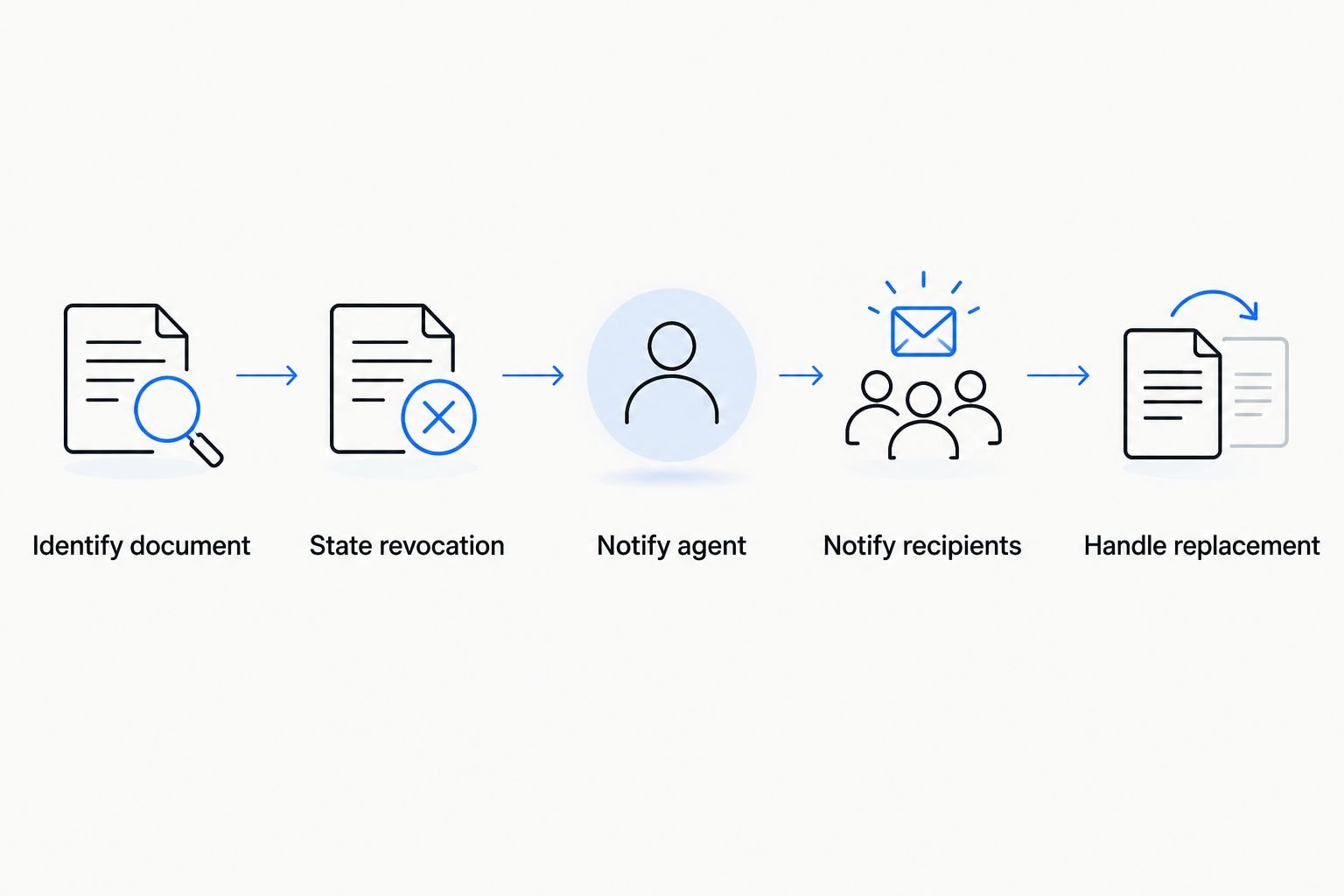
Use a process that identifies the old authority and gets notice to the people relying on it. These steps separate making your decision from proving that you communicated it.
- Identify the document. Find the signed power of attorney and note its date, the agent’s name, any successor agent, and whether it covers financial or health care decisions. If you signed multiple documents, identify each one you intend to revoke.
- Make the revocation clear. State that you are revoking the identified power of attorney. A written revocation creates a record of what you decided; have a Nevada attorney review the language if the document or your circumstances are disputed.
- Notify the agent. Deliver notice in a way you can document. Ask for any copies the agent holds and tell the agent not to act under the revoked authority. Getting a copy back is useful, but it does not replace notice to third parties.
- Notify everyone relying on it. Contact each bank, provider, or other recipient that has the old document. Ask how it accepts revocation notices and how it will update its records. Keep a copy of what you sent and when you sent it.
- Handle a replacement separately. If you still need someone to act for you, prepare and execute a new power of attorney that fits the task. Give the new document to the people who need it, along with notice that the old one has been revoked.
For a 2026 revocation, keep the signed document, copies of notices, and delivery records together. If an institution requests its own form or review, ask it to explain the next step. Do not assume its internal record changes at the moment you send an email or hand over a document.
Signature on Demand is best for Las Vegas families who need Nevada power-of-attorney document preparation and notarization, not legal advice about a contested revocation. That distinction matters if you are replacing an agent under ordinary circumstances versus trying to stop an agent whose actions you dispute.
Why does the revocation process vary?
The document and its recipients determine the work. A short revocation can still require substantial follow-up when several people or institutions have relied on the old power of attorney.
- Type of authority. A financial power of attorney and a health care power of attorney reach different decision-makers. Check which document you are revoking before sending notice.
- Number of recipients. An agent with a copy is not necessarily the only person with one. Banks, health care providers, and other recipients need notice if they hold or rely on the document.
- Prior use. If the agent has already presented the power of attorney, ask the receiving institution how it records a revocation. Its copy will not disappear because you replaced yours.
- A replacement agent. Revocation stops the authority you identified; it does not, by itself, supply a new agent with a usable document. Treat replacement and distribution as separate tasks.
- A dispute about the decision. If an agent challenges the revocation or someone questions the principal’s ability to make it, document preparation alone cannot settle the issue. Speak with a Nevada attorney.
- Property records. If the power of attorney was used for a real estate transaction, tell the title company or other party handling the matter that it has been revoked. Get legal advice about any record-related step your circumstances require.
A useful 2026 check is to list each recipient beside the document it received. Mark when you sent notice and what the recipient said it needed. That record helps you find the gaps; it does not guarantee that an institution has completed its review.
Do you need to notarize a revocation in Nevada?
Do not assume every revocation has the same execution requirements. The applicable law, the document, and the recipient’s requirements need to be considered before you sign. Ask what the institution will accept before relying on a notarized document alone.
Notarization verifies the act of signing through a notarial process; it does not notify an agent, update a bank’s records, or decide a disagreement over authority. If you need the revocation prepared and a signature notarized in Las Vegas, Signature on Demand provides those services. If you need to know whether a particular revocation is legally sufficient, ask a Nevada attorney.
Does a new power of attorney cancel the old one?
Do not rely on a new power of attorney alone to communicate revocation of an older one. Review the language of both documents, state clearly which earlier authority you intend to end, and notify anyone holding the prior document. A recipient that only has the old copy cannot act on instructions it has never received.
Replacing an agent also creates a distribution task. Your new agent needs the current document, while recipients of the old document need to know it is no longer the one to use. Keep those communications distinct so a bank or provider can identify which agent you want it to recognize in 2026.
Can you revoke a power of attorney if the agent has the original?
Yes; the agent’s possession of the original does not give the agent control over your decision to revoke. Identify the document, communicate your revocation, and notify third parties that received it. Request the original and other copies back, but do not delay notice while waiting for their return.
If you believe the agent is still using the document after being told of the revocation, contact the affected institution and a Nevada attorney promptly. Signature on Demand can assist with document preparation and notarization, but a notary cannot force an agent to return paperwork or resolve contested transactions.
What if the power of attorney is durable?
A durable power of attorney is designed to continue despite the principal’s later incapacity. Durable does not mean irrevocable: a principal who is able to make the decision can revoke the authority. The difficult question in a dispute is whether the principal can make that decision, not whether the document uses the word durable.
Do not ask a notary or document preparer to decide that question for your family. If capacity is contested, seek Nevada legal advice before asking an institution to act on competing documents. Keep the discussion focused on the principal’s decision and the specific authority at issue.
What happens when the principal dies?
A power of attorney ends when the principal dies. The agent’s authority under that document does not turn into authority to administer the estate. A person handling matters after death needs the authority applicable to that role; a power of attorney is not a substitute.
Tell any institution still holding the document about the death and ask what documentation it needs. In 2026, keep this separate from an ordinary revocation: the reason the agent’s authority ended is different, even though outdated copies can cause confusion in either situation.
FAQ
Can a power of attorney be revoked in Nevada in 2026?
Yes. A principal who can make that decision can revoke a Nevada power of attorney. Clearly identify the document and notify the agent and anyone relying on it.
Does the agent have to agree to a Nevada power-of-attorney revocation?
No. The agent’s consent is not required for the principal to revoke the authority. Tell the agent and affected institutions so they know the old document should no longer be used.
Is a signed revocation enough to stop a bank from using the old power of attorney?
No. Signing does not, by itself, tell the bank that the authority has ended. Deliver notice and ask the bank how it updates its records.
Can I revoke only one of my powers of attorney?
Yes. Identify the specific document you intend to revoke, especially if you have separate financial and health care powers of attorney. Check the documents and get legal advice if their terms conflict.
Does a durable power of attorney prevent revocation in Nevada?
No. Durability addresses the effect of later incapacity; it does not make the authority irrevocable while the principal can make the revocation decision. Ask a Nevada attorney if capacity is disputed.
Will a new power of attorney automatically reach everyone with the old one?
No. Give the replacement to its intended recipients and separately notify holders of the old document about the revocation. Keep a record of both deliveries.
Can a Nevada notary decide whether a revocation is legally valid?
No. A notary performs a notarial act; that does not settle a dispute over capacity, document terms, or an agent’s conduct. Get advice from a Nevada attorney for those questions.
One last thing
Do not treat the original document as the whole problem. Copies can remain with an agent, a bank, or a health care provider after you revoke a power of attorney. In 2026, the useful finish line is a record of which recipients you notified and what each one said it needed to stop relying on the old authority.
If your circumstances also require a replacement document, keep its delivery record with the revocation record. That makes it easier to distinguish the former agent’s authority from the current one when an institution asks which document applies.


