
No. Both spouses do not automatically need to appear in court for an uncontested Nevada divorce: a qualifying joint petition for summary divorce can be decided without a hearing. Both spouses must sign the required joint-petition documents, and any later court order requiring an appearance controls; agreement alone does not excuse you from attending.
- Nevada does not automatically require both spouses to attend court for a qualifying joint-petition divorce.
- Both spouses must sign the joint petition; notarization does not replace the judge’s divorce decree.
- For Nevada divorce court appearances, follow the court’s actual orders—not assumptions about uncontested cases.
- Signatureondemand provides divorce document preparation, not legal advice or courtroom representation.
Do both spouses need to appear in court for an uncontested divorce?
A qualifying Nevada joint petition can result in a divorce without either spouse attending a hearing. Nevada’s summary-divorce procedure, addressed in NRS 125.181–125.184, allows the court to decide the case from the submitted documents. The court retains authority to require a hearing.
The distinction is the filing method, not simply whether you describe the divorce as uncontested. The following comparison separates the main routes.
| Filing route | Best for | Court-appearance question | Benefit | Limitation |
|---|---|---|---|---|
| Joint petition for summary divorce | Spouses who agree on every required issue and qualify for the procedure | The court can decide the petition without a hearing | Both spouses submit their agreement together | Both must participate, and the court can require further proceedings |
| Complaint-based divorce | Cases that need the complaint-and-response process | Attendance depends on the case and court orders | Provides a route when a joint petition is unsuitable | Service, responses, and additional procedural requirements apply |
For the paperwork sequence, see the notarized divorce agreement to Nevada e-filing workflow. Signing, filing, and judicial approval are separate events.
Why this matters
For a Clark County couple planning an uncontested divorce in 2026, a hearing affects work schedules, childcare, and transportation. But arranging those logistics comes after identifying the correct filing route—not before.
Do not treat “uncontested” as permission to ignore a court notice. An uncontested case means the spouses are not disputing the issues that must be resolved. It does not eliminate the court’s authority to ask questions or require attendance.
Likewise, avoiding a courtroom does not mean avoiding court review. A judge must approve the divorce and enter the decree. Your signed agreement is part of the process, not the final result.
Joint petition: Both spouses sign, but a hearing is not automatic
A joint petition presents both spouses’ request to the court together. It is designed for couples who satisfy Nevada’s summary-divorce requirements and have resolved the issues relevant to their marriage.
For this route, expect participation from 2 spouses, even when there is no hearing. Both spouses must review and sign the required joint-petition paperwork. One spouse cannot substitute an informal statement that the other spouse agrees.
Agreement must extend beyond wanting to end the marriage. Address property, debts, spousal support, and—when applicable—custody, parenting time, and child support. A missing agreement on one of these subjects undermines the premise of a fully agreed filing.
The practical advantage is straightforward: the court can review the written submission instead of requiring live testimony. The limitation is equally important: incomplete documents or unresolved questions can prevent the case from being approved as submitted.
Before using a 2026 joint-petition packet, read the instructions for the court where you will file. Use the version that applies to your circumstances, including whether you have minor children together.
Complaint-based divorce: Agreement does not settle attendance
A divorce filed by complaint is procedurally different from a joint petition. One spouse starts the action, and the rules governing service and responses become relevant.
The spouses can still reach agreement. However, an agreed outcome does not automatically convert the case into a summary joint-petition proceeding or cancel a scheduled hearing.
If your case already has a case number, scheduled event, or pending motion, check those requirements before submitting different paperwork. Do not start a second case just because a joint petition sounds simpler. Obtain legal advice about changing the route in an existing case.
The benefit of the complaint route is that it provides a process when joint participation is unavailable or inappropriate. Its limitation is that you cannot assume the simplified joint-petition rules apply. Read each notice for the event type, required participants, and attendance instructions.
Why court-appearance requirements vary
Whether you must attend depends on the case, not a blanket rule that every Nevada divorce requires both spouses in court. These factors explain the difference:
- Filing route. A qualifying summary joint petition has different procedural requirements from a divorce started by complaint.
- Complete agreement. Disagreement about property, debts, support, or parenting issues changes what the court must resolve.
- Document completeness. Missing signatures, inconsistent terms, or omitted required forms can require correction before approval.
- Residency evidence. The court needs the required basis for Nevada jurisdiction, including appropriate residency documentation.
- Children’s issues. Custody jurisdiction and child-related provisions require attention beyond the spouses’ agreement to divorce.
- Judicial direction. A judge can require a hearing or additional information even when both spouses request approval on the papers.
For a 2026 filing, the most useful next move is to inspect your actual packet and court notices. A general answer about uncontested divorce cannot override instructions issued in your case.
What should we check before expecting a divorce without a hearing?
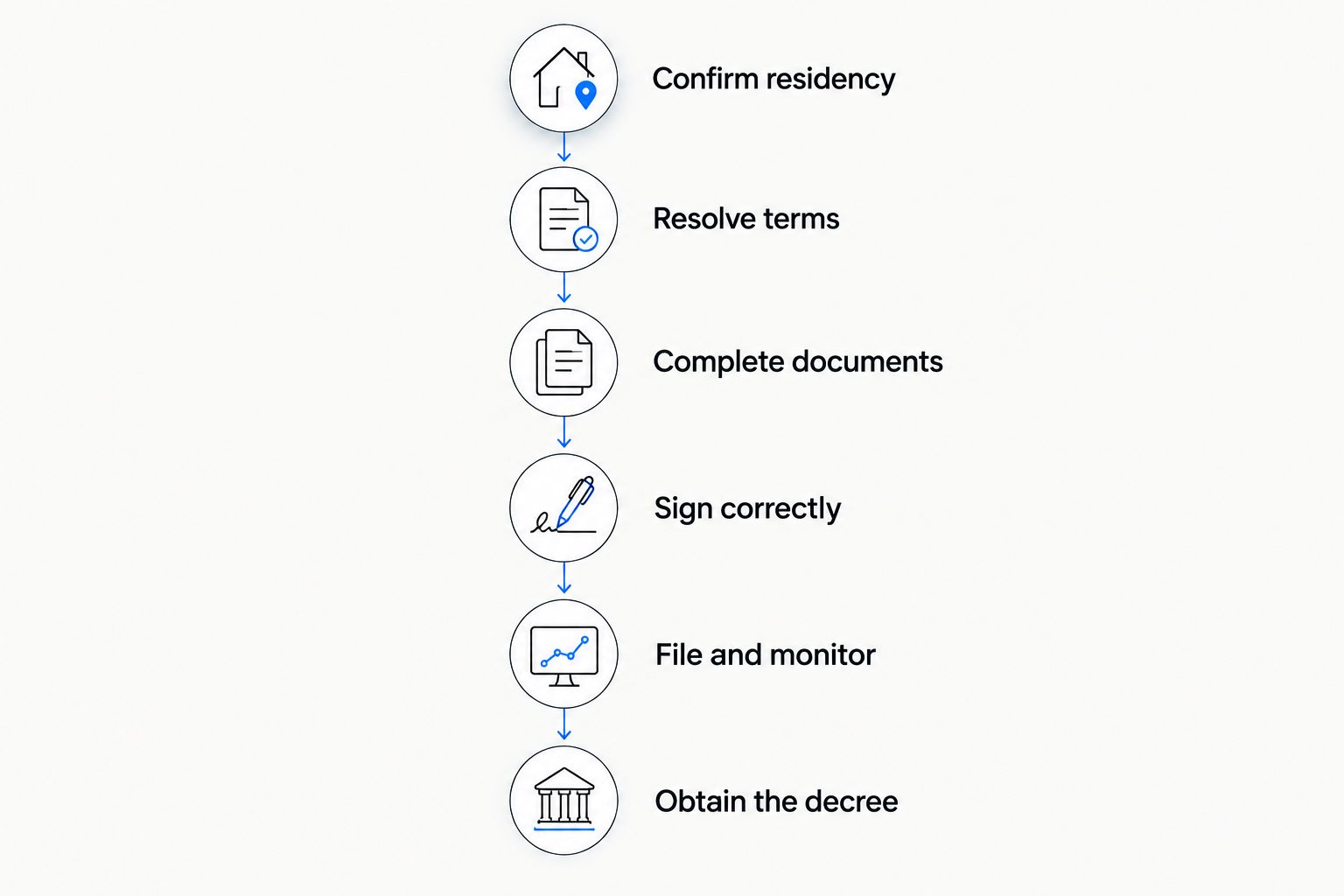
Use this sequence before planning around a no-hearing outcome. It separates eligibility, agreement, execution, and approval so that a completed signing appointment does not look like a completed divorce.
- Confirm residency. Nevada generally requires at least 1 spouse to have resided in the state for 6 weeks before filing. Review the applicable residency-affidavit requirements; a local mailing address alone is not a substitute for the required proof.
- Resolve terms. Write down the agreement on each issue the forms require. Do not leave debt responsibility, support, or parenting arrangements for an informal conversation after filing.
- Complete documents. Use the appropriate court packet and make the proposed decree consistent with the petition. Check names, requested relief, attachments, and all required signature fields.
- Sign correctly. Follow the instructions for signatures and notarization. A notary verifies the required notarial act; the notary does not decide whether your settlement protects your interests.
- File and monitor. Submit the required documents through the applicable court process. Watch for rejected filings, correction requests, and court orders after submission.
- Obtain the decree. Confirm that the judge has signed and entered the divorce decree before treating the marriage as legally ended.
Nevada’s general residency rule appears in NRS 125.020. For the summary-divorce procedure, consult NRS 125.181–125.184; for Clark County form instructions, consult the Family Law Self-Help Center’s joint-petition materials. These are the statutory and court-instruction sources for the procedural distinctions explained in this 2026 guide.
Residency for divorce and jurisdiction over child custody are separate questions. If your children recently moved between states, obtain legal advice rather than assuming the divorce residency requirement settles custody jurisdiction too.
What if the judge schedules a hearing anyway?
Follow the hearing order, even if both spouses still agree. Read the notice to identify who must attend, what the court wants addressed, and whether the appearance is in person or remote.
Do not assume that a hearing notice requires both spouses simply because both signed the petition. Conversely, do not assume that only one spouse must attend. The actual order determines the obligation.
If the notice is unclear, ask court staff about scheduling and attendance instructions. Ask a Nevada attorney about the legal effect of the order or how to respond to a substantive concern. Court staff can explain procedures but cannot choose your legal position.
If you cannot attend as ordered, address that before the scheduled event through the court’s required process. An email between spouses does not change a court date, and a document preparer cannot excuse either spouse from appearing.
Can we get divorced if only one spouse lives in Nevada?
At least 1 spouse must satisfy Nevada’s general 6-week residency requirement, but both spouses do not need to live in Nevada merely to meet that rule. The court still needs the required residency evidence and jurisdiction for the issues it will decide.
An out-of-state spouse is not automatically a reason for a hearing. The filing route, signed documents, and court directions still matter. Confirm the signing and notarization requirements rather than assuming the spouses must use the same appointment.
If the case involves out-of-state children, property questions, or concerns about the court’s authority over either spouse, obtain legal advice. Meeting the residency rule does not answer every jurisdictional question.
Does notarizing the divorce paperwork replace appearing in court?
No. Notarization and court attendance serve different purposes. A notarial act addresses the execution of a document; a court appearance addresses what the judge requires in the divorce case.
A mobile notary can remove travel from the signing step, but notarization does not grant the divorce. It also does not guarantee that a joint petition qualifies for approval without a hearing.
Check the document’s instructions before signing. Where notarization is required, follow the notary’s directions about when to sign and what identification to present. Do not assume every page in a divorce packet needs a notarial certificate.
When document preparation fits—and when legal advice is needed
Signatureondemand is best for Clark County couples who need uncontested-divorce document preparation rather than legal representation. The Nevada-licensed document preparation service also provides mobile and remote online notary services.
The benefit of document preparation is help with the paperwork task. The limit is that document preparation is not legal advice: choosing settlement terms, evaluating rights, handling disputed issues, and advising on court orders belong with an attorney.
For a 2026 uncontested filing, decide what kind of help you need before booking. If you have already reached a complete agreement and need document preparation, that is different from asking whether you should waive support or accept a proposed custody arrangement.
Signatureondemand serves individuals and families in Las Vegas, Henderson, North Las Vegas, and Summerlin. Its divorce document preparation service does not replace judicial approval or a required appearance.
Get help with divorce documents
Ask about Nevada divorce document preparation and notarization for your agreed filing.
Before seeking preparation help, gather the relevant facts and your agreed terms. If you cannot explain who receives an asset, who owes a debt, or what parenting arrangement you want documented, resolve that question first. A form cannot turn an unfinished negotiation into a complete agreement.
FAQ
Do both spouses need to appear in court for divorce in Nevada?
No, both spouses do not automatically need to appear for a qualifying Nevada joint-petition divorce. The court can decide the petition without a hearing, but any order requiring attendance must be followed.
Can neither spouse attend court for an uncontested Nevada divorce?
Yes, a qualifying joint petition can be approved without either spouse attending a hearing. That does not eliminate required signatures, filing requirements, or the need for a judge-entered decree.
Do both spouses have to sign a Nevada joint petition for divorce?
Yes, both spouses must sign the required joint-petition paperwork. A spouse’s verbal agreement does not replace the required participation and signatures.
How long must I live in Nevada before filing for divorce?
Nevada generally requires at least 1 spouse to have lived in the state for 6 weeks before filing for divorce. The required residency evidence must also be provided, and child-custody jurisdiction is a separate issue.
Can I skip a hearing if my spouse and I agree on everything?
No, agreement does not excuse you from a court-ordered appearance. Follow the hearing notice or obtain a change through the court’s required procedure.
Does a notarized divorce agreement mean I am divorced?
No, a notarized divorce agreement does not end the marriage. The judge must approve the divorce and enter the decree.
Can Signatureondemand tell us whether our divorce settlement is fair?
No, Signatureondemand’s document preparation service does not provide legal advice about settlement fairness. Ask a Nevada attorney to evaluate support, property, debt, or custody terms before you sign if you need advice.
One last thing
Check for an entered decree, not just a successful filing receipt. A receipt shows that you submitted documents; it does not establish that the judge granted your divorce.
Keep the final decree and read its terms. Court attendance is only one procedural question—the document that determines your obligations is the court’s final order.


