
No. In 2026, an ordinary Nevada will does not need to be notarized to be valid; it generally needs the testator’s signature and the signatures of two competent witnesses under Nevada’s will-execution rules. Notarization can help make a will self-proving, but it does not replace the witnesses required for an ordinary will. Nevada also recognizes handwritten wills under separate rules.
- Does a will need to be notarized in Nevada? No; an ordinary will generally needs two competent witnesses.
- A notary does not replace the witness signatures required for an ordinary Nevada will.
- A handwritten will follows different rules: its signature, date and material provisions must be in the testator’s handwriting.
- Signature on Demand is best for Nevada families who need document preparation or notary services, not legal advice.
Why this matters
A notary checks identity and performs a notarial act. A witness attests to the signing of a will. Those are different jobs, and treating them as interchangeable can leave your family with a document that does not meet Nevada’s execution rules.
Signature on Demand offers Nevada document preparation and notary services for individuals and families in Clark County. If you already have a will to sign, the first question is not whether to book a notary. It is which Nevada signing rules apply to that will.
Does a will need to be notarized in Nevada?
No. For an ordinary written Nevada will, focus on the testator’s signature and two competent witnesses. Nevada Revised Statutes Chapter 133 sets out the rules for executing wills, including separate provisions for handwritten and electronic wills. Notarization serves a different purpose: it can support self-proving execution, which addresses proof of the will after death.
| Type of will or signing step | Is notarization required for validity? | What matters instead? |
|---|---|---|
| Ordinary written will | No | The testator’s signature and signatures of two competent witnesses under Nevada’s execution rules |
| Handwritten, or holographic, will | No | The signature, date and material provisions must be in the testator’s handwriting |
| Self-proving execution | Notarization is part of this additional step | The will still needs to meet the applicable execution requirements |
| Electronic will | Do not apply the paper-will checklist without checking its separate rules | Nevada has specific statutory requirements for electronic wills |
The distinction is practical. A notary stamp on an ordinary will does not supply missing witness signatures. Conversely, an ordinary will that meets Nevada’s execution requirements does not become invalid merely because no notary was present.
What does signing an ordinary Nevada will involve?
Use this sequence for a conventional paper will in 2026:
- Identify the final document. Make sure the pages you intend as your will are the pages being signed. Review names and instructions before the signing, not while witnesses are waiting.
- Sign as the testator. Nevada’s ordinary-will rules address the testator’s signature and the acknowledgment of that signature before witnesses.
- Have two competent witnesses sign. The witnesses subscribe their names to the will in the testator’s presence. Do not substitute a notary for either witness.
- Decide whether to make the will self-proving. If you want this additional step, arrange the appropriate notarial act as part of a signing that also satisfies the will’s witness requirements.
- Keep the signed original identifiable. Your family needs to know which document is the executed will. A draft and a signed will are not the same thing.
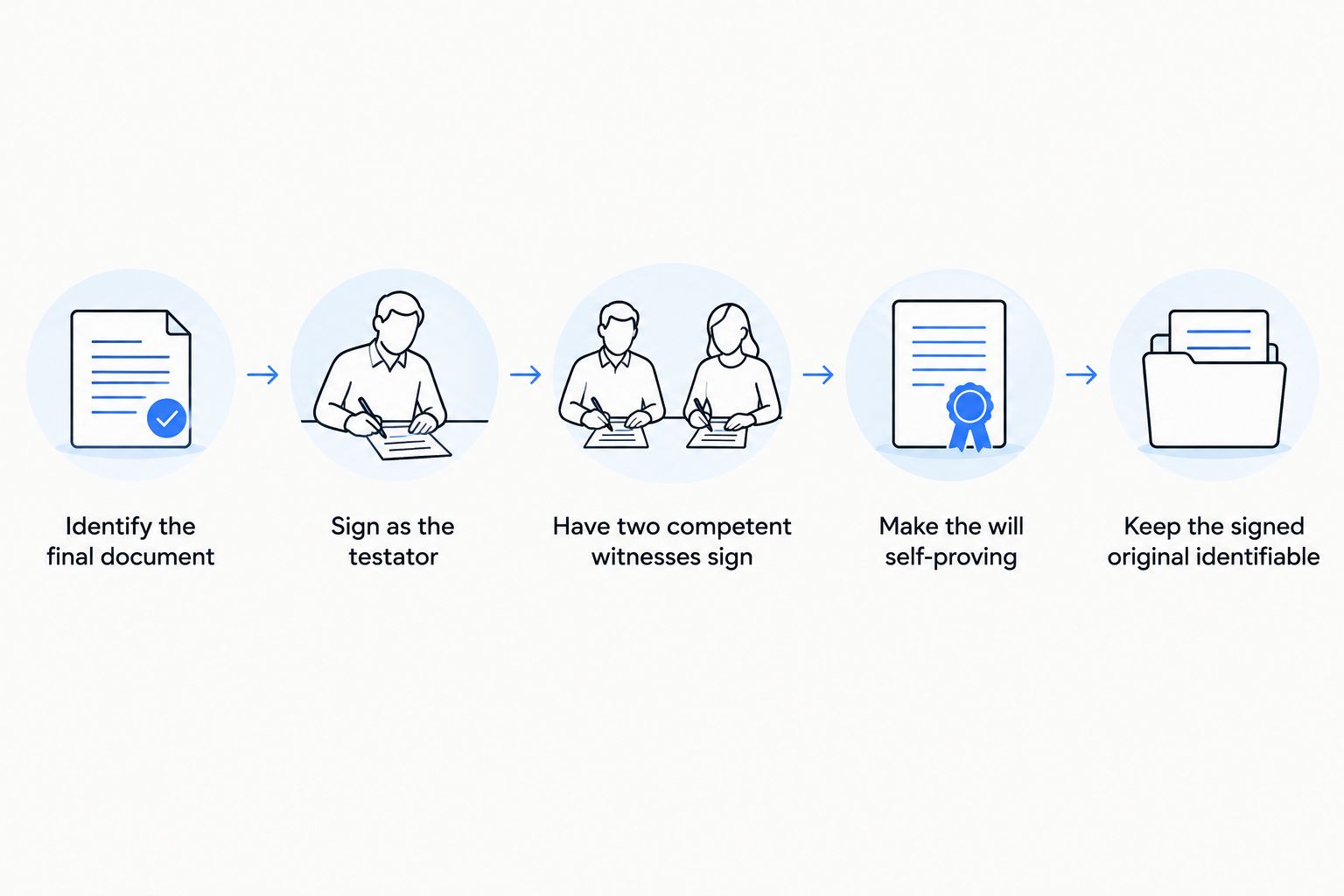
The sequence is about execution, not the quality of the will’s instructions. If you need advice about beneficiaries, property, taxes or a disputed family situation, speak with a Nevada estate-planning attorney before signing. A document preparer or notary cannot make those legal decisions for you.
When does notarization help a Nevada will?
Notarization matters when you choose a self-proving process. Its purpose is to help establish the will’s execution later; it is not a substitute for signing an ordinary will correctly in the first place. In 2026, ask specifically for a self-proving will signing if that is what you want. Asking only for a notarized signature does not explain whether witnesses are needed or whether the self-proving requirements will be met.
Keep these roles separate:
- Testator: The person making the will signs or acknowledges the signature under the applicable rules.
- Witnesses: For an ordinary will, two competent witnesses sign as required by Nevada law.
- Notary: The notary performs the applicable notarial act for a self-proving step. The notary’s seal alone does not repair an improperly witnessed ordinary will.
Signature on Demand is best for Nevada families who need document preparation or notary services, not legal advice. Its service scope makes it relevant when you need help arranging a document or a notarial act. The limit matters just as much: a notary does not choose your estate plan or certify that its terms achieve your goals.
Arrange your Nevada document signing
Check document preparation and notary services before you schedule your will signing.
Do handwritten wills need witnesses or a notary in Nevada?
A qualifying handwritten will, also called a holographic will, does not need witnesses or notarization under Nevada’s separate rule. Its signature, date and material provisions must be in the testator’s handwriting. That is a different route to validity, not a shortcut for a typed will with missing witnesses.
The phrase material provisions refers to the instructions that give the will its effect. If a handwritten note leaves those instructions unclear, a notary cannot resolve the ambiguity by stamping it. Likewise, adding a handwritten signature to typed estate-planning instructions does not turn the typed instructions into handwritten material provisions.
For a 2026 Nevada will, decide which signing route you are using before you sign. Do not mix parts of the ordinary-will and handwritten-will rules and assume the result qualifies under either one. If you have already signed a document and are unsure which rule applies, get legal advice rather than altering the original or asking someone to notarize it afterward.
Why do Nevada will-signing requirements vary?
Nevada’s rules depend on the document and the kind of proof you want available later. These are the factors that change the signing checklist:
- Typed versus handwritten text. An ordinary written will uses the witness rules; a holographic will must satisfy the handwriting requirements for its signature, date and material provisions.
- Witness participation. Two competent witnesses matter for an ordinary will. A notary is not an alternative to them.
- Self-proving status. This optional execution step involves notarization, but it does not erase the will’s underlying requirements.
- Electronic format. Nevada has separate rules for electronic wills. Do not assume a video call, an electronic signature or a remote notarization alone creates a valid electronic will.
- Changes after signing. A revised document needs attention to its own execution. A notary stamp on an old version does not validate new instructions.
The right question in 2026 is therefore not simply whether a notary is available. Ask what kind of will you have, which execution rule governs it, and whether you also want it to be self-proving.
Can a notary act as one of the two witnesses?
Do not count the notarial act as a witness signature. For an ordinary Nevada will, arrange two competent witnesses to sign under the witness rules, regardless of whether a notary also participates. If a proposed signer has more than one role, confirm the execution plan with a Nevada attorney before the appointment rather than assuming one signature serves both purposes.
This distinction matters when you book mobile or remote service. Tell the provider that the document is a will and whether you are arranging witnesses, a self-proving step, or both. Signature on Demand provides mobile and remote online notary services, but the service description alone does not establish that a particular will is eligible for a particular signing method.
Can you notarize a will after the witnesses have signed?
A later notarial act does not replace a missing witness or fix an improperly executed ordinary will. If the will was already signed, identify exactly what you want notarized and whether the proposed self-proving procedure fits the completed signing. Do not add signatures or a seal simply to make the document look complete.
In 2026, the safer move when execution is uncertain is to have a Nevada estate-planning attorney review the situation. The answer depends on what was signed, who was present and what the document says; a notary cannot determine the will’s legal validity for you.
Is a will the same as a power of attorney or living trust?
No. A will gives instructions for after death; a power of attorney authorizes someone to act under its terms, and a living trust is a separate estate-planning document. Each document has its own purpose and signing requirements. Do not transfer the will’s two-witness checklist to another document without checking the rules that apply to it.
For a Nevada family planning in 2026, the useful step is to list the documents you actually need before arranging a signing. Signature on Demand offers preparation services for wills, trusts and powers of attorney, plus notary services. It does not replace an attorney when you need advice on which document fits your circumstances.
FAQ
Does a will need to be notarized in Nevada in 2026?
No. An ordinary Nevada will generally requires the testator’s signature and two competent witnesses, not a notary. Notarization can be used for a self-proving step.
How many witnesses does an ordinary Nevada will need?
An ordinary Nevada will needs two competent witnesses under the state’s execution rules. Their signatures are not replaced by a notary’s seal.
Does a handwritten will need to be notarized in Nevada?
No. A qualifying Nevada holographic will does not need notarization or witnesses, but its signature, date and material provisions must be in the testator’s handwriting.
Does notarizing a Nevada will make it valid?
Notarization alone does not make an improperly executed ordinary Nevada will valid. The will must satisfy the execution rules that apply to its format.
What is a self-proving will in Nevada?
A self-proving will has an additional execution step intended to establish proof of signing later. It still must meet the applicable requirements for executing the will.
Can remote online notarization replace will witnesses in Nevada?
No. Remote online notarization does not, by itself, replace the witnesses required for an ordinary Nevada will. Electronic wills have separate rules that need their own review.
Should I sign a Nevada will before meeting the witnesses?
Follow Nevada’s execution rules for signing or acknowledging your signature before the witnesses. If you have already signed, confirm the correct procedure before anyone adds witness signatures.
One last thing
A notary stamp is not a cure for the wrong signing process. In 2026, decide whether your document is an ordinary written will, a qualifying handwritten will or an electronic will before you arrange witnesses or notarization. That decision determines the checklist; the seal does not.


