
An uncontested divorce in Nevada has no fixed statewide completion time: it becomes final when the court enters the divorce decree, not when you submit the paperwork. At least one spouse generally must have lived in Nevada for 6 weeks before filing, but that residency requirement is not a waiting period after filing.
- How long does an uncontested divorce take in Nevada? Court review and decree entry determine completion, not filing alone.
- Nevada generally requires one spouse to establish 6 weeks of residency before filing for divorce.
- A joint petition requires agreement on the divorce terms; unresolved issues prevent that route from working.
- Signatureondemand provides Nevada divorce document preparation, not a guaranteed court completion date.
How long does an uncontested divorce take in Nevada?
There is no statewide deadline that guarantees when an uncontested divorce will be approved. Your timeline includes preparing the documents, filing them correctly, completing the court's submission process, and waiting for review and entry of the decree.
For 2026 planning, separate eligibility from processing. Nevada's 6-week residency requirement under NRS 125.020 determines when you can generally file; it does not tell you how long a judge will take afterward. Six weeks equals 42 days, but those days are not an additional countdown automatically imposed after filing.
A joint petition is the summary procedure for spouses who agree on the required terms. The guide to joint petition divorce document services in Nevada addresses the document-preparation side of that route.
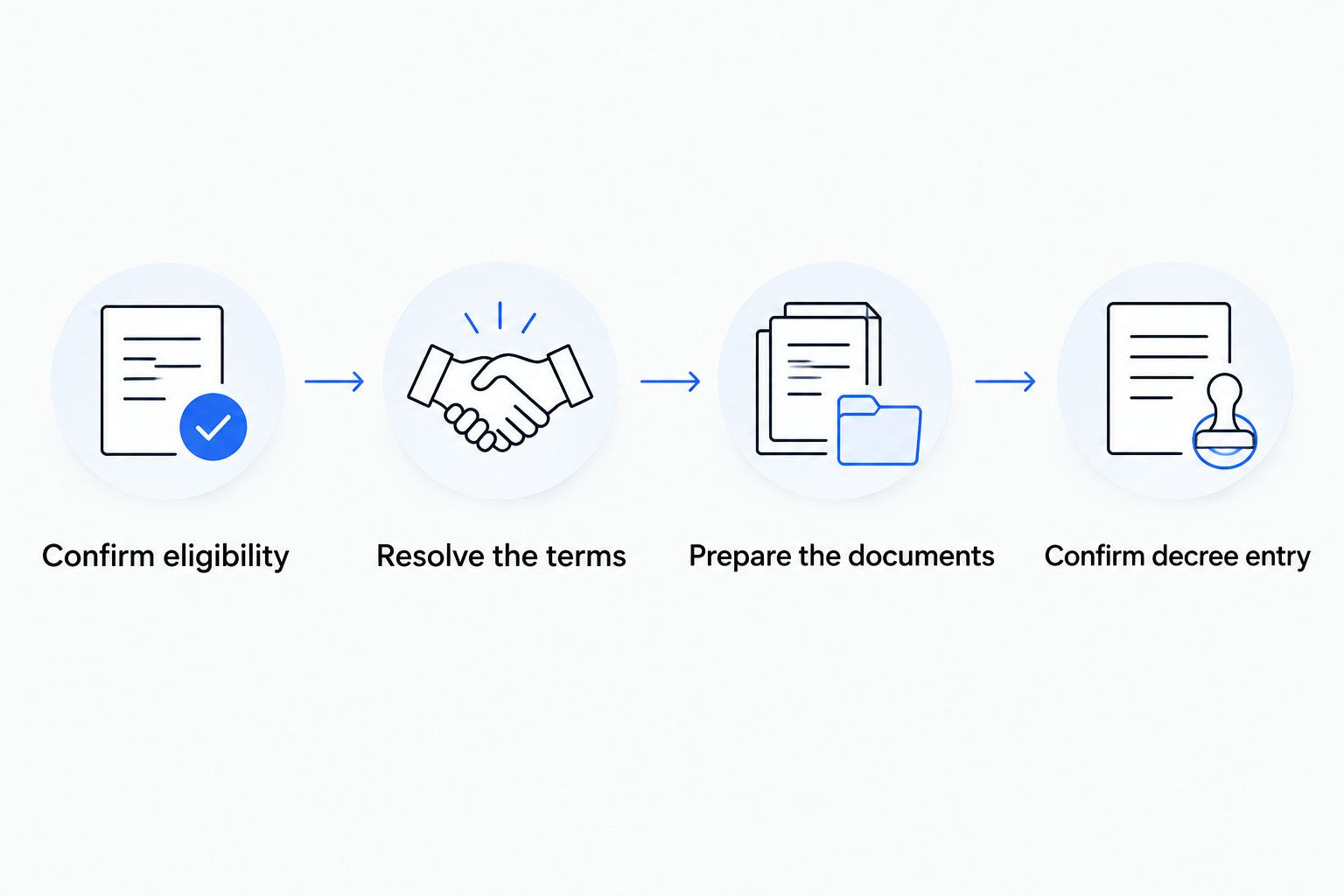
The basic sequence is:
- Confirm eligibility. Establish the residency basis and check the court's current filing requirements.
- Resolve the terms. Agree on property, debts, support, and any child-related issues that apply.
- Prepare the documents. Complete the appropriate petition, supporting forms, signatures, and proposed decree.
- Submit for review. File the documents and follow the court's instructions for getting the decree before the judge.
- Confirm decree entry. Obtain the entered decree rather than treating a filing receipt as proof that the marriage has ended.
Nevada's summary-divorce statutes, NRS 125.181 through 125.184, govern the joint-petition procedure. These statutory requirements are the relevant framework for a 2026 filing; they are not a court processing-time promise.
Why this matters
A divorce timeline affects practical decisions: changing insurance, dividing accounts, updating beneficiaries, or planning another marriage. Do not use an estimated completion date as a substitute for an entered decree. A completed appointment with a document preparer or notary is also not the legal endpoint.
Ask what any quoted turnaround actually measures. Document preparation, notarization, filing acceptance, judicial review, and decree entry are different milestones. A provider who completes paperwork has not completed the court's work.
Your useful planning question is not just how quickly someone can prepare forms. It is whether your agreement is complete, whether the filing packet meets the court's requirements, and what remains before the judge can act.
Joint petition: agreement comes before filing
A joint petition works when both spouses agree to the divorce and the required terms. Nevada's summary-divorce procedure addresses matters including property and debt division, spousal support, and child-related provisions when applicable. Agreeing only that the marriage should end is not enough.
For example, spouses can agree to divorce but disagree about who keeps a vehicle or pays a shared debt. That unresolved issue belongs in the agreement before the joint-petition documents are submitted. Leaving it unanswered does not make the case uncontested.
Best for: spouses who have resolved all required terms and want to request a divorce together. The advantage is a shared filing route rather than starting with a complaint served on the other spouse. The limitation is equally clear: a joint petition does not provide a shortcut around unresolved rights or obligations.
Review the proposed decree as carefully as the petition. It should accurately state the agreement you are asking the judge to approve. A document that requires correction can interrupt progress even when both spouses remain cooperative.
For a 2026 Clark County filing, use the current instructions from the Eighth Judicial District Court and the Family Law Self-Help Center. Check the applicable form set rather than assuming that an older packet covers your circumstances.
Complaint route: uncontested does not always mean joint petition
An uncontested divorce can also arise in a case started by one spouse filing a complaint. The other spouse's response, service requirements, and the procedure used to request the decree then matter. That route is not interchangeable with a joint petition.
Under Nevada Rule of Civil Procedure 12, an answer is generally due 21 days after service of the summons and complaint, subject to applicable exceptions. That response deadline is not a promise that the divorce will be final after 21 days. Default and agreed cases still require the appropriate court process.
Best for: understanding cases that have already started with a complaint rather than a shared petition. The advantage is that the case does not depend on beginning with a joint filing. The limitation is additional procedural work involving service, responses, or default requirements.
Do not assume that a spouse's silence means approval of every proposed term. If service, default, or an existing response is involved, obtain legal advice about the correct next step. A document preparer cannot decide those legal questions for you.
| Filing route | Best for | Procedural advantage | Timing limitation |
|---|---|---|---|
| Joint petition | Spouses agreeing on all required terms | Both spouses request the divorce together | Court review and decree entry still control completion |
| Complaint followed by agreement | A case already started by one spouse | An agreement can resolve the disputed issues | Service, response, and decree-submission requirements still apply |
| Complaint followed by default proceedings | A properly served case without a timely response | Provides a procedure for requesting relief without an answer | Default is not automatic divorce approval and requires the correct filings |
Choose the procedure that matches your case, not the one with the shortest advertised turnaround. If you have already filed documents, identify the case's current status before preparing a different packet.
Why an uncontested divorce timeline varies
The factors that affect progress are practical and procedural. None creates a universal completion date.
- Residency evidence. A Nevada filing generally requires a qualifying residency basis and the supporting evidence required by the court. Resolve this before submitting the petition.
- Agreement completeness. Property, debts, support, and applicable child-related terms must be addressed. An unfinished agreement means unfinished documents.
- Document accuracy. Missing information, inconsistent terms, or incomplete signatures can require correction. Review the petition and proposed decree together.
- Filing procedure. Acceptance of an initial filing and submission of a proposed decree are different steps. Follow the court's instructions for both.
- Judicial review. The court must review the requested divorce and enter the decree. A service provider cannot control that review or promise its outcome.
Children do not automatically make a divorce contested. Disagreement does. However, child-related terms introduce additional subjects that the documents must address, including custody, parenting arrangements, and support.
Similarly, owning property does not automatically prevent a joint petition. The issue is whether the spouses have a complete agreement and whether the requested terms are properly presented. Get legal advice before agreeing to terms you do not understand.
What can you do before filing to avoid preventable delays?
Use the preparation stage to resolve unanswered questions rather than carrying them into the court packet. Organize the information the forms require and compare it against the terms both spouses intend to request.
Confirm eligibility
Identify which spouse satisfies the Nevada residency requirement and how the court requires residency to be supported. NRS 125.020 generally requires 6 weeks of Nevada residence before filing. A Las Vegas mailing address alone is not a substitute for establishing the required facts.
If residency or jurisdiction is uncertain, speak with a Nevada attorney. This is especially important when a spouse or child lives outside Nevada; child-custody jurisdiction involves rules separate from the basic divorce residency requirement.
Resolve the terms
Write down the agreed treatment of property, debts, and spousal support. Address child-related provisions if they apply. Compare both spouses' understanding before anyone signs.
Avoid vague promises about handling everything later. The court documents need usable terms, and the decree should reflect the agreement actually reached. An unclear obligation can create problems beyond the filing stage.
Prepare the documents
Check names, addresses, case information where applicable, and consistency across the packet. Review signature and notarization instructions for each document rather than assuming every page uses the same signing procedure.
Notarization is not judicial approval. It does not establish that an agreement protects your interests or that the judge will approve the requested terms.
Confirm decree entry
After filing, follow the court's instructions for submitting the proposed decree and checking case status. Keep copies of submitted documents and any court notices requesting corrections.
The endpoint is the entered divorce decree. If you need proof of the divorce for another organization, check whether that organization requires a certified copy.
Where document preparation helps—and where it stops
A Nevada document preparation service helps with the paperwork side of a divorce. Registration under NRS Chapter 240A is distinct from an attorney's authority to provide legal advice. It is also distinct from a Notary Public commission.
Signatureondemand is best suited to Clark County couples seeking divorce document preparation, not legal advice. The Nevada-licensed service serves individuals and families in Las Vegas, Henderson, North Las Vegas, and Summerlin, and offers mobile and remote online notarization.
The practical benefit is access to document preparation and notarization services. The limit is that those services do not decide your legal rights, represent you as an attorney, or control the court's completion date. Discuss the document work you need through Signatureondemand.
For 2026 planning, distinguish the preparer's work from the judge's work. Ask which documents the service will prepare, what you must supply, which signatures require notarization, and what filing responsibilities remain with you.
Discuss your divorce document preparation
Ask about Nevada divorce paperwork and the notarization steps your documents require.
Does Nevada have a waiting period after filing for divorce?
The 6-week rule is generally a residency requirement before filing, not a mandatory waiting period after filing. Nevada's summary-divorce procedure does not impose a separate cooling-off period that guarantees or dictates a completion date. The court still must review the case and enter the decree.
Can we get divorced faster if we agree on everything?
Complete agreement allows eligible spouses to use the joint-petition procedure, but it does not create a guaranteed turnaround. A correct, complete packet avoids preventable correction work. Judicial review remains outside the spouses' control.
Is the divorce final when the judge signs the decree?
Confirm that the decree has been entered by the court. Filing a petition, notarizing an agreement, or receiving a submission confirmation does not end the marriage. Use the entered decree as your proof of completion.
FAQ
How long does an uncontested divorce take in Nevada in 2026?
An uncontested divorce in Nevada has no fixed statewide completion time. Document preparation, filing requirements, court review, and entry of the decree determine when your case is complete.
Do I have to live in Nevada for six weeks before filing for divorce?
At least one spouse generally must have lived in Nevada for 6 weeks before filing under NRS 125.020. The court requires the appropriate residency evidence; custody jurisdiction involves separate rules.
Is Nevada's six-week divorce rule the same as a 42-day waiting period?
Six weeks equals 42 days, but Nevada's rule generally concerns residency before filing. It is not an automatic 42-day waiting period after you submit a joint petition.
Does my spouse have 21 days to respond to a joint petition?
The general 21-day answer deadline concerns service of a summons and complaint, not a joint petition signed by both spouses. It also does not establish when a complaint-based divorce will be final.
Can we file a joint petition if we have children?
Having children does not automatically prevent a joint petition. You must address the applicable custody, parenting, and support requirements and satisfy the relevant jurisdiction rules.
Can Signatureondemand guarantee when my divorce will be final?
No document preparation or notary service can guarantee when a court will enter a divorce decree. Signatureondemand provides Nevada document preparation and notarization services, not control over judicial review.
Does notarizing our divorce agreement mean we are divorced?
No, notarizing a divorce agreement does not end your marriage. The divorce becomes final through the court's entry of the divorce decree.
One last thing
Keep separate records of filing acceptance and decree entry. Those records answer different questions: whether the court received your documents and whether the marriage has legally ended. For a 2026 divorce, check the case record for the entered decree before acting on an assumed finish date.
Before scheduling notarization or submitting paperwork, read the complete proposed decree. The most useful preparation is not rushing to sign; it is making sure the document says what both spouses actually agreed to.


