
A funded revocable living trust is generally better than a will for keeping assets titled in the trust out of Nevada probate. A will is still needed if you want to nominate a guardian for minor children or direct assets left outside the trust. For many Nevada families, the useful choice is not trust or will but a trust paired with a will.
- Living trust vs will Nevada: a funded trust avoids probate for assets titled in it; a will does not.
- A Nevada will lets parents nominate a guardian for minor children; a trust does not replace that function.
- Signature on Demand is best for Nevada families seeking document preparation after deciding what documents they need.
- A signed trust that never receives assets does not solve the probate problem for those assets.
Is a living trust better than a will in Nevada?
A living trust wins on probate avoidance for assets properly transferred into it. A will wins on guardian nominations. Neither document covers every estate-planning task. In 2026, start with the outcome you need, then check how each asset is owned and whether it already has a beneficiary designation.
| Question | Revocable living trust | Will |
|---|---|---|
| When does it control assets? | During your lifetime and after death, for assets placed in the trust | After death, for assets governed by the will |
| Can it keep covered assets out of probate? | Yes, when assets are properly titled in the trust | No; the will is handled through the probate process when probate is required |
| Can you change it while you have legal capacity? | Generally yes, if it is revocable | Generally yes |
| Can it nominate a guardian for minor children? | No; use a will for that nomination | Yes; a court makes the appointment |
| Who handles the assets? | The trustee, then the successor trustee under the trust terms | The personal representative through the applicable estate process |
| What is the main limitation? | An unfunded trust does not cover assets left outside it | A will does not, by itself, keep assets out of probate |
This comparison concerns a revocable living trust, not every type of trust. It also does not mean every asset outside a trust enters probate. An account with a valid beneficiary designation, for example, follows that designation rather than a contrary instruction in a will.
Why this matters for Nevada families
Signing documents is only part of the job. If your aim is to keep a home out of probate, its ownership must match the plan. If your aim is to name someone to care for minor children, that nomination belongs in a will even when you also have a trust.
The practical starting point in 2026 is an asset list: real estate, bank and investment accounts, vehicles, and anything with a named beneficiary. Mark how each item is titled. That exercise shows where a trust can do work, where another transfer method already applies, and where an asset needs attention.
A guide to living trusts for Nevada families can help you organize the document questions. For advice about which arrangement fits your property, family circumstances, or tax position, speak with a Nevada estate-planning attorney.
When a living trust is the better choice
A revocable living trust is the better document for a specific goal: letting a successor trustee manage assets held in the trust without relying on a will to transfer those assets through probate. You can serve as your own trustee while you have capacity and name a successor trustee to take over under the trust terms.
That makes the trust relevant when you own property you intend to transfer into it and want instructions for its management after your death or during incapacity. The distinction is assets held in the trust. Signing a trust document does not retitle a house or change an account owner by itself.
A trust also has limits. It does not replace beneficiary designations on accounts governed by those designations. It does not name a guardian for a child, and a revocable trust does not automatically remove estate taxes or shield your own assets from your creditors. Ask an attorney to review any plan built around those goals.
In 2026, treat funding as a separate task from preparation. Identify the assets intended for the trust, determine which transfers are appropriate, and confirm that the necessary ownership changes were completed. Keep records your successor trustee can locate; the trust cannot administer an asset the trustee does not know exists.
When a will is the better choice
A will is essential when you want to nominate a guardian for minor children. The nomination states your preference; the court decides who is appointed. A trust can set terms for property held for a child, but it does not replace the guardian nomination.
A will also states who should handle your estate and who should receive assets governed by the will. In Nevada, an ordinary written will generally requires the testator's signature and 2 competent witnesses under Nevada's will-execution rules. Do not assume that notarizing a document replaces the required witnesses. Electronic wills have separate Nevada rules, so have an attorney check the execution method if you are not using an ordinary written will.
The drawback is direct: a will does not avoid probate for assets that must pass under it. Probate is the court process used when it is required to administer a deceased person's estate. A will gives instructions for that process; it is not a substitute for changing how property is held during life.
If your assets already pass through valid beneficiary designations or other nonprobate arrangements, that may affect how much work a trust would do. It does not eliminate the need to check whether any property remains outside those arrangements or whether you need a guardian nomination.
Why the answer varies
A living trust vs will Nevada decision depends on these facts, not on a universal ranking:
- Real estate ownership. A trust affects a property only when the appropriate ownership transfer is completed. Review the current deed before assuming the trust covers the home.
- Beneficiary designations. Check accounts and policies with named beneficiaries. A will generally does not override a valid designation on an asset that passes directly to that beneficiary.
- Minor children. A will provides a place to nominate a guardian. A trust addresses management of assets held under its terms; those are different tasks.
- Incapacity planning. A successor trustee can manage trust property under the trust terms. Financial and healthcare powers of attorney address decisions outside that role.
- Property left outside the trust. An unfunded or partly funded trust leaves gaps. A companion will can address remaining assets, but property passing under that will can still require probate.
- Complex family or tax questions. Blended families, business interests, disputed ownership, and tax concerns call for legal advice rather than a document choice based on a general comparison.
The order matters: identify what you own, check how it passes, then decide which instructions are missing. Choosing a trust first and asking about asset ownership later reverses the work that makes the trust effective.
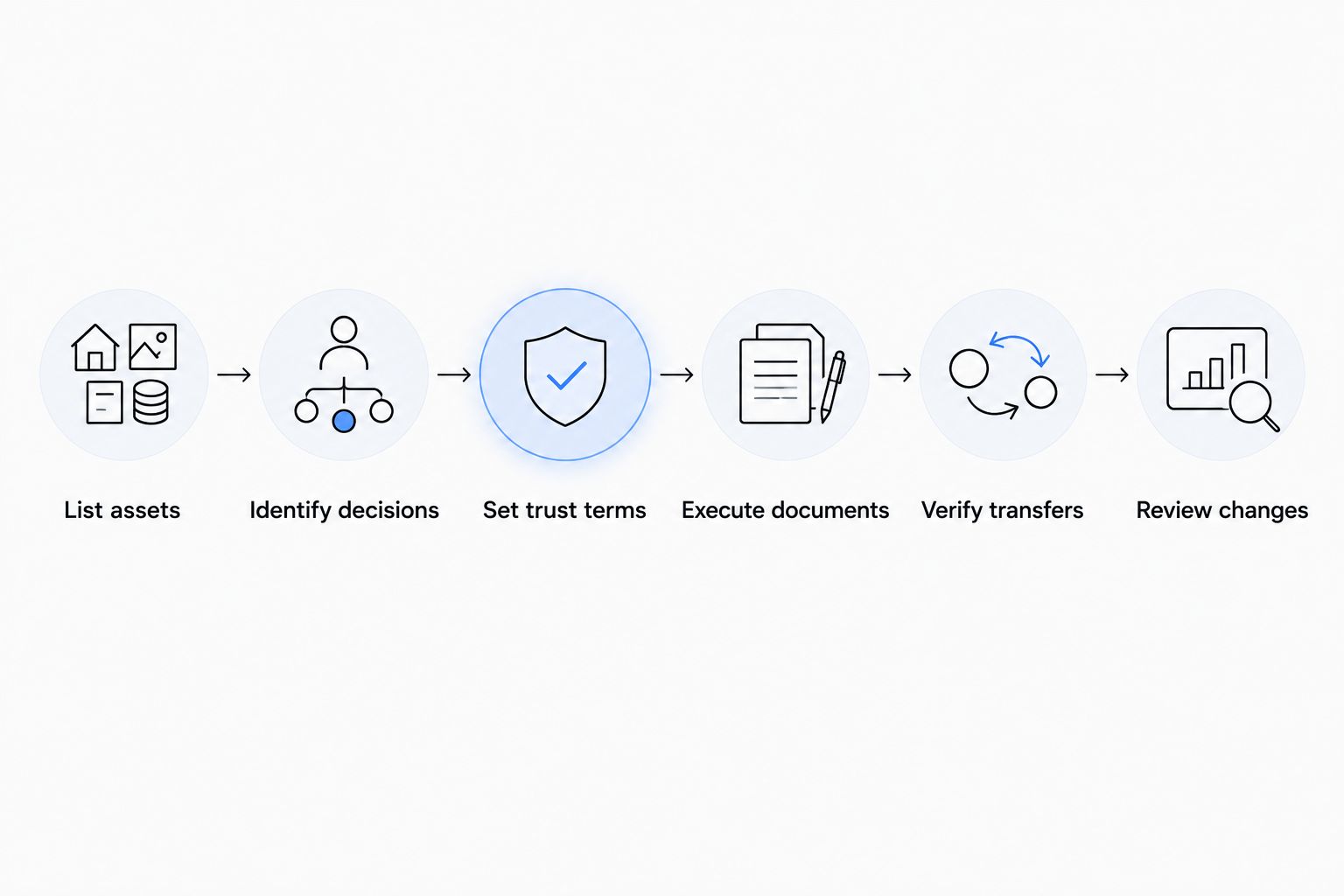
How do you put a Nevada living trust plan into effect?
Prepare the documents, then carry out the asset transfers. The first step records your instructions; the second determines which assets the trust actually controls. Use this sequence as a planning checklist in 2026, not as a substitute for legal advice about a particular deed, account, or beneficiary.
- List each asset and its current owner. Include real estate and accounts with beneficiary designations. Do not assume an asset belongs to the trust because it appears on your personal inventory.
- Identify the decision each document must cover. Separate asset management, distribution after death, guardian nominations, and financial or healthcare decisions during incapacity.
- Set the trust terms with appropriate advice. Name the trustee and successor trustee and specify who receives trust property. Get attorney guidance where ownership or family circumstances make those decisions complicated.
- Execute each document under its applicable rules. A will, trust, deed, and power of attorney do not share one universal signing procedure. Confirm the requirements for each document rather than treating a notary stamp as the complete process.
- Complete and verify appropriate transfers. Check deeds and account records after changes are made. An instruction to transfer an asset is not the same as confirmation that the transfer occurred.
- Review the plan after ownership changes. A newly acquired asset, changed beneficiary, or property sale can leave the document set out of step with what you own.
Signature on Demand provides Nevada-licensed estate document preparation and mobile or remote online notary services for individuals and families in Clark County. Signature on Demand is best for families who know which documents they need prepared and want help with the document process, not legal advice. If you need someone to decide whether a trust, will, or transfer method fits your situation, consult a Nevada attorney first.
Prepare your estate documents
Ask about Nevada document preparation and notarization in Clark County.
Does a Nevada living trust replace a will?
No. A Nevada living trust does not replace a will's guardian nomination or address every asset left outside the trust. People who use a trust commonly also have a companion will to address property not transferred into the trust. That will does not make the omitted property automatically avoid probate.
Before relying on both documents, compare their instructions. A trust cannot fix an outdated beneficiary designation simply by stating a different beneficiary, and a will does not retitle an asset into a trust. Each part of the plan must match the way the relevant property passes.
Will a living trust keep my Nevada house out of probate?
A living trust can keep a Nevada house out of probate when the house is properly transferred into the trust and remains covered by it. A signed trust alone is not proof that the deed changed. Check the recorded ownership and seek legal advice before changing title, especially if the property has a mortgage or shared ownership.
The same check applies after a sale or replacement purchase. A plan that covered one house does not establish how a later-acquired house is titled. In 2026, review the current deed rather than relying on your memory of the original trust signing.
Can I use a will without a living trust in Nevada?
Yes. You can use a will without a living trust in Nevada. A will can state who should receive assets governed by it and nominate a guardian for minor children, but it does not itself keep probate assets out of court. Whether a trust adds value depends on what you own and how each asset is already set to pass.
A will-only approach still requires attention to beneficiary designations and other documents for incapacity. A will takes effect at death; it does not authorize someone to handle your finances or healthcare decisions while you are alive. Treat those as separate planning questions.
FAQ
Is a living trust better than a will in Nevada in 2026?
A funded living trust is better for keeping assets held in it out of probate; a will is needed to nominate a guardian for minor children. Many Nevada plans use both for different tasks.
Does a will avoid probate in Nevada?
No. A will provides instructions for the estate process but does not itself keep probate assets out of probate. Assets passing by valid beneficiary designation follow that designation instead.
What happens if I sign a trust but do not put assets in it?
The trust does not control assets that were never transferred into it. Check deeds and account ownership rather than treating the signed document as confirmation of funding.
Can a living trust name a guardian for my child in Nevada?
No. Use a will to nominate a guardian for a minor child; the court makes the appointment. A trust can separately govern assets held for the child.
Does a Nevada will have to be notarized?
Notarization does not replace the witnesses required for an ordinary written Nevada will. Nevada has separate rules for electronic wills, so confirm which execution rules apply to your document.
Does a successor trustee control everything I own?
No. A successor trustee's authority under a trust concerns property held in that trust. Other assets and decisions require a check of their ownership, beneficiary designations, and applicable documents.
Can a document preparer tell me whether I need a trust?
No. A Nevada document preparer cannot give you individualized legal advice about whether a trust fits your circumstances. Ask a Nevada estate-planning attorney to advise on that choice, then arrange document preparation as appropriate.
One last thing
The most useful trust check is not whether the document was signed; it is whether the intended assets are actually in it. In 2026, compare your current deeds and account records with your estate documents. Signature on Demand can help with Nevada document preparation and notarization, while an attorney can resolve questions about ownership, legal effect, and the right plan for your family.


