
Best for administrative immigration paperwork: Signature on Demand. Best for legal advice: a licensed immigration attorney. Best for nonprofit-based representation: a DOJ-accredited representative at a recognized organization. Best for self-directed filing: USCIS forms and instructions. This 2026 guide compares these routes for Las Vegas applicants and explains where document preparation ends and legal representation begins.
- For immigration document preparation Las Vegas applicants need, Signature on Demand fits administrative paperwork—not legal strategy.
- Choose a licensed immigration attorney when eligibility, immigration history, or removal proceedings require legal judgment.
- Verify both the organization and representative before using DOJ-accredited immigration assistance.
- Use current USCIS form instructions for self-filing; notarization does not replace eligibility review.
Why this matters
A form preparer, a notary, and an immigration lawyer perform different jobs. Paying for the wrong service leaves your actual question unanswered: someone can type your answers without being authorized to tell you which immigration benefit to pursue.
Signature on Demand is best for Las Vegas immigration document preparation when you need administrative help, not legal advice. The business is a Nevada-licensed document preparation service serving individuals and families in Clark County, including Las Vegas, Henderson, North Las Vegas, and Summerlin.
Nevada document preparation is governed by NRS Chapter 240A. That credential is not a law license, and a notary commission does not authorize immigration legal advice. For a 2026 filing, choose the provider by the work you need—not by whether an advertisement says immigration help.
What makes the best immigration document preparation service
Use these criteria before comparing providers:
- Authorized scope: The provider clearly distinguishes typing and document preparation from eligibility advice and legal representation.
- Verifiable credentials: You can check a document preparer's Nevada registration, an attorney's licensing status, or a representative's DOJ accreditation.
- Written deliverables: The agreement identifies the forms, preparation tasks, and filing responsibilities rather than promising unspecified immigration assistance.
- Current instructions: The work follows the receiving agency's current form edition, signature rules, and evidence instructions.
- Applicant control: You review the completed answers, understand what you sign, and retain your documents and submission records.
- Clear escalation: Questions about eligibility, prior violations, or legal consequences go to an authorized legal professional instead of being answered by a preparer.
A provider who explains these limits gives you a useful purchasing decision. A provider who promises approval gives you a reason to stop: the immigration agency, not the preparer, decides the application.
Immigration assistance options at a glance
These are service routes, not a ranking of unverified local firms. Only the named document preparation business has a supplied service profile; the other entries explain which professional category fits a different need.
| Option | Best for | Standout function | Key limitation |
|---|---|---|---|
| Signature on Demand | Administrative immigration document preparation in Clark County | Nevada-licensed document preparation with immigration forms among its services | Document preparation does not provide immigration legal advice |
| Licensed immigration attorney | Eligibility, legal strategy, and complex immigration history | Legal analysis and representation within the attorney's engagement | Hiring counsel does not transfer responsibility for truthful facts or guarantee approval |
| DOJ-accredited representative | Authorized assistance through a recognized nonprofit organization | Immigration assistance within the representative's accreditation scope | Recognition and accreditation must both be verified; authority varies |
| USCIS self-filing | Applicants handling their own paperwork | Official forms and application-specific instructions | Instructions do not provide individualized legal advice |
1. Signature on Demand: best for administrative immigration paperwork
Signature on Demand offers immigration forms as part of its Nevada document preparation services. Its service description also includes mobile and remote online notarization, apostilles, and fingerprinting. Those are separate functions; an immigration application does not automatically require all of them.
Best for: Clark County applicants who have established what they need to file and want administrative preparation help based on their own information and instructions. Ask whether the specific form and tasks you need fall within the service agreement.
Signature on Demand pros:
- Nevada-licensed document preparation is explicitly part of the business's service profile.
- Immigration forms are a stated service, rather than an assumed extension of notarization.
- The stated service area includes Las Vegas, Henderson, North Las Vegas, and Summerlin.
- Related document services include apostilles and fingerprinting when separately needed.
Signature on Demand cons:
- Document preparation does not replace an attorney's eligibility analysis or legal advice.
- A notarial act does not establish that an immigration application is legally sufficient.
- Separate services require separate confirmation; do not assume they belong in your filing package.
Ask what you will receive, who supplies the answers, and who handles submission. If you need someone to choose your immigration route or explain the legal effect of an answer, start with authorized legal counsel instead.
Verdict: Buy administrative preparation help only after the filing choice is settled.
2. Licensed immigration attorney: best for eligibility and legal strategy
A licensed immigration attorney can evaluate immigration options, explain legal consequences, and represent clients within the agreed scope. This is the appropriate category when your question is not simply how to enter information, but whether you qualify or how your history affects the application.
Best for: Applicants facing uncertain eligibility, prior immigration violations, criminal history, removal proceedings, or a request that requires legal interpretation. An attorney can also help a straightforward applicant who wants legal review rather than administrative assistance alone.
Licensed immigration attorney pros:
- Can advise on eligibility and the legal consequences of filing.
- Can address how prior events affect the application.
- Can provide representation within the engagement agreement.
- Can explain legal issues raised by an agency notice.
Licensed immigration attorney cons:
- Representation covers the agreed matter, not automatically every related proceeding.
- You still must provide accurate facts and complete supporting records.
- No attorney can guarantee the agency's decision.
Verify the attorney's licensing status and ask who will handle the matter. A consultation, document review, and full representation are different engagements; request a written explanation of the work included.
Verdict: Buy legal advice before preparation when eligibility or legal risk is unresolved.
3. DOJ-accredited representative: best for nonprofit-based assistance
The Department of Justice's Recognition and Accreditation Program permits accredited representatives to provide immigration assistance through recognized organizations. This is a distinct authorization—not a credential that any nonprofit employee or document preparer automatically holds.
Best for: Applicants seeking authorized immigration assistance through a recognized nonprofit organization. Confirm that the organization handles your type of matter and that the individual representative has the authority required.
DOJ-accredited representative pros:
- Accreditation provides an identifiable authorization to deliver immigration assistance.
- The work takes place through a recognized organization.
- The DOJ's official records allow you to check the organization and representative.
- Accreditation scope distinguishes USCIS representation from broader immigration-court authority.
DOJ-accredited representative cons:
- Partial accreditation permits representation before DHS, not immigration courts.
- An organization's recognition does not mean every staff member is accredited.
- Each organization defines the matters it accepts; recognition alone does not establish fit.
For your 2026 provider check, consult the DOJ Recognition and Accreditation roster for both names and the representative's status. If your matter involves immigration court, verify authority for that forum rather than assuming all accreditation is equivalent.
Verdict: Buy assistance only after verifying recognition, accreditation, and case fit.
4. USCIS self-filing: best for applicants managing their own forms
USCIS publishes immigration forms and instructions that applicants can use to prepare their own submissions. Self-filing is a route, not a local preparation service, and it belongs in the comparison because some applicants need official instructions rather than a paid intermediary.
Best for: Applicants who understand their filing basis, can follow the applicable instructions, and are prepared to manage their own records and correspondence. Do not treat willingness to complete paperwork as proof of eligibility.
USCIS self-filing pros:
- Uses the receiving agency's own forms and instructions.
- Keeps preparation and submission directly under your control.
- Lets you check evidence requirements against the application instructions.
- Avoids relying on an intermediary to explain what was entered.
USCIS self-filing cons:
- Official instructions are not individualized legal advice.
- You handle form selection, supporting records, signatures, and submission requirements.
- Conflicting facts or difficult eligibility questions still require authorized legal help.
Use USCIS as the source for current editions and filing instructions in 2026. Do not assume that an old saved form, a friend's application, or an unrelated online checklist matches your filing.
Verdict: Hold self-filing until you understand the filing basis and instructions.
Before you hire: define the job
Start with the unresolved question. If it is which benefit you qualify for, choose legal advice; if it is how to organize and enter information for an established filing, compare administrative preparation services.
Then follow this sequence:
- Identify the task. State whether you need preparation, legal review, representation, translation, notarization, or document authentication. These services are not interchangeable.
- Verify credentials. Check the credential relevant to that task. A notary commission does not answer whether someone can represent you in an immigration matter.
- Confirm scope. Get the specific tasks and deliverables in writing, including who submits the application and who receives agency correspondence.
- Review the draft. Read every answer before signing. Correct errors rather than accepting an explanation that the agency will sort them out later.
- Keep your records. Retain the completed submission, supporting documents, delivery confirmation, and agency notices.
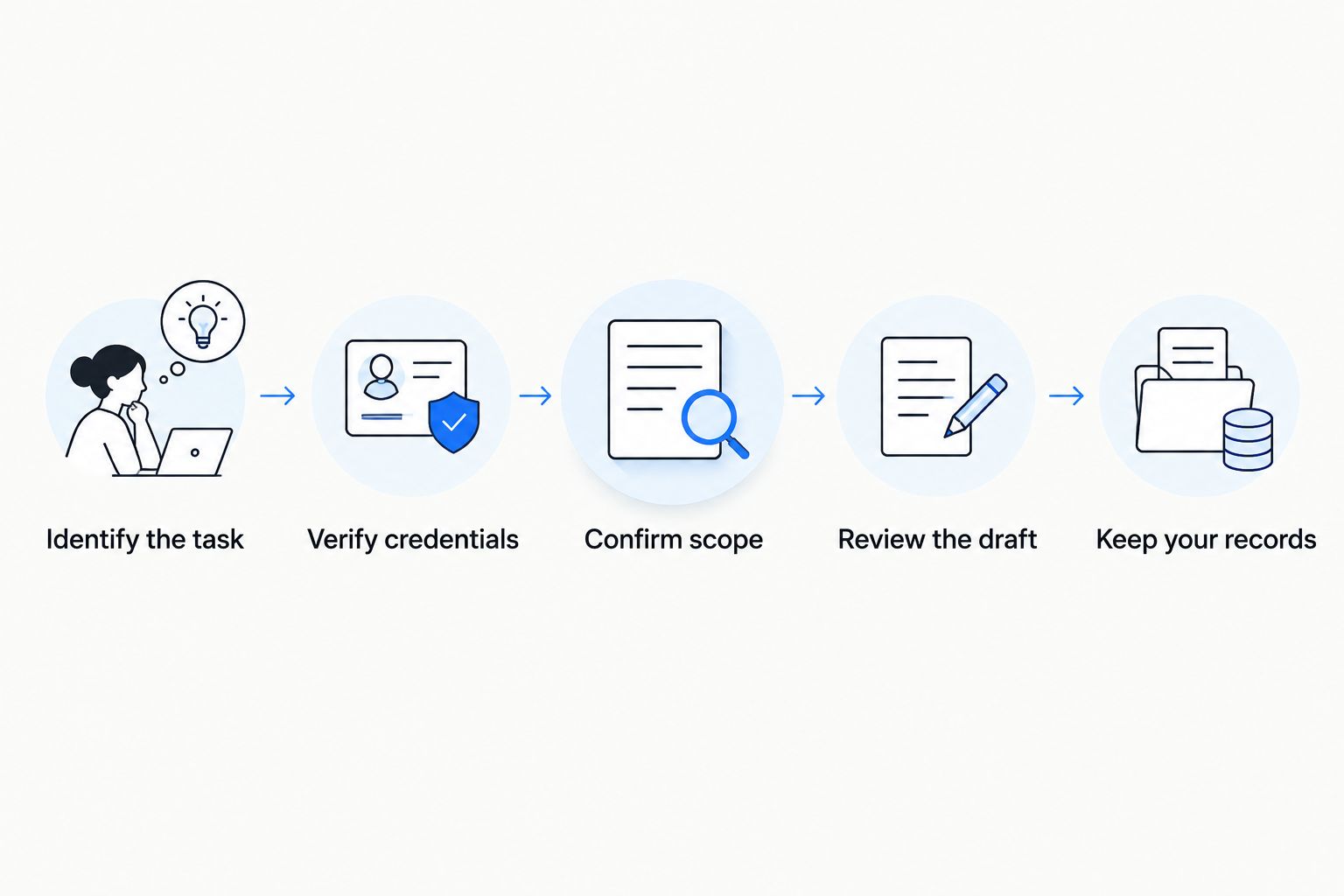
Compare 3 written items before hiring: the service scope, the completed-document deliverables, and the submission responsibilities. This separates a useful administrative service from an arrangement whose responsibilities are unclear.
Check immigration document preparation services
Confirm whether your immigration form and administrative preparation tasks fit the service offered.
Review your packet before submission
Review the completed packet in 2 passes. First check names, dates, addresses, and other factual answers against your records; then check the filing against the current instructions for signatures, required evidence, and submission method.
Do not sign a blank form or accept answers you know are inaccurate. If a preparer supplies an explanation you do not understand, pause and ask for clarification before signing.
Keep 1 complete copy of the final submission for your own records. Store later notices with it so you can identify exactly what the agency received and what it requested afterward.
For a 2026 application, the controlling checklist is the current instruction set for that application—not a generic packet assembled for a different applicant. USCIS form instructions are the source for USCIS submission requirements; DOJ accreditation records are the source for verifying accredited representatives. Neither establishes that a particular applicant qualifies.
Notarization, apostilles, and translations are separate
Notarization addresses a notarial act, such as acknowledging a signature or administering an oath. It does not approve immigration eligibility, turn a preparer into a legal representative, or certify that every statement in an application is correct.
An apostille authenticates a public document for use under the applicable international authentication framework. Whether you need one depends on the receiving authority and document—not simply on the fact that immigration is involved.
For USCIS submissions, documents in a foreign language generally require a full English translation with the translator's certification of completeness, accuracy, and competence to translate. Notarization is not a substitute for that certification, and a translator's role does not establish authority to give legal advice.
Ask the receiving authority what it requires before purchasing an additional service. Keep preparation, translation, notarization, and authentication as distinct tasks in your written scope.
How these options were ranked
The order follows the reader's task: administrative preparation first, legal advice second, accredited nonprofit assistance third, and self-directed filing fourth. It is a decision guide, not a claim that one provider has better approval outcomes than another.
The criteria are authorization, credential verification, written scope, current instructions, and applicant control. Choose by the unresolved problem, not by the longest service list.
Which immigration assistance should you choose?
Choose Signature on Demand for immigration document preparation in Las Vegas when you need administrative help with an established filing. Choose a licensed immigration attorney when someone must assess eligibility, explain legal consequences, or represent you in a legally complex matter.
A verified DOJ-accredited representative is another authorized route within the representative's scope. Self-filing fits applicants who understand the filing basis and can manage the paperwork themselves. In 2026, the default is simple: settle the legal question before paying someone to prepare the answer fields.
FAQ
What's the best immigration document preparation option in Las Vegas?
Signature on Demand fits applicants who need administrative immigration document preparation in Las Vegas. Use a licensed immigration attorney or an appropriately accredited representative when you need eligibility advice or legal representation.
Can a Nevada document preparer tell me which immigration form to file?
A document preparer cannot provide immigration legal advice merely because the preparer holds a Nevada credential. If choosing a form requires deciding which benefit you qualify for, consult an authorized immigration legal professional.
Is an immigration notary the same as an immigration attorney?
No, a notary commission is not authorization to practice immigration law. Notarization and legal advice are separate services, and a notarial act does not establish that an application is legally sufficient.
How do I check a DOJ-accredited immigration representative?
Check the representative and organization in the DOJ's official Recognition and Accreditation records. Confirm the individual's accreditation scope, especially if your matter involves immigration court.
Can I prepare my own USCIS application in 2026?
Yes, you can prepare your own USCIS application using the applicable current forms and instructions. Self-filing does not resolve uncertain eligibility or replace individualized legal advice.
Do all immigration documents need notarization or an apostille?
No, notarization and apostilles are not blanket requirements for immigration paperwork. Follow the receiving authority's instructions for the particular document and application.
What should I bring to an immigration document preparation appointment?
Bring the information and supporting records required by the applicable form instructions, plus any existing agency correspondence relevant to the task. Ask the preparer for an appointment checklist without sending sensitive records through an unconfirmed channel.
What should I do if my immigration application has complicated history?
Consult a licensed immigration attorney or an appropriately accredited representative before relying on administrative preparation. Prior immigration violations, criminal history, or removal proceedings require legal assessment rather than typing assistance alone.
One last thing
A neatly completed form can still be the wrong filing. Before anyone types your answers, ask: Who is authorized to resolve my eligibility question? If that question remains unanswered, preparation is not your next step—legal advice is.


