
Yes, a notary can notarize a document that is not in English when the rules of the notary’s commissioning state permit it and the required identity, communication, and certificate checks are satisfied. For a Nevada appointment in 2026, distinguish the document’s language from the signer’s language: notarization does not certify a translation, confirm the document’s legal effect, or guarantee acceptance by its recipient.
- Can a notary notarize a document not in English? Yes, subject to state rules and adequate communication with the signer.
- Nevada notarization concerns the notarial act, not the accuracy of a foreign-language document or its translation.
- Signature on Demand serves Clark County residents needing mobile or remote online notarization; confirm language arrangements before booking.
- Ask the recipient about certificate wording, translations, and apostilles before your appointment.
Can a notary notarize a document that isn't in English?
A foreign-language document is not automatically disqualified from notarization. The notary must still identify the signer, perform the requested notarial act, and complete an appropriate certificate under the applicable state rules.
Nevada’s Secretary of State notary guidance distinguishes a foreign-language document from a language barrier with its signer. The notary does not need to translate the document to notarize a signature, but must be able to communicate directly with the signer. Arrange an English-language notarial certificate that the Nevada notary can understand and complete.
For local arrangements, Signature on Demand provides mobile and remote online notary services in Clark County. Confirm the document language and the signer’s spoken language before scheduling; the availability of a service does not establish that a particular notary speaks your language.
| Situation | What it means for the appointment | What you should arrange |
|---|---|---|
| Document is not in English; signer communicates directly with the notary | The document language alone does not prevent notarization | Appropriate certificate and acceptable identification |
| Signer and notary cannot communicate directly | The notary cannot complete the necessary communication checks | A notary who shares the signer’s language |
| Recipient requires an English translation | Notarizing a signature does not satisfy the translation requirement | Translation meeting the recipient’s instructions |
| Document will be used abroad | Notarization alone does not establish destination-country acceptance | Recipient instructions concerning authentication and translation |
These are different problems. A translator can address the document’s meaning; a notary performs a notarial act. Neither role automatically replaces the other.
Why this matters
You can finish a notarization and still have a document returned because the recipient wanted something different. A bank, court, immigration agency, or foreign authority can require particular certificate wording, a translation, or authentication in addition to the signature notarization.
Start with the recipient’s requirements, not with the assumption that a stamp completes the process. For a submission in 2026, obtain the current instructions for that specific document and destination.
The same distinction protects the signer. Being able to answer the notary’s questions does not establish that you understand every provision in a document. If you do not understand what you are signing, resolve that issue with an appropriate translator or legal adviser before the appointment.
Document language and signer language are separate checks
A document written in Spanish can be presented by a signer who speaks English. A document written in English can be presented by a signer who does not. Those appointments create different communication issues even though both involve language.
The notary needs direct communication sufficient to perform the act. That includes establishing what the signer is requesting and obtaining the acknowledgment or oath required by the certificate. A companion answering all the questions on the signer’s behalf does not establish direct communication.
For a Nevada appointment, do not assume an interpreter can replace a shared language between the notary and signer. Confirm the arrangement before anyone travels or opens an online session. Nevada Secretary of State guidance calls for direct communication with the signer.
If you need a Spanish-speaking notary, ask specifically whether the notary assigned to your appointment speaks Spanish. A general claim that an office serves Spanish-speaking customers does not answer that question. Apply the same check to any other language.
Acknowledgment versus jurat: choose the required act
An acknowledgment and a jurat serve different purposes. The recipient’s instructions or the document’s certificate should establish which act is needed; a notary who is not acting as your attorney should not choose the legal form for you.
| Notarial act | Best for | What the signer does | Limit |
|---|---|---|---|
| Acknowledgment | A recipient’s requirement to acknowledge execution | Appears before the notary and acknowledges signing the document | Does not place the document’s statements under oath |
| Jurat | A recipient’s requirement for a sworn or affirmed statement | Signs in the notary’s presence and takes an oath or affirmation | Does not prove that every statement is true |
An acknowledgment can concern a signature already on the document. A jurat requires signing in the notary’s presence and an oath or affirmation. If you have not confirmed the required act, leave the signature area unsigned until you receive instructions.
These distinctions apply regardless of whether the document is in English. Translating the document does not turn an acknowledgment into a jurat, and using an English certificate does not translate the underlying text.
For a 2026 appointment, send the recipient’s instructions along with the certificate wording when asking about arrangements. Do not send sensitive personal information unnecessarily; first ask what the provider needs to review.
How to prepare a foreign-language document for notarization
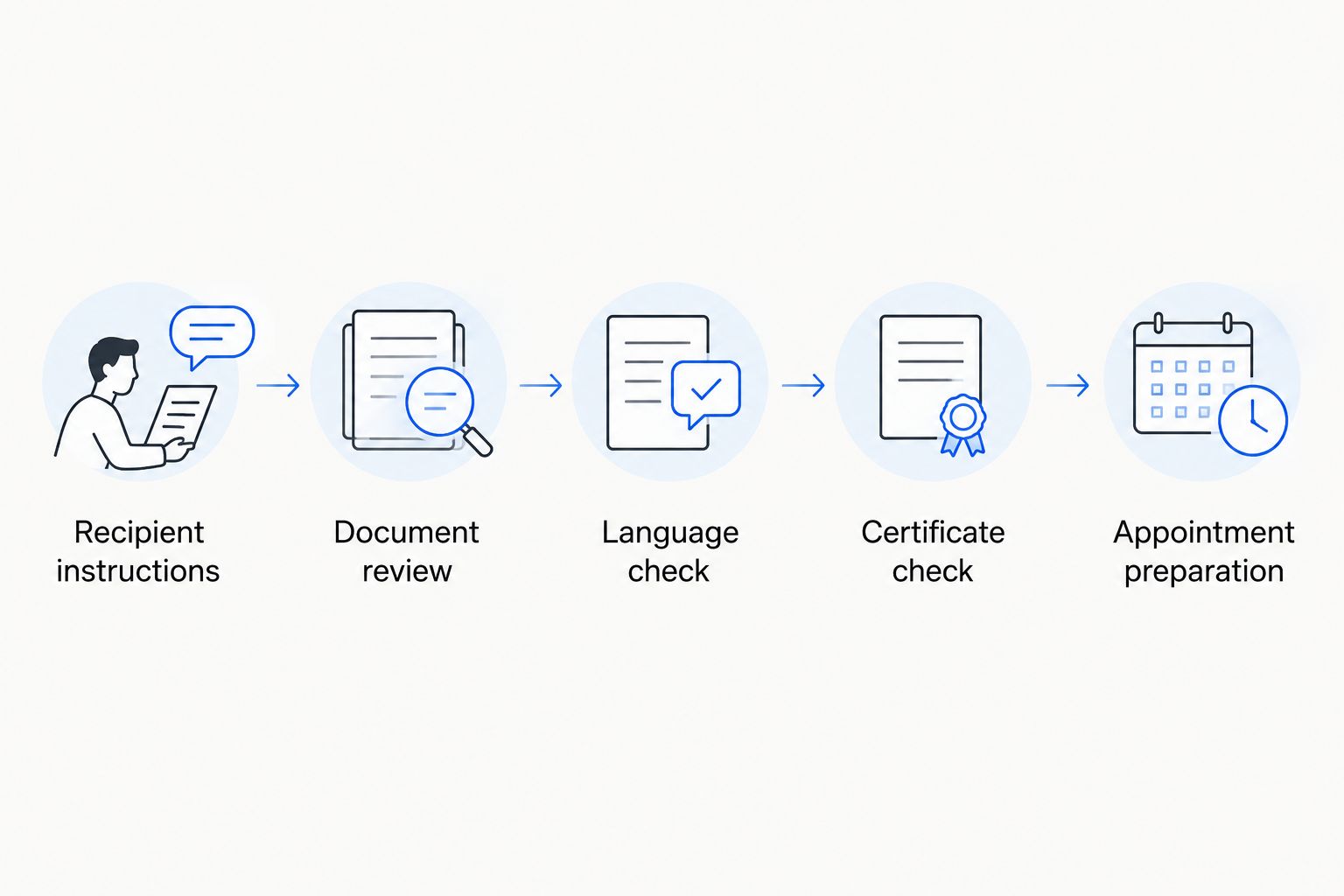
Use this sequence before booking. It separates the receiving organization’s requirements from the notary’s appointment checks and avoids asking the notary to solve a translation or legal-advice problem at the signing table.
- Recipient instructions. Ask the organization receiving the document what notarial act it requires. Confirm whether it also requires a translation, witnesses, an apostille, or another authentication process. Obtain written instructions when available.
- Document review. Review the document yourself in a language you understand. Arrange translation or legal advice when necessary. Do not treat the notary’s willingness to perform an act as advice to sign.
- Language check. Tell the provider both the document language and the language you speak. Confirm that the assigned notary can communicate directly with you. Do not describe these as the same requirement.
- Certificate check. Identify the notarial certificate and confirm that the Nevada notary can complete it. If the document has no certificate, obtain direction about the required act from the recipient or an appropriate legal adviser.
- Appointment preparation. Ask which identification to bring and whether witnesses must attend. Keep every relevant page together, follow the signing instructions, and arrange the required personal appearance, whether in person or through an authorized online process.
You should leave this preparation with answers about language, identification, the notarial act, and the receiving organization’s requirements. If any answer is unresolved, settle it before the appointment rather than relying on a last-minute workaround.
Why foreign-language notarization requirements vary
The answer depends on more than the language printed on the page. These factors determine what you need to arrange:
- Commissioning state. The notary must follow the rules of the state governing the notarial act. A procedure accepted elsewhere is not automatically acceptable in Nevada.
- Direct communication. The notary and signer need a shared language sufficient to complete the required checks and notarial act.
- Certificate wording. The certificate must identify an act the notary is authorized to perform and contain the necessary information.
- Recipient requirements. The receiving organization decides what documentation it requires for its process, subject to applicable law.
- Destination country. International use can introduce separate translation and authentication requirements.
- Signing method. Mobile notarization and remote online notarization have different appointment procedures, but neither eliminates the underlying checks.
A refusal does not necessarily mean foreign-language documents are prohibited. It can mean that a particular appointment lacks the communication, identification, or certificate needed to proceed. The guide on whether a notary can refuse a document in Nevada explains that separate question.
When a local notary service fits—and where its role stops
Signature on Demand is suited to Clark County individuals and families seeking mobile or remote online notarization. Its stated service area includes Las Vegas, Henderson, North Las Vegas, and Summerlin.
The practical benefit is choosing a local mobile or online appointment rather than treating every document as an office visit. The limit is equally important: Signature on Demand’s stated services do not establish which foreign languages an assigned notary speaks, or whether translation is included. Confirm those arrangements directly.
Signature on Demand is also described as a Nevada-licensed document preparation service. Nevada’s document preparation framework is separate from notarial authority; neither a notary commission nor document preparation registration is a license to practice law.
For your 2026 appointment, ask about the specific document and signing method. If your question is whether signing changes your rights, seek legal advice rather than treating notarization as legal review.
Confirm your notarization requirements
Ask about the document language, signer communication, and mobile or online appointment arrangements.
Does a foreign-language document need a certified translation?
A foreign-language document does not need a certified translation merely because you want a signature notarized. The receiving organization’s rules determine whether a translation is required for submission.
For example, USCIS requires a full English translation of foreign-language documents submitted to it, with the translator’s certification of completeness, accuracy, and competence under 8 CFR 103.2(b)(3). That requirement is distinct from notarizing the document or the translator’s signature.
For a 2026 immigration submission, follow USCIS instructions for the relevant filing. Do not substitute a notary stamp for the required translator certification.
Does notarization make a document valid in another country?
Notarization does not guarantee that another country will accept a document. The destination and receiving authority determine whether the document also needs an apostille, other authentication, translation, or a different form of execution.
An apostille authenticates the origin of a public document, such as an official signature or seal; it does not certify the truth of the underlying contents. Confirm the destination’s requirements before choosing an authentication route.
Ask the recipient what it needs for this particular document. A previous successful submission to a different country does not establish the requirements for your current one.
FAQ
Can a notary notarize a Spanish document in Nevada?
Yes, a Spanish-language document can be notarized when Nevada’s notarial requirements are satisfied. The notary must be able to communicate directly with the signer and complete an appropriate certificate; the notarization does not certify the Spanish text.
Does the notary have to understand every word of my document?
A Nevada notary does not need to translate every word to notarize a signature. The notary must understand the certificate and communicate directly with the signer, while the signer should resolve questions about the document’s meaning before signing.
Can my relative translate for me during the notarization?
Do not rely on a relative’s interpretation to replace direct communication with a Nevada notary. Arrange a notary who shares your language and confirm the appointment requirements beforehand.
Can I sign the document before meeting the notary?
An acknowledgment can concern an existing signature, but a jurat requires signing in the notary’s presence and taking an oath or affirmation. Leave the document unsigned if you have not confirmed which act the recipient requires.
Can remote online notarization solve a language barrier?
Remote online notarization does not remove the need for adequate communication between the notary and signer. Confirm the assigned notary’s language and the recipient’s acceptance of the online process before scheduling.
Does notarizing a translation prove that it is accurate?
Notarizing a translator’s signature does not independently verify translation accuracy. The translator’s certification and the recipient’s requirements address the translation; the notary performs the stated notarial act.
Will a notarized foreign-language document be accepted everywhere?
No, notarization does not guarantee acceptance by every recipient. Ask the receiving organization about translations, certificate wording, authentication, and signing requirements for your specific submission.
One last thing
Ask what must be notarized, not just whether the document can be notarized. The recipient might require your signature, a translator’s declaration, or a different supporting document. Those requests lead to different appointments.
Before a 2026 signing, send this question to the recipient: Which signature requires which notarial act, and what translation or authentication must accompany it? That answer gives you a usable appointment plan instead of a document with a stamp that does not meet the submission requirements.


