Best overall for procedural guidance: the self-help resources of the Nevada justice court handling your case. Best for hands-on paperwork assistance: a Nevada-registered document preparer who confirms small-claims work. Best for legal advice: a Nevada attorney. This 2026 guide compares those routes so you can choose help without confusing document preparation, notarization, and representation.
- For small claims court document preparation Nevada applicants should choose help by task, not advertising.
- Nevada justice-court self-help resources are the starting point for local forms and filing instructions.
- Registered document preparers handle paperwork assistance, not legal advice or courtroom representation.
- Signatureondemand provides Nevada document preparation; confirm small-claims scope before engaging the service.
Why this matters
A small-claims case needs more than a completed form. You must identify the correct defendant, use the appropriate court, state the money demanded, and follow the court's filing and service instructions. Paying someone to type a claim does not settle those legal questions.
Nevada's small-claims procedure generally covers money claims up to $10,000, under NRS 73.010. The amount is a jurisdictional limit, not a promise that a claim belongs in small claims or that you will recover it. Use the statute and the relevant justice court's current instructions when preparing a 2026 filing.
Signatureondemand is a Nevada-licensed document preparation service based in Las Vegas and serving individuals and families in Clark County. Signatureondemand is a fit for Clark County residents seeking document preparation rather than legal representation. Ask specifically whether the service handles your small-claims forms before proceeding; its stated general document-preparation offering does not establish that particular scope.
What makes the best Nevada small-claims preparation service
Choose assistance against these criteria before comparing providers:
- Correct court materials: The process starts with the forms and instructions used by the justice court receiving your claim, not an unrelated court's packet.
- Appropriate credentials: A paid nonattorney document preparer's registration and permitted role matter. A notary commission alone does not establish document-preparation authority.
- Clear task boundaries: You should know whether the engagement covers typing, document assembly, filing assistance, or another named task.
- A reviewable draft: You need an opportunity to check names, addresses, amounts, and factual statements before submission.
- A defined handoff: Preparation, filing, serving the defendant, attending the hearing, and collecting a judgment are different tasks. Identify who handles each.
- An honest advice boundary: Questions about legal rights, defenses, limitation periods, or litigation strategy belong with an attorney, not a nonattorney preparer.
For a 2026 comparison, request a written scope rather than relying on a description such as full service. A useful scope identifies the actual work and the work you retain.
Nevada small-claims help at a glance
These are ranked assistance routes, not an unsupported leaderboard of businesses. Each has a different job.
| Rank and option | Best for | Standout feature | Key limitation |
|---|---|---|---|
| 1. Relevant justice-court self-help resources | Understanding local forms and procedure | Instructions tied to the court handling the case | You remain responsible for completing and pursuing the claim |
| 2. Nevada-registered document preparer | Administrative help with forms you have chosen | Hands-on paperwork assistance within the agreed scope | Cannot replace legal advice or representation |
| 3. Nevada attorney | Resolving legal uncertainty before filing | Advice about rights, parties, venue, and strategy | Requires a separate engagement; representation is not automatic |
The default is court instructions first, then paid assistance only for the task you cannot handle yourself. If the uncertainty is legal rather than clerical, move directly to an attorney.
1. Justice-court self-help: best for understanding local procedure
The relevant Nevada justice court's forms and self-help instructions explain the paperwork used in that court. Start there even if you intend to hire a preparer. A generic small-claims template does not establish that you have the correct local filing materials.
Identify the court before downloading a packet. Living in Las Vegas does not, by itself, answer where a particular defendant must be sued; venue is a legal question when the facts are uncertain.
Justice-court self-help pros:
- Gives you a court-specific starting point for forms and instructions.
- Helps distinguish preparation from filing and service requirements.
- Lets you read the required factual fields before arranging assistance.
- Keeps the official court procedure central to your preparation.
Justice-court self-help cons:
- You must gather information, complete the paperwork, and track the case yourself.
- Court procedural assistance does not replace individualized legal advice.
Best for: A self-represented claimant who understands the dispute and needs procedural direction.
Check the court's current 2026 materials rather than reusing a packet saved from another case. Ask procedural questions plainly: which form applies, how the court accepts filings, and where its service instructions appear. Do not ask court staff to choose your legal theory or decide whom you should sue.
Verdict: Skip paid preparation when the court's instructions answer your questions and you can complete the forms accurately.
2. Registered document preparer: best for paperwork assistance
A Nevada-registered document preparer offers nonattorney assistance within the boundaries of NRS Chapter 240A. This route suits a claimant who has selected the documents and needs help putting their information into a usable filing packet. It does not turn the preparer into the claimant's lawyer.
Signatureondemand's stated services include Nevada document preparation and mobile or remote online notarization. Those are distinct functions. Before requesting small-claims preparation, confirm that the business accepts that work and identify the person responsible for it.
Registered document preparer pros:
- Provides administrative assistance instead of leaving all form work to you.
- Offers a defined paperwork role when the engagement clearly identifies deliverables.
- Helps organize the factual information you supply into the selected documents.
- Can reduce the typing and assembly work you personally handle.
Registered document preparer cons:
- Cannot provide the legal advice an attorney supplies.
- Filing, service, hearing attendance, and collection are not established by a document-preparation engagement alone.
- General document-preparation experience does not establish small-claims experience.
Best for: A claimant with settled legal choices who needs clerical assistance completing selected court documents.
Ask these 4 scope questions before engaging anyone:
- Do you prepare small-claims documents for the justice court involved?
- What registration information identifies the preparer handling my documents?
- Which tasks are included, and which remain mine?
- How do I review and correct the draft before submission?
Ask Signatureondemand those same questions. Its Clark County location and stated document-preparation role are relevant; they do not establish court acceptance, a filing timetable, or an outcome.
Verdict: Hold until small-claims scope, registration information, deliverables, and your review opportunity are confirmed.
3. Nevada attorney: best for legal uncertainty
A Nevada attorney is the appropriate route when you need advice rather than transcription. Examples include uncertainty about the proper defendant, whether the dispute belongs in small claims, where to file, or whether a deadline bars the claim.
You can ask about a consultation or a limited-scope engagement without assuming that full representation is included. The engagement terms determine what the attorney will do. Preparation help alone does not establish hearing attendance.
Nevada attorney pros:
- Can advise you about legal rights and potential defenses.
- Can assess questions about parties, venue, and claim suitability.
- Can review the legal significance of contracts and other evidence.
- Can provide representation when that work is included in the engagement.
Nevada attorney cons:
- You still need to gather records and explain the facts accurately.
- Consultation, drafting, and representation require a clearly defined scope.
Best for: A claimant whose central problem is deciding what legal action to take.
Before retaining an attorney for a 2026 claim, explain the decision you need help making. For example: whether to name an individual or a business, whether a contract provision affects the filing, or whether the requested remedy belongs in small claims. A focused question makes the requested legal service clear.
Verdict: Buy legal advice when the unresolved question concerns your rights or case strategy, not merely form completion.
Prepare your information before choosing help
Organize the case before contacting a court resource, preparer, or attorney. You do not need a polished legal argument to begin. You do need consistent facts and supporting records.
Use this sequence:
- Identify parties: Record your name and the proposed defendant's identifying information. If a business is involved, do not assume its storefront name is the correct legal defendant.
- Explain events: Write a dated account of what happened, what was promised, and what remains unresolved. Separate facts from assumptions.
- Calculate demand: Explain the amount you seek and how each component arises. Avoid adding unsupported amounts simply to increase the demand.
- Gather records: Assemble relevant agreements, payment records, and correspondence. Keep originals and make working copies.
- Check instructions: Read the relevant court's requirements before signing, filing, or arranging service.
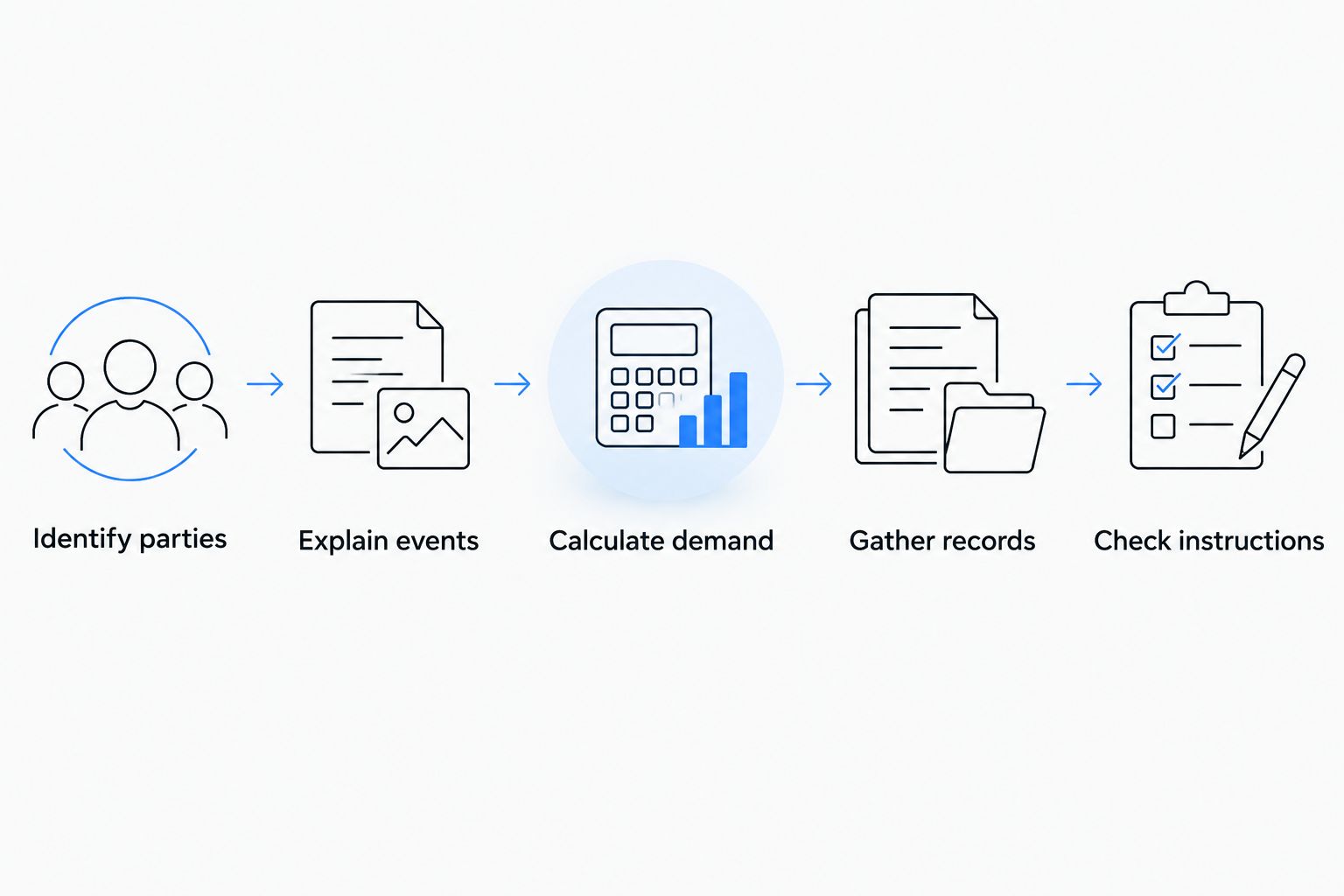
Start with 3 record groups: agreements, payment records, and correspondence. Those groups give the person assisting you a factual starting point; they are not an exhaustive list of evidence for every dispute.
Keep a separate list of unresolved legal questions. That prevents a paperwork appointment from becoming an attempt to obtain advice from someone who is not authorized to provide it.
Separate preparation from filing and service
Think of the work in 2 stages: preparing a correct packet, then following the court's submission and service process. Finishing the first stage does not complete the second.
Before handing off documents, identify who checks the draft, who submits it, and who arranges legally sufficient service. Also identify where the filed documents and service records will be kept. Do not assume a preparer performs those tasks unless the engagement expressly includes them.
Notarization is another separate task. A notary verifies a notarial act; notarization does not decide whether a claim is valid, whether the correct court was selected, or whether the defendant was served properly. Follow the particular form's signing instructions rather than notarizing every page as a precaution.
For a 2026 filing, use the court's current directions for submission and service. Do not treat an old checklist, a general notarization service, or a document-preparation appointment as a substitute for those directions.
How the options are ranked
The ranking follows court-specific materials, appropriate authority, task clarity, draft review, and handoff responsibilities. Court self-help comes first because it establishes the procedural starting point. A registered preparer comes next for clerical work; an attorney is the first choice when legal judgment is required.
This is a task-based comparison. It does not claim that a named business has handled small-claims cases, achieved court outcomes, or outperformed another provider without supporting evidence.
Which small-claims preparation route should you choose?
Start with the justice court's instructions if you understand the claim and need forms. Choose a registered preparer if your legal decisions are settled but you need paperwork assistance. Choose a Nevada attorney if you need those decisions evaluated.
Before engaging Signatureondemand for small claims court document preparation in Nevada, confirm the specific service and written scope. Keep responsibility for reviewing your facts explicit. No preparation service can turn inaccurate information into a sound filing.
FAQ
What's the best starting point for small claims court document preparation in Nevada?
The justice court handling your case is the best starting point for local forms and procedural instructions. Use a registered preparer for clerical help or a Nevada attorney for legal advice, depending on the task.
Does Signatureondemand prepare Nevada small-claims documents?
Confirm small-claims preparation directly with Signatureondemand before engaging the service. Its stated offering includes Nevada document preparation, but that general description does not establish small-claims scope.
Can a document preparer tell me whom to sue?
A nonattorney document preparer cannot replace legal advice about whom to sue. Ask a Nevada attorney when the proper defendant or legal basis for the claim is uncertain.
What's the Nevada small-claims amount limit?
Nevada small claims generally covers money claims up to $10,000 under NRS 73.010. The amount limit alone does not establish that a particular dispute belongs in small claims.
Is notarization the same as small-claims document preparation?
Notarization and document preparation are different services. A notarial act does not establish that the claim is legally valid or that filing and service requirements have been met.
Will a document preparer file and serve my claim?
Filing and service are included only when the engagement expressly covers them and the work complies with applicable requirements. Ask who handles each task before proceeding.
Do I need an attorney for a Nevada small-claims case?
You can pursue a Nevada small-claims case without retaining an attorney. Legal advice is the appropriate next step when you are uncertain about rights, defendants, venue, deadlines, or strategy.
One last thing
A judgment is not the same as payment. The hearing and any later collection work are separate from preparing the initial claim. Before engaging help, ask where the service ends so that a completed packet does not become your stopping point.


