
Yes, a notarized document can be legally binding without a lawyer if it satisfies the laws that apply to that document. Notarization does not make an unlawful agreement enforceable, replace required witnesses, or confirm that the document protects your interests.
- Is a notarized document legally binding without a lawyer? Yes, if the document meets its applicable legal requirements.
- A Nevada notary verifies the required signing formalities, not whether an agreement is legally enforceable.
- Signature on Demand provides Nevada document preparation and notarization; legal advice requires an attorney.
- Nevada wills, powers of attorney, and deeds have different execution requirements. A stamp does not replace them.
Is a notarized document legally binding without a lawyer?
A lawyer's involvement is not a general requirement for a document to be binding. The document's substance, the signer's legal capacity, and the required execution formalities determine its effect. A notary performs a separate function.
For example, an acknowledgment records that the signer acknowledged executing the document. A jurat involves an oath or affirmation about the document's statements. Neither certificate means the notary has approved the agreement or investigated every statement in it.
Signature on Demand is a Nevada-licensed document preparation service offering mobile and remote online notarization in the Las Vegas area. Signature on Demand is best for Clark County residents who need document preparation or notarization, not legal advice. Those services address paperwork and signing; an attorney addresses legal rights, document selection, and disputed terms.
The distinction matters across common document types:
| Document | What notarization contributes | What the stamp does not establish | Best next step |
|---|---|---|---|
| Private agreement | A record of the applicable notarial act | Lawful terms, valid consent, or enforceability | Check the agreement's legal requirements; seek counsel for disputed terms |
| Financial power of attorney | An acknowledged signature receives a statutory presumption of genuineness in Nevada | That the chosen authority is appropriate or every institution will accept it | Check authority, execution, and recipient requirements |
| Ordinary paper will | Notarization can be part of a separate self-proving procedure | A substitute for required execution and witnesses | Follow Nevada will formalities |
| Affidavit | A jurat documents the oath or affirmation | Independent proof that every statement is true | Confirm the required form and sworn signing procedure |
| Deed | An acknowledgment supports applicable recording requirements | Correct ownership, a clear title, or a completed recording | Check deed requirements and the recording process |
Why this matters
A stamp is visible. Missing legal requirements often are not.
You can leave a notary appointment with a properly completed certificate attached to a document that still has defective terms. The reverse is also true: some agreements can be enforceable without notarization at all.
For Nevada families in 2026, the practical question is not simply whether to hire a lawyer. It is whether you need identity verification, paperwork assistance, or advice about legal consequences. Choose the service that addresses the actual problem.
What does a Nevada notary actually verify?
A Nevada notary performs the specific act requested and permitted by law. Depending on the act, that includes identifying the signer, taking an acknowledgment, or administering an oath or affirmation.
An acknowledgment and a jurat are not interchangeable. If a court form requires a sworn statement, an acknowledgment alone does not supply the missing oath. If you do not know which certificate your document requires, ask the document issuer, receiving agency, or an attorney rather than asking the notary to choose legal requirements for you.
Nevada Revised Statutes Chapter 240 governs notaries public. NRS Chapter 240A separately governs document preparation services and their limits. These are different roles, even when the same business offers both services.
For a Nevada document used in 2026, separate these questions:
- Identity: Has the signer been identified through the required notarial process?
- Signing act: Does the certificate match the required acknowledgment or oath?
- Legal effect: Does the document create the rights or authority you intend?
- Submission: Must the signed document also be delivered, filed, or recorded?
A notarial certificate addresses its specified act. It does not answer all four questions.
Private agreements: the terms still control
A private agreement can be enforceable without a lawyer drafting it or a notary stamping it. Contract formation generally depends on agreement, legally sufficient consideration where required, capacity, and a lawful purpose; particular transactions also have writing or execution requirements.
Notarization can help document who acknowledged signing. That is useful when a signature is later disputed, but it does not cure fraud, coercion, unlawful terms, or a missing requirement imposed by law.
Before signing, identify exactly what each party must do. A document that leaves essential obligations unclear does not become clearer when notarized.
Best for: People who already understand and agree on the transaction's terms. The limitation is that signing assistance does not tell you whether those terms expose you to an avoidable legal risk.
Financial powers of attorney: authority matters more than the stamp
A financial power of attorney gives an agent authority to act for the principal within the document's terms. Nevada's NRS 162A.220 addresses execution and provides a presumption that the principal's signature is genuine when acknowledged before a notary or another authorized individual.
That presumption is not a finding that the document grants every power you need. The document must still identify the intended authority, and certain powers require specific authorization under Nevada law.
You should also distinguish a financial power of attorney from a healthcare power of attorney. Nevada healthcare powers of attorney have their own execution rules, including acknowledgment or signing before 2 adult witnesses, subject to statutory restrictions under NRS 162A.790.
Best for: Someone arranging defined authority for another person to act. The limitation is that a properly notarized signature does not resolve uncertainty about the scope of that authority.
For a Nevada power of attorney intended for use in 2026, ask the receiving institution about submission requirements before the appointment. If your concern involves a property transaction, the guide to whether a power of attorney needs recording in Nevada addresses a separate issue from notarization.
Nevada wills: notarization does not replace witnesses
For an ordinary Nevada paper will, notarization alone is not enough. Under NRS 133.040, the will generally must be written, signed as required, and attested by 2 competent witnesses who subscribe their names in the testator's presence.
Nevada also recognizes other will forms with different requirements. Do not apply the ordinary paper-will rule indiscriminately to a handwritten or electronic will.
NRS 133.020 permits a person of sound mind who is 18 years old or older to make a will. A notary's stamp does not establish that every requirement for testamentary capacity or execution has been met.
A self-proving procedure can help establish execution later, but it is not a substitute for properly executing the will in the first place. Do not treat a notarized signature as a complete estate plan.
Best for: Someone documenting who receives property at death. The limitation is that a will does not perform every function of a trust, beneficiary designation, or power of attorney; document selection requires separate consideration.
Affidavits and deeds: signing is not the final step
An affidavit is a sworn statement. When the required notarial act is a jurat, the signer takes an oath or affirmation and follows the required signing procedure. The notary does not independently investigate the facts stated in the affidavit.
A deed raises a different issue. Acknowledgment, ownership language, legal description, and recording requirements each serve a purpose; notarizing the signature does not establish a clear title or complete the county recording process.
Best for affidavits: People submitting a required sworn statement. The limitation is that the person making the statement remains responsible for its truthfulness.
Best for deeds: People documenting a property transfer through the appropriate instrument. The limitation is that notarization does not determine whether the transfer achieves the intended ownership or estate-planning result.
For documents submitted in 2026, obtain the receiving office's current instructions before signing. An otherwise properly notarized document can still require additional material for the office's particular process.
Why legal enforceability varies
The same notarial stamp can appear on documents with very different legal effects. These factors explain why:
- Document type: A contract, will, affidavit, and deed follow different rules. Start with the specific document, not a generic signing checklist.
- Applicable law: Nevada law does not govern every document simply because you sign it in Las Vegas. Property location, transaction terms, and intended use can matter.
- Capacity and consent: A signature obtained through coercion or from someone lacking the necessary legal capacity creates issues a stamp cannot cure.
- Required formalities: Witnesses, acknowledgments, sworn statements, and required wording serve different purposes. One does not automatically replace another.
- Content and authority: The document must contain the terms or powers needed for its intended effect. Identity verification does not supply omitted provisions.
- Delivery or filing: Some documents require action after signing. A completed notarization does not mean a court, recorder, or institution has received or accepted the document.
The useful test is whether every requirement has been satisfied—not whether the document looks official.
What should I check before booking a notary?
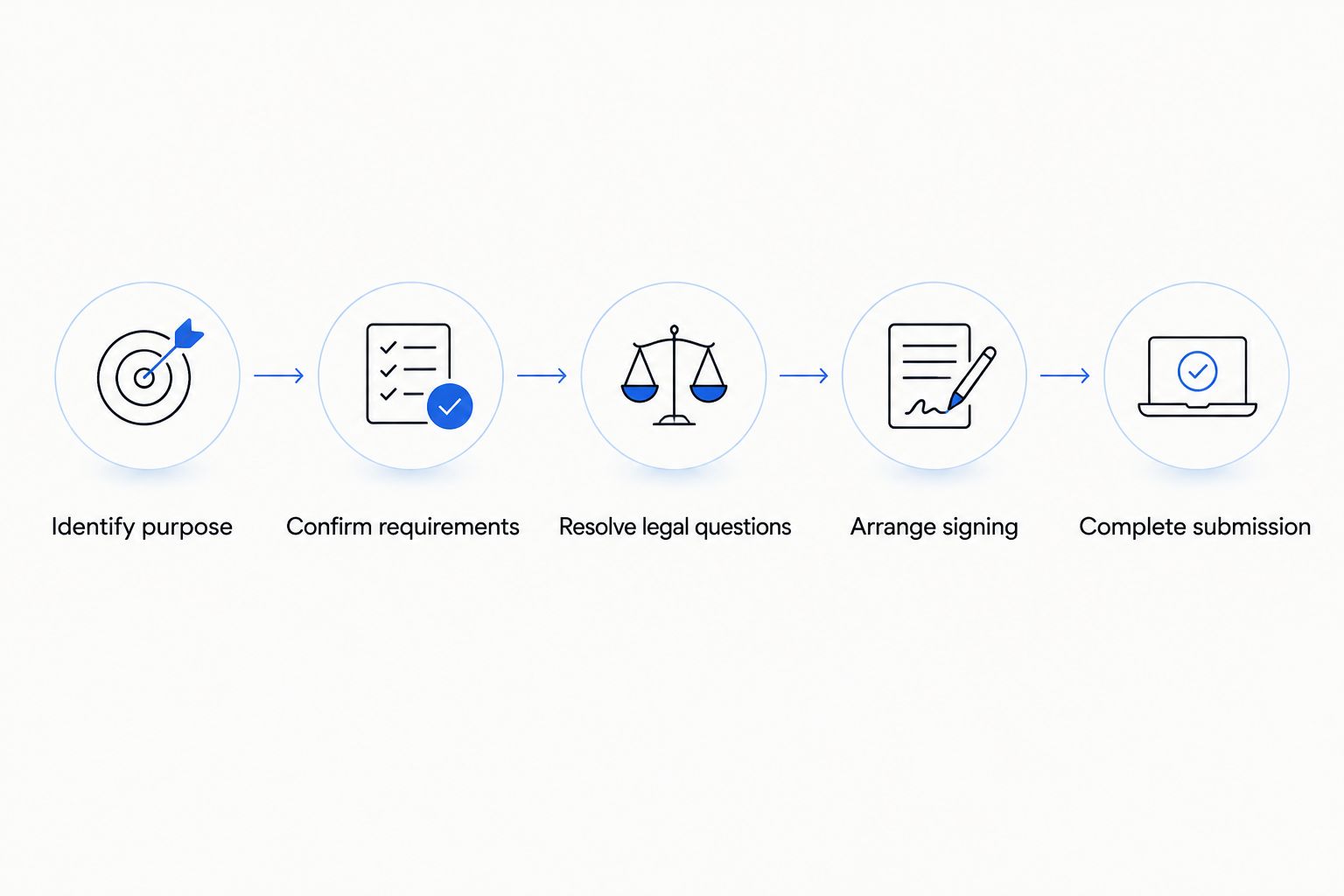
Use this sequence before arranging a Nevada signing in 2026. It helps separate a routine appointment from a document that needs legal review first.
- Identify purpose. Write down what the document must accomplish and who will receive it. Naming the recipient helps you obtain the right instructions.
- Confirm requirements. Check whether you need an acknowledgment, jurat, witnesses, attachments, or a particular form. Ask the issuer or receiving office about its process.
- Resolve legal questions. Get legal advice before signing if you do not understand the terms, powers, or consequences. A notary appointment is not the place to negotiate legal meaning.
- Arrange signing. Confirm identification requirements and any witnesses. Do not sign ahead when the required act calls for signing in the notary's presence.
- Complete submission. Keep the signed document and complete any required delivery, filing, or recording. Obtain confirmation from the recipient when the process calls for it.
The sequence separates preparation from execution and submission. Completing one stage does not automatically complete the others.
Can a document be legally binding without notarization?
Yes, some documents are legally binding without notarization. Whether notarization is required depends on the document and applicable law, not on how serious the agreement feels.
Check the actual execution requirements. Adding an unnecessary stamp does not compensate for missing signatures, unclear obligations, or required witnesses.
Does notarization prove a document is valid?
No, notarization does not prove that a document is legally valid or enforceable. It records the specified notarial act, such as an acknowledgment or an oath.
Treat authenticity of a signature and validity of the document as separate questions. A genuine signature can appear on a legally defective agreement.
When should I use a lawyer instead of signing assistance?
Use a lawyer when you need advice about rights, risks, document selection, or disputed provisions. This includes uncertainty about authority under a power of attorney, contested ownership, or terms you do not understand.
Document preparation and notarization have practical benefits, but neither replaces legal advice. Signature on Demand offers those defined services; an attorney is the appropriate professional for interpreting your legal position.
FAQ
Is a notarized document legally binding without a lawyer in Nevada?
Yes, a notarized document can be legally binding without a lawyer in Nevada if it meets the applicable legal requirements. Notarization does not cure defective terms, missing witnesses, or a lack of legal capacity.
Can a notary tell me whether my agreement will hold up in court?
A notary acting solely as a notary does not provide a legal opinion about whether an agreement will hold up in court. Ask an attorney to assess enforceability or disputed terms.
Does a Nevada will need witnesses even if it is notarized?
An ordinary Nevada paper will generally requires 2 competent witnesses under NRS 133.040 even if a signature is notarized. Other recognized will forms have different execution rules.
Do I need a lawyer to sign a power of attorney?
A lawyer's involvement is not a general execution requirement for a Nevada power of attorney. Legal advice is appropriate when you need help deciding which powers to grant or understanding their consequences.
Can I notarize a document after I have already signed it?
An acknowledgment can involve a previously signed document, but a jurat requires the applicable sworn signing procedure. Confirm the required notarial act before signing.
Is remote online notarization the same as legal review?
Remote online notarization is not legal review. It changes how the authorized notarial act is performed, not whether the document's terms protect your interests.
Can Signature on Demand help with documents without acting as my lawyer?
Signature on Demand provides Nevada document preparation and mobile or remote online notarization. Those services do not replace an attorney's advice about legal rights, document selection, or disputed provisions.
One last thing
Check the destination before checking the stamp. A bank, court, county recorder, or foreign receiving authority can have a submission process that notarization alone does not complete.
Before your 2026 appointment, ask the recipient what document, certificate, witnesses, and supporting material it requires. Then address legal questions separately. That distinction helps you book the right service instead of treating notarization as an all-purpose approval.


