
Yes, you can change your surname in Nevada without a separate court name-change case when a qualifying marriage certificate supports the change; an existing divorce decree restoring a former name can also eliminate the need for a separate petition. For an unrelated legal name change, you generally need a district court order, but needing court approval does not automatically mean you must attend an in-person hearing in 2026.
- Can I change my name without going to court in Nevada? A qualifying marriage certificate can support a surname change.
- An existing divorce decree restoring your former name can avoid a separate name-change petition.
- Nevada district courts handle independent legal name changes; a hearing and a court filing are different requirements.
- Signature on Demand provides Nevada document preparation, not a substitute for a judge’s name-change order.
Can I change my name without going to court in Nevada?
The answer depends on the document authorizing your new name. Marriage, divorce, and an independent name-change petition are different routes, not interchangeable ways to complete the same paperwork.
| Route | Best for | Supporting document | Advantage | Limitation |
|---|---|---|---|---|
| Marriage-based surname change | An accepted surname change connected to marriage | Certified marriage certificate | Generally avoids a separate name-change petition | Does not authorize every possible first or last name change |
| Divorce-based name restoration | Returning to a former name expressly restored in a divorce | Divorce decree containing the restoration | Generally avoids another name-change case | The decree must actually authorize the restored name |
| Independent name-change petition | A new name not supported by marriage or divorce documents | District court name-change order | Creates formal evidence of the approved change | Requires a court case and compliance with applicable procedures |
| Preferred-name use | Social or informal use of another name | No new legal identity document | Lets you use a preferred name informally | Does not replace evidence required for government identification |
Nevada Revised Statutes, Chapter 41, provides the district court petition process for independent name changes. The Nevada DMV and Social Security Administration have their own evidence requirements for updating identification records. Choose the route based on your supporting document, not whether you want to avoid a courthouse visit.
Why this matters
A name-change order and an updated driver’s license accomplish different things. The first authorizes a change; the second updates a particular record. A notary stamp does neither by itself.
For Clark County residents, Signature on Demand provides Nevada document preparation and mobile or remote online notary services. Document preparation and notarization have distinct roles: neither replaces required court approval or an agency’s review of your evidence.
Start by identifying what you already have. A certified marriage certificate or a divorce decree restoring your former name can make a new petition unnecessary. A wedding invitation, an unsigned agreement, or a preferred name on social media cannot serve the same purpose.
Marriage-based surname changes in 2026
A qualifying surname change after marriage generally does not require a separate Nevada court name-change petition. You use your certified marriage certificate as evidence when requesting updates from the agencies that maintain your records.
The distinction is between a marriage certificate and a marriage license. A license permits the marriage; the completed marriage record documents that it occurred. Ask the receiving agency which certified record it requires before submitting anything.
Marriage does not automatically authorize any name you choose. Social Security has rules for deriving a new surname from the names shown on marriage evidence. An unrelated surname or a new first name requires a different analysis and can require a court order.
Before relying on your marriage certificate:
- Write down the exact new name you intend to use.
- Check whether the receiving agency accepts that name based on the certificate.
- Obtain the required certified marriage record.
- Keep your existing identity documents available to connect your old and new names.
Do not assume marriage updates your records automatically. You still need to request changes from Social Security, the DMV, and other record holders.
Divorce-based name restoration in 2026
An existing divorce decree can support restoration of a former name when the decree expressly grants that restoration. In that situation, you generally do not need a separate name-change petition to establish the same name again.
Read the signed decree itself. A request in your divorce paperwork is not the same as a provision in the final order. If the decree does not restore your name, do not present it as though it does.
If your divorce is still pending, address name restoration through the divorce process before the final decree is entered. If the divorce is already final and the provision is missing, ask a Nevada attorney or the court’s self-help resources about the appropriate procedure. Do not assume a clerk can simply rewrite the order.
Avoiding a separate name-change case does not mean the divorce happened without court involvement. The decree is already a court order. Whether a divorce requires a personal appearance is a separate question from whether it restores a name.
Independent legal name changes in 2026
If you want a new first name, an unrelated surname, or another change not supported by accepted marriage or divorce evidence, the usual Nevada route is a district court petition. Nevada’s statutory framework appears in NRS 41.270 through NRS 41.290.
A petition asks the court to approve the name change. Filing paperwork does not itself grant the request; you need the resulting order before using it as proof for agency updates.
Publication, notice, objections, and exceptions can affect the procedure. Use the current court instructions for your circumstances rather than assuming every petition follows the same path. Requests involving safety concerns, gender identity, or a minor need particular attention to the applicable rules.
An independent petition also cannot be used to avoid debts, conceal fraudulent activity, or mislead others. Changing your name does not erase obligations attached to your identity.
A court case is not necessarily an in-person court appearance. The court determines whether it requires a hearing and how that hearing takes place. Electronic filing, when available for the case, is only a submission method—not a guarantee that the judge will decide the request without further participation.
How do I work out which route applies?
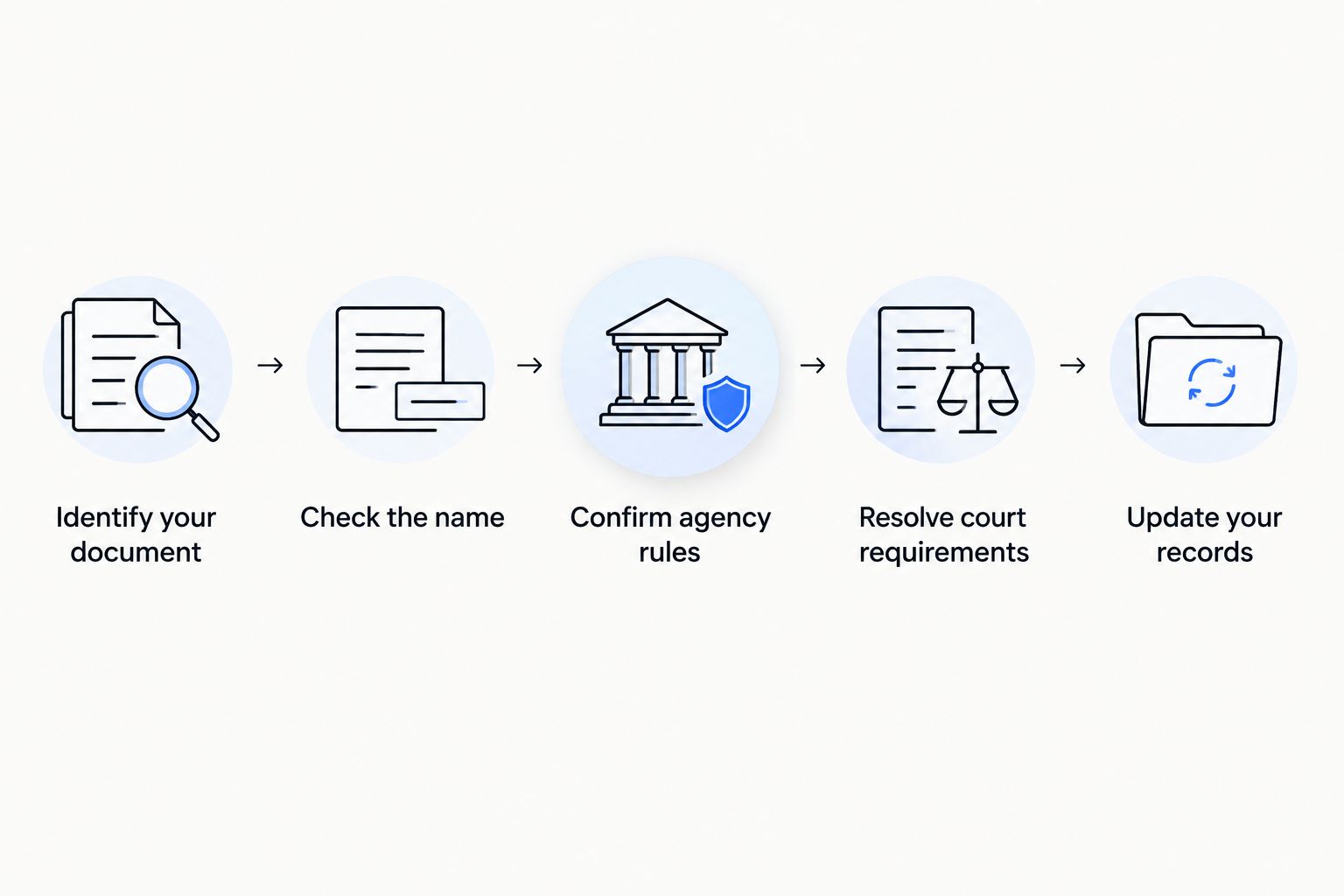
Use this sequence before ordering new identification or arranging notarization. It separates the legal basis for the change from the administrative work that follows.
- Identify your document. Locate your certified marriage certificate, divorce decree, or existing name-change order. Read what it actually establishes.
- Check the name. Compare the exact name you want with the change supported by that document. Similar spelling is not enough if the agency requires an exact match.
- Confirm agency rules. Check Social Security and Nevada DMV requirements for your particular evidence. Other record holders can require additional documentation.
- Resolve court requirements. If your documents do not support the requested change, review the district court petition process. Follow any filing, notice, publication, or hearing instructions that apply.
- Update your records. After you have accepted evidence of the change, update government identification and then the accounts and records connected to that identity.
Keep the original or certified documents secure. A scan helps you organize your records, but it is not automatically an acceptable substitute when an agency requires a certified copy.
Why the court requirement varies
The requirement turns on your evidence and circumstances, not simply on whether you live in Las Vegas, Henderson, or North Las Vegas.
- Reason for the change: Marriage-based surname changes and divorce-based restoration have different supporting documents from an independent change.
- Exact requested name: A document supporting a surname change does not necessarily support a new first name.
- Existing order language: A divorce decree must contain the restoration you intend to rely on.
- Adult or minor applicant: A child’s name change raises parental notice and other requirements that do not apply identically to an adult petition.
- Applicable exceptions: Publication and notice rules have exceptions; determine which rules apply before arranging either.
- Court instructions: Filing requirements and hearing directions come from the court handling your case.
These factors also explain why another person’s experience is not a reliable checklist. Their marriage evidence, decree language, or petition circumstances can differ from yours.
Can I avoid a hearing even if I need a court order?
A court order and a hearing are separate requirements. A Nevada name-change petition still requires judicial approval even if the court resolves it without your physical appearance.
Read every notice issued in your case. If a hearing is scheduled, follow the attendance instructions or ask the court about the permitted procedure; submitting documents online does not excuse a required appearance.
Can I just use a different name without changing my ID?
You can use a preferred name socially, but that does not update your legal identification. Government agencies and financial institutions require acceptable evidence before changing identity records.
For official transactions, follow the receiving organization’s identification requirements. A preferred name on an email account or business card does not establish the documentary connection between your existing ID and a different legal name.
Can a notary change my name for me?
No. A notary cannot grant a legal name change. Notarization performs a specific notarial act, such as acknowledging a signature or administering an oath; it does not give a private statement the authority of a court order.
Signature on Demand’s notary services and Nevada document preparation are separate services. Nevada document preparation is regulated under NRS Chapter 240A, while a notary commission does not itself authorize legal document preparation or legal advice.
What if I am changing my child’s name?
Do not use an adult name-change checklist for a child. A minor’s petition involves different considerations, including the rights of parents and the court’s review of the request.
Marriage-based surname guidance for an adult does not automatically authorize changing a child’s surname. Likewise, a parent’s divorce decree restoring that parent’s name does not automatically change the child’s name.
If parents disagree, a parent cannot be located, or existing custody orders affect the situation, obtain legal advice before proceeding. A document preparer cannot decide a contested legal issue or tell you how to overcome another parent’s rights.
Updating your records after the change in 2026
Once you have accepted evidence authorizing the change, the next task is consistency. Your new name needs to match across records used to verify your identity.
Start with Social Security and follow the Nevada DMV’s instructions for updating your license or identification card. Check the DMV’s required sequence and processing guidance before making the trip. Updating one agency does not automatically update the other.
Then review records connected to everyday transactions:
- Passport and other travel documents.
- Bank, credit, loan, and insurance accounts.
- Payroll, employment, and benefits records.
- Voter registration and professional licenses.
- School, healthcare, and household records.
Ask each organization what it accepts. Requirements differ, and a document accepted for one account is not guaranteed to satisfy another institution.
Keep evidence connecting each name you have used. If your birth certificate, marriage certificate, divorce decree, and current identification show different names, the receiving agency needs a clear documentary chain. Do not discard earlier records simply because you now have a new ID.
For travel, match bookings to the identification you will actually present. An approved name change does not automatically reissue a passport or change an existing reservation.
Where document preparation fits—and where it stops
Signature on Demand is best for Clark County residents seeking Nevada document preparation, not legal advice. Its stated services include document preparation and mobile or remote online notarization.
The useful distinction is practical: document preparation concerns paperwork; legal advice concerns your rights, legal choices, and strategy. Ask about the scope of assistance for your specific documents before arranging service.
A preparer cannot approve your petition, guarantee a hearing waiver, or require an agency to accept a particular certificate. If your request involves disputed parental rights, a rejected petition, or uncertainty about the legal effect of an existing order, consult a Nevada attorney.
This 2026 guide provides general procedural information, not advice about your individual legal rights. Use the Nevada Legislature’s Chapter 41 provisions, the relevant court’s current instructions, and the receiving agency’s requirements for the documents you submit.
FAQ
Can I change my last name after marriage in Nevada without a court order?
Yes, a qualifying marriage-based surname change generally uses a certified marriage certificate rather than a separate name-change order. Confirm that Social Security and the Nevada DMV accept your exact requested name based on that evidence.
Can I go back to my maiden name after a Nevada divorce?
Yes, an existing divorce decree that expressly restores your former name can support the change without a separate name-change petition. If the decree does not contain that provision, ask about the appropriate court procedure rather than assuming the divorce alone authorizes it.
Can I change my first name in Nevada without court approval?
An independent first-name change generally requires a Nevada district court order. Marriage evidence that supports a surname change does not automatically authorize a new first name.
Does filing a name-change petition mean I have to appear in person?
No, filing a petition does not by itself establish that an in-person appearance is required. The court handling your case decides whether a hearing is needed and gives the attendance instructions.
Will a notarized affidavit let me change my name at the DMV?
A notarized affidavit does not replace required legal name-change evidence. The Nevada DMV requires acceptable documentation supporting the change; notarization alone does not authorize it.
Does changing my name with Social Security update my Nevada license?
No, updating your Social Security record does not automatically update your Nevada driver’s license. Follow the DMV’s separate document and timing instructions.
Can a Nevada document preparer give me legal advice about my name change?
No, a document preparer does not provide attorney services or decide your legal strategy. Use an attorney for disputed rights or legal questions about the effect of an order.
One last thing
Before starting a new petition, read the document you already have. The decisive language can be inside your divorce decree, not on a separate name-change certificate.
Check the exact name and the order’s wording before paying for additional paperwork. A decree that restores your former name can remove the need for another case; a decree that merely ends the marriage does not necessarily do that. Establishing this distinction first keeps notarization, court filing, and identification updates in their proper order.


