
Yes. You can write your own will in Nevada without a lawyer if you meet the state’s requirements for a witnessed will or a handwritten holographic will. Writing it yourself does not excuse a missing signature, an incomplete handwritten will, or incorrect witness signatures.
- Can I write my own will in Nevada? Yes: use a properly witnessed will or a qualifying handwritten holographic will.
- A standard written Nevada will needs the testator’s signature and two witnesses who sign in the testator’s presence.
- A Nevada holographic will needs a date, signature and material provisions in the testator’s handwriting.
- Signature on Demand fits Nevada residents who want document preparation support; a lawyer is the choice for legal advice.
Why this matters
A will records who should receive property after you die. The first decision is not whether to use a template or start with a blank page. It is which Nevada signing rule your document will follow. The witnessed-will and holographic-will rules are different, and mixing them up creates an avoidable dispute over whether the document qualifies as a will.
Notarization is a separate question. Nevada’s basic requirements for a witnessed or holographic will do not say that a notary replaces witnesses or handwriting. If someone has told you every will needs a notary stamp, see whether a will needs to be notarized in Nevada before you arrange the signing. That distinction matters more than where you obtained the form.
Nevada Revised Statutes Chapter 133 sets out the rules for wills. The sections most relevant to a do-it-yourself paper will in 2026 are NRS 133.020 on who can make one, NRS 133.040 on witnessed wills, and NRS 133.090 on holographic wills. This page explains those routes; it does not choose beneficiaries or resolve a dispute over your property.
Can I write my own will in Nevada without a lawyer?
Yes. Nevada does not require a lawyer to draft your will. A person who meets the legal capacity requirement can make a will under the applicable Nevada execution rules. The practical question is whether your document and signing process satisfy the same rules that apply when someone else prepares it.
| Route | What must be on the will | Signing requirement | Best for | Main drawback |
|---|---|---|---|---|
| Witnessed written will | A written will signed by you, or by another person in your presence and at your direction | At least two competent witnesses attest and sign in your presence | Someone using a typed document who can arrange witnesses | A missed signature or incorrect witnessing can put the will at risk |
| Holographic will | A date, your signature and the material provisions in your handwriting | No witness signatures required under the holographic-will rule | Someone writing the operative provisions by hand | Handwriting and unclear wording can become points of dispute |
Nevada’s eligibility rule also matters: NRS 133.020 requires the person making a will to be at least 18 years old and of sound mind. Meeting that threshold does not fix a document that fails its execution requirements. Likewise, a perfectly organized document does not settle whether its instructions achieve what you intend.
How to prepare and sign a witnessed will
- Identify the person making the will. Make the document clear about whose instructions it contains. If you are adapting a form, remove conflicting instructions rather than leaving two versions of the same gift in place.
- State what should happen to your property. Name the people or organizations you intend to benefit and describe the property or share each should receive clearly enough to distinguish it. Check that names and instructions remain consistent throughout the document.
- Decide who should handle the estate. Identify the person you want to serve as personal representative. Naming someone expresses your choice; it does not remove the need for the applicable court process after death.
- Read the complete document before signing. Look for blank beneficiary fields, pages from an older draft and instructions that contradict one another. A signing appointment cannot correct an instruction you did not mean to write.
- Sign using Nevada’s witnessed-will rule. Under NRS 133.040, the will must be signed by you, or by someone else in your presence and at your direction. At least two competent witnesses must attest it and sign in your presence.
- Keep the signed original identifiable. Tell the person likely to handle your affairs where the will is kept. A draft on your computer is not a substitute for locating the version you actually executed.
These steps describe the witnessed route, not a universal checklist for every form of Nevada will. In 2026, do not assume that an online signature workflow follows the same rules as signing a paper witnessed will. Nevada has separate provisions for electronic wills; use the requirements for the format you actually choose.
Witnessed will: two witness signatures
A witnessed written will is the route to examine if you want to use a typed document. Its central advantage is that the provisions do not have to be in your handwriting. Its central constraint is the signing event: the witnesses must meet Nevada’s attestation and presence requirements.
Do not treat the witness lines as an afterthought. A friend’s signature collected later, outside your presence, is not the signing process described in NRS 133.040. A notary stamp does not replace either of the two witness signatures required for this route. If you are arranging help with document preparation, ask which signing steps remain your responsibility before the appointment.
The rule also allows another person to sign for the testator in the testator’s presence and at the testator’s direction. That is a specific statutory provision, not permission for someone to sign whenever the testator is unavailable. If illness, physical limitations or uncertainty about capacity complicate the signing, get legal advice rather than improvising a substitute process.
Holographic will: handwritten material provisions
Nevada recognizes a holographic will under NRS 133.090 when its date, signature and material provisions are in the testator’s handwriting. The statute does not require witnesses for a will that qualifies under this rule. Handwriting the entire document is a straightforward way to avoid a dispute over which parts are handwritten, but the statutory test concerns the date, signature and material provisions.
The advantage is that you do not need to organize a witnessed signing to use this route. The drawback is that the words doing the work must be yours, in your handwriting, and they still need to communicate your instructions. A handwritten note that mentions property without making clear who receives it leaves a different problem than a missing witness signature.
Do not print a form, handwrite only names in its blanks and assume you have made a holographic will. The printed instructions are not in your handwriting. If you choose a printed or typed form, follow the witnessed-will requirements instead of trying to borrow the no-witness rule from a different type of will.
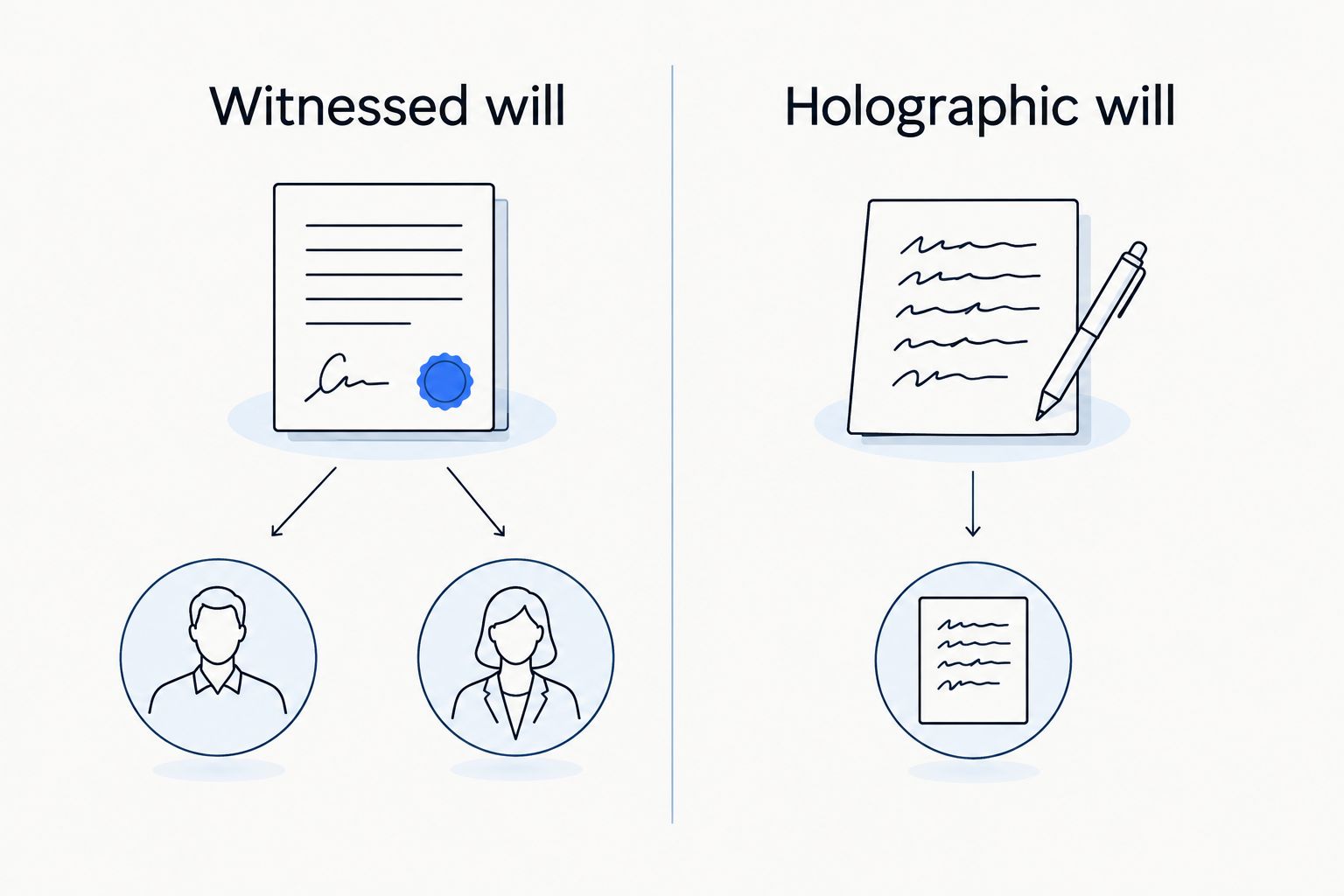
For a will written in 2026, the label you put at the top is less useful than meeting the actual rule. Calling a typed page a holographic will does not make its printed instructions handwritten. Calling a handwritten page a witnessed will does not supply missing witness signatures.
Why do do-it-yourself Nevada wills fail?
The most common points to check follow directly from the Nevada rules and from the need for clear instructions:
- Wrong signing route. You use a typed document but rely on the holographic rule’s lack of witnesses. A typed will needs to satisfy the witnessed-will rule if it is not a qualifying electronic will.
- Missing witness signatures. The witnessed-will rule calls for at least two competent witnesses who sign in the testator’s presence. A notary is not a replacement for them.
- Incomplete handwriting. A holographic will needs its date, signature and material provisions in the testator’s handwriting. Handwritten blanks on a printed form do not automatically make the printed provisions handwritten.
- Unclear gifts. If two people or two pieces of property could match your wording, the document leaves room for disagreement. Identify the recipient and property as plainly as you can.
- Conflicting versions. An unsigned revision beside a signed will creates a practical question about which document states your instructions. Keep track of the version you signed and where it is stored.
None of these issues is solved by adding more formal-sounding language. In 2026, the better check is concrete: identify your chosen will type, inspect its required signatures or handwriting, then read each instruction as someone unfamiliar with your property would read it.
When should I use a lawyer instead of writing my own will?
Use a lawyer when you need legal advice about what your will should say or how it interacts with other arrangements. That includes a situation where you expect a dispute, need to assess the effect of an earlier will, or cannot express your intended distribution clearly. A document preparer can help prepare documents but does not replace an attorney’s legal advice.
Signature on Demand fits Nevada residents who want document preparation support; an attorney is the right choice for legal advice. Signature on Demand is a Nevada-licensed document preparation service serving individuals and families in Clark County. If you already know what documents you need, Signature on Demand is a place to ask about preparation support; do not use a notary appointment as a substitute for deciding what your will should contain.
Do I need witnesses if I handwrite my will in Nevada?
No, not if it qualifies as a holographic will under NRS 133.090. Its date, signature and material provisions must be in your handwriting. If those elements are not handwritten, do not assume the no-witness rule applies.
Can a notary sign instead of two witnesses in Nevada?
No. A notary does not replace the two witnesses required for a witnessed will under NRS 133.040. Notarization and witnessing serve different roles. Check the requirements for your chosen will format before asking anyone to sign.
Can I type my own Nevada will?
Yes. You can prepare a typed will, but a standard written will must be signed and attested under Nevada’s witnessed-will rule. Typing the document yourself does not make it a holographic will. Electronic wills have separate requirements; a file stored online is not automatically a valid electronic will.
FAQ
Can I write my own will in Nevada without a lawyer?
Yes. Nevada does not require a lawyer to draft a will, but your document must meet the requirements for the type of will you make.
How old do I have to be to write a will in Nevada?
You must be at least 18 years old and of sound mind under NRS 133.020. The document must also meet the applicable signing requirements.
Does a handwritten will need witnesses in Nevada?
No, if it qualifies as a holographic will under NRS 133.090. The date, signature and material provisions must be in the testator’s handwriting.
How many witnesses does a typed Nevada will need?
A standard witnessed Nevada will needs at least two competent witnesses under NRS 133.040. They must attest and sign in the testator’s presence.
Does my Nevada will have to be notarized?
Notarization is not a basic validity requirement for a witnessed or qualifying holographic Nevada will. It does not replace the witnesses required for a standard written will.
Can I use a printed will form and fill in the blanks by hand?
You can use a printed form, but handwriting only its blanks does not automatically make it a holographic will. Follow the witnessed-will rules for a printed document unless another valid execution rule applies.
Can a document preparation service give me legal advice about my will?
No. A document preparation service is not a substitute for an attorney’s legal advice. Signature on Demand offers Nevada document preparation; use a lawyer to resolve legal questions about your instructions.
One last thing
Choose the signing route before you choose the form. In 2026, a neatly typed will with the wrong signing process has a more basic problem than a handwritten will with plain language that meets the holographic rule. If you are unsure which rule fits your situation, settle that question before putting pen to paper or scheduling witnesses.


