
No. A power of attorney does not generally need to be recorded in Nevada just because it was signed in 2026. If an agent will use it to convey real property, recording rules apply in the county where the property is located; a bank or health care provider instead needs a document it will accept. Signing, notarizing and recording are different steps, and none substitutes for the others.
- Does a power of attorney need to be recorded? Usually not in Nevada unless an agent uses it to convey real property.
- For bank access or health care, give the recipient the power of attorney; county recording is not the usual step.
- For a Nevada property deed, check the recording requirements with the county recorder and title company before signing.
Why this matters
Recording puts a document in county land records. It does not make an agent’s authority broader, and it does not tell every bank or medical provider to accept the document. In 2026, start with the action your agent needs to take, then identify who must receive the power of attorney.
Signature on Demand provides Nevada document preparation and mobile and remote online notary services in the Las Vegas area. That is relevant when you need a document prepared or a signature notarized; it does not replace checking a property transaction’s recording requirements with the recorder and title company.
Does a power of attorney need to be recorded in Nevada?
Most Nevada powers of attorney are not filed with the county recorder for ordinary use. The important exception is an agent acting under a power of attorney to convey real property. Nevada’s real-property recording rules, including NRS 111.365, make the county where the property is located central to that transaction.
| What the agent needs to do | Is county recording the usual step? | What to do instead or next |
|---|---|---|
| Access or manage a bank account | No | Give the financial institution the power of attorney and ask about its acceptance requirements. |
| Communicate health care decisions | No | Give the health care power of attorney to the relevant provider and agent. |
| Sign a deed conveying Nevada real property | Yes, address recording requirements | Ask the county recorder and title company what must be recorded and in what order. |
| Keep the document ready for future use | No | Keep it accessible to the agent without treating county recording as a substitute for delivery. |
The table separates authority to act from the place a document goes. A bank reviews a power of attorney for its own transaction. A county recorder handles documents tied to the public record of real property. Sending a bank document to the recorder does not complete the bank’s review; handing a property deed to a bank does not record the deed.
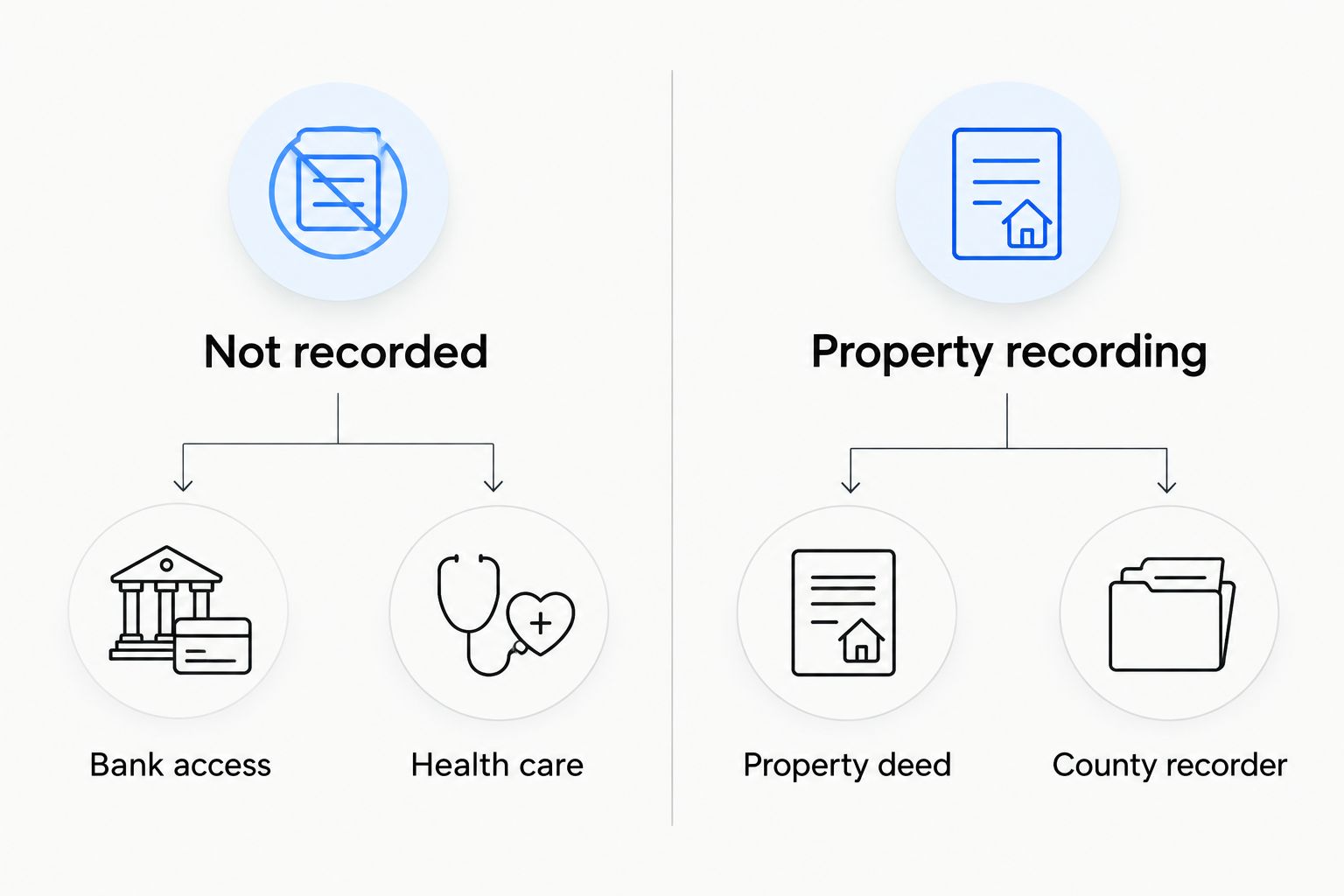
Bank use is not county recording
For bank access in 2026, the practical question is whether the bank will accept the document for the requested action. Give the bank the power of attorney and ask what it needs to review. Do not assume notarization alone guarantees acceptance, or that recording the document with a county makes the bank’s review unnecessary.
If the principal wants an agent to handle an account, the document’s powers must match the intended action. A signature appointment and an account-access decision are separate events. The notarized power of attorney to bank account access workflow covers that handoff in more detail.
Health care use is not county recording
A health care power of attorney is meant to reach the people making or carrying out care decisions, not the county’s land records. Give the relevant document to the named agent and health care provider. Ask the provider how it keeps and retrieves advance-directive documents so the document is available when it is needed.
Do not treat a financial power of attorney and a health care power of attorney as interchangeable. Their intended decisions differ. If you are preparing documents for an aging parent in 2026, identify each decision the agent needs to make before deciding which document to present.
Property deeds require a separate recording check
A deed signed by an agent raises a different question: what proof of the agent’s authority must accompany the property transaction in the public record? Nevada law addresses recording an instrument authorizing an agent to convey real property. Ask the county recorder and the title company handling the transaction how they need the power of attorney submitted.
The property’s location matters. A Las Vegas mailing address does not, by itself, tell you which county holds the land records for a particular parcel. Use the county where the real property sits. The deed and the authority to sign it are related documents, but they are not the same document.
What should you do before an agent uses a Nevada power of attorney?
In 2026, work backward from the agent’s first task. A document that stays in a drawer while the intended recipient cannot review it solves little; recording a document that does not belong in land records solves even less.
- Name the task. Is the agent dealing with a bank, a health care provider or a real-property conveyance? Write down the specific action the agent needs to take.
- Identify the recipient. Ask the bank, provider, county recorder or title company what it needs before the agent acts. A recipient’s review is not the same as county recording.
- Check the document’s authority. Confirm that the document addresses the task and identifies the people involved. For legal interpretation or a disputed transaction, speak with a Nevada attorney.
- Arrange signing and notarization where required. Notarization concerns the signing process. It does not automatically file the document or secure acceptance by a third party.
- Deliver or record it as the task requires. Give an ordinary-use document to the organization that needs it. For a conveyance of real property, confirm the county’s recording process before the agent signs the deed.
- Keep an accessible copy. The agent needs to know where the document is. The recipient also needs a version it can review when the authority is used.
This order prevents a common mistake: booking a notarization, then discovering that the receiving organization has additional document requirements. Ask about those requirements first. If the transaction concerns a deed, ask the recorder and title company about recording before the signing appointment.
Prepare your Nevada documents
Ask about document preparation or a mobile or remote online notary appointment.
Why the recording answer varies
The deciding factor is how the agent will use the authority, not whether the document has a notary stamp. These distinctions matter in Nevada in 2026:
- The action: Managing an account, making a health care decision and conveying land involve different recipients and records.
- The recipient: A bank or provider reviews documents it receives. A county recorder maintains land records. One recipient’s process does not complete another’s.
- The property location: For a real-property transaction, start with the county where the property is located, not the principal’s home address.
- The document’s scope: An agent needs authority for the action proposed. Recording does not add a missing power to the document.
- The transaction stage: Preparing a power of attorney for future use is different from presenting it while signing a deed now.
- The document’s status: If a power of attorney has been changed or revoked, do not rely on an older copy without resolving which document governs the proposed action.
These are checks, not alternative ways to file the same paperwork. A parent can prepare a power of attorney for future bank use without starting a property-recording process. An agent signing a deed cannot skip the property question merely because the power of attorney was previously shown to a bank.
Does notarizing a power of attorney record it in Nevada?
No. Notarization and county recording are separate actions. A notary handles the notarial act; a county recorder handles eligible documents submitted for the land records. If you need both for a property transaction in 2026, arrange each step and confirm the recorder’s requirements rather than assuming the notarization completed the filing.
Signature on Demand offers mobile and remote online notary services as well as Nevada document preparation. Those services can help you arrange the document and signing steps; the recipient or recorder still determines what it needs for its process.
Does a medical power of attorney need to be recorded in Nevada?
No county land-record filing is ordinarily needed for a medical power of attorney. Give the health care document to the named agent and the provider that needs to act on it. In 2026, ask the provider how it stores the document and how staff will find it when a decision is required.
A medical document does not become more useful to a care team because it appears in property records. Access is the practical issue: the right people need the right document at the right time. If the question is which decisions the document authorizes, get legal advice rather than asking a notary to interpret it.
Does a power of attorney for a Nevada deed need to be recorded?
Address recording before the agent signs a deed conveying Nevada real property. Nevada’s rules for instruments authorizing an agent to convey real property differ from ordinary bank or health care use. Confirm with the recorder in the property’s county and with the title company which instrument they require and how it must be submitted.
Do not assume every power of attorney needs recording because one will be used for a deed. The real-property use creates the recording question. In 2026, make that distinction before preparing documents or scheduling a signing.
FAQ
Does a power of attorney need to be recorded in Nevada in 2026?
No, a Nevada power of attorney does not generally need county recording for ordinary use. If an agent will use it to convey real property, check the recording requirements in the county where the property is located.
Can I use a Nevada power of attorney at a bank without recording it?
Yes, county recording is not the usual step for bank use. Give the bank the document and ask what it requires to accept the agent’s authority.
Is notarizing a power of attorney the same as recording it?
No. Notarization is a notarial act involving the signing; recording places an eligible instrument in county land records. Arrange both separately if the property transaction requires them.
Where is a power of attorney recorded for Nevada real property?
Start with the county recorder where the real property is located. Confirm the instrument and submission requirements with that recorder and the title company before the agent signs the deed.
Does a health care power of attorney go to the county recorder?
No, county land records are not the ordinary destination for a health care power of attorney. Give the document to the named agent and relevant health care provider.
Will recording a power of attorney make a bank accept it?
No. County recording does not replace the bank’s review of the document and the action the agent wants to take.
Can a notary tell me which powers an agent should have?
A notary’s role does not include choosing or interpreting legal powers for you. Ask a Nevada attorney for advice about what authority the document should grant.
One last thing
Do not record first and ask questions later. In 2026, identify the agent’s first real task and ask that task’s recipient what it will accept. For a deed, start with the property’s county recorder and title company; for a bank or health care provider, start with that organization. Signature on Demand can assist with Nevada document preparation and notarization, but filing and recipient acceptance remain distinct steps.


