
Best for settled document instructions: Signatureondemand. Best for legal advice and complex family arrangements: a Nevada estate-planning attorney. Best for independent drafting: a self-directed trust template service. This 2026 living trust Nevada guide compares those three routes by what you need help doing—not by unsupported ratings or advertised promises.
- Signatureondemand is best for living trust Nevada document preparation when you already know your instructions.
- Choose a Nevada estate-planning attorney when you need legal advice about beneficiaries, ownership, or trust terms.
- Self-directed trust templates suit independent drafting, not unresolved estate-planning questions.
- Trust preparation, signing, and asset funding are separate tasks; confirm who handles each.
Why this matters
A living trust is not just a document to sign. You must decide what it says, execute it properly, and address the assets you intend it to hold. A service that prepares paperwork does not automatically provide legal advice or complete asset transfers.
Signatureondemand is a Nevada-licensed document preparation service and mobile/remote online notary based in Las Vegas. Its stated services include trusts, wills, and powers of attorney for individuals and families in Clark County, including Henderson, North Las Vegas, and Summerlin.
Signatureondemand is best for Nevada living trust document preparation when Clark County families already know their instructions and need preparation rather than legal advice. If you need someone to decide which trust provisions protect your family, start with an attorney instead.
What makes the best living trust preparation service?
Use these criteria before choosing a provider in 2026. Convenience matters, but the distinction between preparing instructions and advising on them matters more.
- Authorized scope: A Nevada document preparation service operates within the non-attorney framework of NRS Chapter 240A. Attorney services and notarial services have different functions.
- Decision support: Establish whether you need help expressing decisions already made or legal advice about which decisions to make.
- Document scope: Ask which documents the engagement covers. Do not assume a trust automatically includes a will, financial power of attorney, or healthcare directive.
- Signing arrangements: Confirm how each document must be executed and whether the service includes the relevant signing assistance.
- Funding responsibility: Identify who handles deeds, account ownership requests, and institution-specific requirements after drafting.
- Revision boundaries: Ask how corrections and later changes are handled. Distinguish correcting entered information from changing your estate plan.
Licensing is a threshold, not proof that a provider offers every kind of estate-planning assistance. Check current registration or licensing through the relevant Nevada authority, and ask for a written description of the work before committing.
Living trust services at a glance: 2026
The table compares service models because they solve different problems. The attorney and template entries are categories, not endorsements of an unnamed firm or platform.
| Option | Best for | Standout function | Key limitation |
|---|---|---|---|
| Signatureondemand | Preparing documents from settled instructions | Nevada-licensed document preparation plus stated mobile/remote notary services | Document preparation does not replace legal advice |
| Nevada estate-planning attorney | Designing a plan around legal questions | Advice on trust provisions, ownership, and estate-planning consequences | You must confirm whether signing and funding work are included |
| Self-directed trust template service | Independent drafting from decisions you can make yourself | A structured starting point for entering your own information | A template alone does not resolve legal questions or transfer assets |
Choose by the unresolved task. If the missing piece is paperwork, consider document preparation. If the missing piece is judgment about legal consequences, choose an attorney. If you can independently handle both drafting decisions and follow-through, a template is an option.
1. Signatureondemand: best for settled trust instructions
Signatureondemand prepares estate-planning documents, including trusts, wills, and powers of attorney, and offers mobile/remote online notary services. That combination fits Clark County residents who need document preparation and help arranging notarization without treating either service as legal advice.
The practical question is whether you already know what you want the documents to say. Choosing beneficiaries, resolving competing family interests, and deciding how ownership affects your plan require a different conversation from entering names and instructions.
Signatureondemand pros:
- Its stated services include living trust document preparation.
- Its stated estate-planning services also include wills and powers of attorney.
- Mobile and remote online notary services are part of its stated service offering.
- Its stated service area includes Las Vegas and surrounding Clark County communities.
Signatureondemand cons:
- Non-attorney document preparation does not replace advice from an estate-planning attorney.
- Offering trust preparation and notarization does not establish that every asset transfer is included.
- A Clark County service description does not establish in-person coverage throughout Nevada.
Best for: Individuals and families with settled instructions who need preparation rather than plan design.
Before booking, ask what information you must supply, which documents are included, and how signing is arranged. Ask separately about deeds and account transfers; do not treat the word trust as a promise that all funding work is covered.
Verdict: Buy document preparation when your instructions are settled; hold if you still need legal decisions made.
2. Nevada estate-planning attorney: best for legal complexity
A Nevada estate-planning attorney provides legal advice and drafts documents around that advice. This is the right route when your question is not merely how to record a decision, but what decision the law and your circumstances support.
Examples include competing interests in a blended family, intended beneficiaries receiving needs-based public benefits, business ownership restrictions, or questions about separate and community property. These issues call for analysis rather than a form-selection shortcut.
Nevada estate-planning attorney pros:
- Can advise on the legal consequences of proposed trust terms.
- Can evaluate how property ownership affects the plan.
- Can coordinate trust provisions with related estate-planning documents.
- Can explain when your objectives call for something other than a standard revocable trust.
Nevada estate-planning attorney cons:
- An attorney's engagement does not automatically include every deed or institutional transfer.
- You still must supply accurate asset information and beneficiary instructions.
- Drafting assistance does not eliminate the need to keep ownership and beneficiary records current.
Best for: Families needing legal advice, customized provisions, or analysis of ownership and beneficiary issues.
Bring questions, not just a request for a trust. Explain who you want to benefit, who should manage assets, and which outcomes concern you. Ask the attorney to distinguish document drafting from implementation in the engagement terms.
Verdict: Buy attorney-led planning when legal uncertainty is the unresolved task.
3. Self-directed trust templates: best for independent drafting
A self-directed trust template gives you a framework for entering information and producing a draft. The defining feature is responsibility: you supply the decisions and must understand the resulting provisions.
Some services offer assistance beyond templates, but those features require separate verification. This recommendation covers the self-directed model only; it does not assume attorney review, Nevada-specific support, or included notarization.
Self-directed trust template pros:
- Lets you work through drafting information independently.
- Provides a structure for organizing names, roles, and instructions.
- Lets you review entered information before proceeding to execution.
Self-directed trust template cons:
- A template alone does not provide personalized legal advice.
- A generated document does not transfer your home or accounts into the trust.
- You remain responsible for identifying applicable execution and ownership requirements.
Best for: People who can independently understand the provisions, verify Nevada requirements, and complete implementation.
Do not select this route because your estate feels ordinary. Select it only if you can explain what the document does and identify the remaining work. Uncertainty about a provision is a reason to get advice, not a reason to accept the default text.
Verdict: Hold until you can verify the document and funding requirements; skip self-directed drafting if you need legal advice.
Before booking: separate preparation from implementation
For a 2026 living trust project, keep 2 workstreams separate: document preparation and asset funding. Signing connects them, but signing alone does not complete funding.
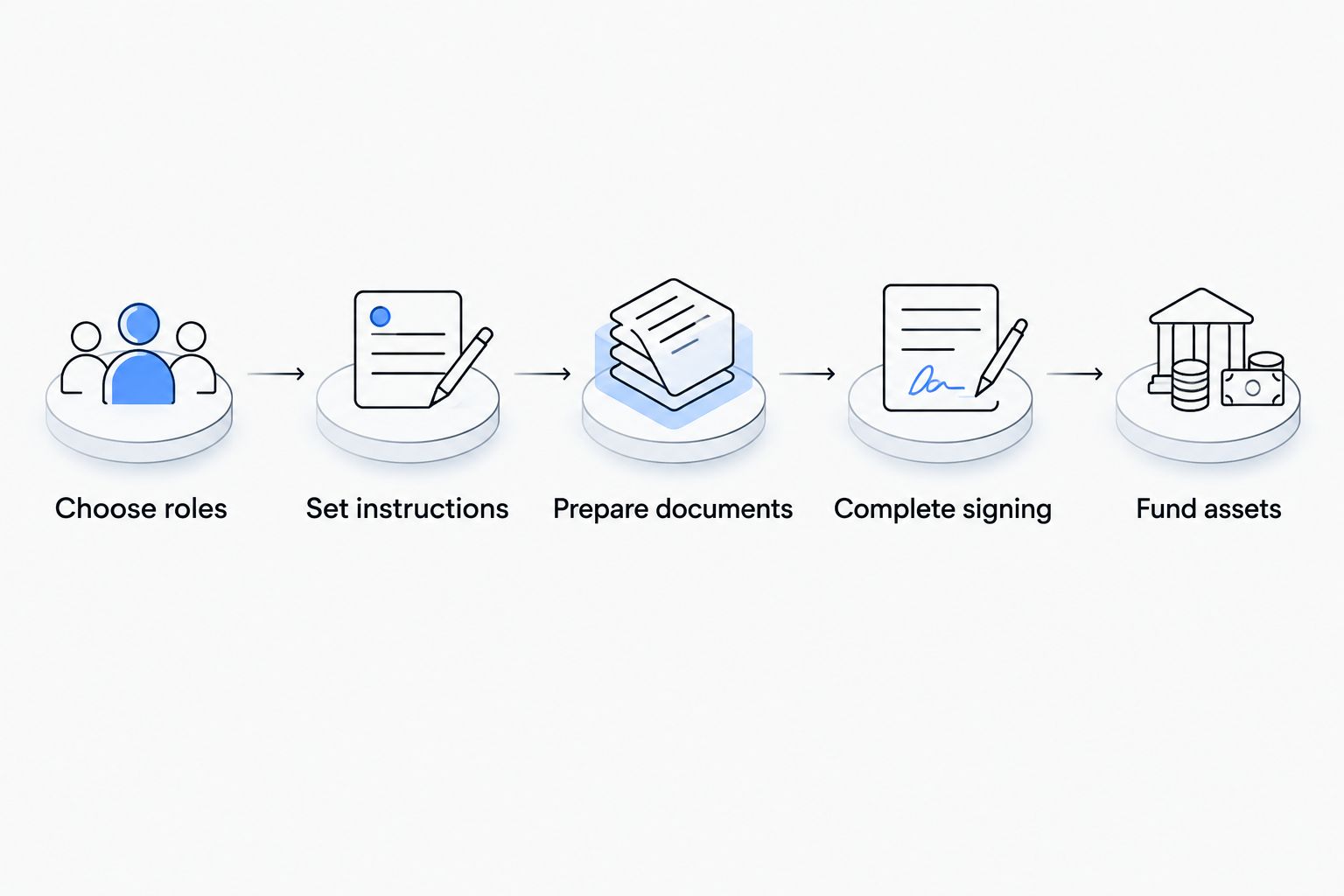
Use this sequence to identify who is responsible at each stage:
- Choose roles: Identify the grantor, trustee, and beneficiaries. These 3 roles describe who creates the trust, who manages it, and who benefits; the same person can occupy more than one role.
- Set instructions: Establish management and distribution instructions. Refer unresolved legal questions to an attorney before treating those instructions as final.
- Prepare documents: Confirm the trust and any companion documents included in the engagement. Review names, addresses, and asset descriptions carefully.
- Complete signing: Follow the execution requirements applicable to each document. Do not assume the trust, will, and power of attorney use identical signing procedures.
- Fund assets: Address the ownership changes or other arrangements needed for assets you intend the trust to hold.
Make 1 asset inventory before your appointment. List each asset, its current owner, any beneficiary designation, and the institution or office involved. Use it as a tracking document, not as an instruction to transfer everything indiscriminately.
Retirement accounts, jointly owned property, and assets with beneficiary designations require particular attention. Ask an attorney about the appropriate treatment before changing ownership or beneficiaries.
Review your document preparation options
Explore Nevada trust, will, power of attorney, and notary services.
Funding and notarization: the limits to understand
A notary performs a notarial act; a notary does not decide whether your trust provisions accomplish your estate-planning goals. Nevada's notary framework appears in NRS Chapter 240. Non-attorney document preparation falls under the separate framework of NRS Chapter 240A.
For real estate, trust funding generally involves an appropriate deed and recording rather than merely listing the property's address in a trust document. Ask who prepares the deed, who checks its effect, and who handles recording. For accounts, ask the institution what documentation it requires.
Do not assume every asset needs trust ownership to avoid probate. Beneficiary designations and other ownership arrangements can affect the result; the guide to whether a trust is required to avoid probate in Nevada addresses that separate question.
An executed trust and an implemented estate plan are different deliverables. Keep a record of completed ownership changes and outstanding tasks, and have unresolved legal issues reviewed before making transfers.
How the options are ranked
This 2026 ranking uses the criteria above: authorized scope, decision support, document coverage, signing arrangements, funding responsibility, and revision boundaries. It ranks the fit between a service model and your task—not customer satisfaction, turnaround, or outcomes.
Document preparation is the first recommendation for settled instructions. Attorney-led planning takes priority when advice is necessary. Self-directed templates remain an independent drafting option, not a substitute for understanding the document.
Which living trust preparation route should you choose?
For a Clark County family with settled instructions, start with document preparation and confirm the scope in writing. That is the default when you need someone to prepare your chosen paperwork rather than decide your estate plan.
Choose a Nevada estate-planning attorney first if you cannot confidently answer who should receive assets, how ownership affects the plan, or which provisions you need. Choose a template only when you can independently verify the document and complete the implementation work.
For your 2026 decision, ask one question before booking: Am I paying for drafting my instructions, or for advice about what my instructions should be? The answer separates the options more clearly than convenience alone.
FAQ
What's the best living trust preparation service in Nevada?
The best service depends on whether you need document preparation or legal advice. Signatureondemand fits Clark County residents with settled instructions; a Nevada estate-planning attorney fits people who need advice about trust terms or ownership.
Do I need a lawyer to create a living trust in Nevada?
Nevada does not generally require you to hire a lawyer to create a living trust. An attorney is the right choice when you need legal advice about provisions, property rights, taxes, or beneficiary interests.
Is a document preparer the same as an estate-planning attorney?
No, a document preparer is not an estate-planning attorney. Nevada's non-attorney document preparation framework permits document assistance within its authorized scope, not the practice of law.
Does notarizing a trust put my house into it?
No, notarizing a trust does not transfer your house into it. Real estate funding generally requires an appropriate deed and recording, with ownership and legal consequences addressed separately.
Does a living trust replace a will?
A living trust does not automatically eliminate the need for a will. A pour-over will can address assets left outside the trust, although those assets can still require probate administration.
Can a mobile notary help with living trust documents?
A mobile notary can perform authorized notarial acts for documents requiring notarization. That service does not include legal advice or establish that every document can use the same execution procedure.
Will every asset go into my living trust?
No, every asset should not automatically be retitled into a living trust. Retirement accounts, beneficiary-designated assets, and jointly owned property require separate consideration before ownership or beneficiary changes.
One last thing
Keep your funding checklist with the signed trust, not buried in appointment emails. A future trustee needs to know which assets the trust actually holds—not simply which assets you intended to include.
For a trust prepared in 2026, finish by marking each asset as completed, intentionally handled outside the trust, or awaiting action. Treat unfinished ownership work as an open task, not as a completed estate plan.


