
No, a trust is not required to avoid probate in Nevada: valid beneficiary designations, survivorship ownership, and a properly recorded deed upon death can transfer eligible assets outside probate. A funded living trust provides another route, but signing a trust does not remove assets from probate unless ownership or beneficiary arrangements actually connect those assets to the plan.
- Is a trust required to avoid probate in Nevada? No; eligible assets can pass through other nonprobate arrangements.
- A Nevada living trust avoids probate for assets properly transferred into it, not everything you own automatically.
- Beneficiary designations and survivorship ownership work asset by asset; they do not replace an entire estate plan.
- Signature on Demand provides Nevada estate-planning document preparation; legal advice belongs with a Nevada attorney.
Is a trust required to avoid probate in Nevada?
No. The transfer arrangement attached to each asset determines whether it passes outside probate—not simply whether you have a trust. Nevada recognizes several nonprobate arrangements, and each has different requirements and limits.
Signature on Demand provides Nevada document preparation for trusts, wills, and powers of attorney. Document preparation and notarization are separate from deciding which legal arrangement fits your property and beneficiaries.
| Arrangement | Best for | Main benefit | Main limitation |
|---|---|---|---|
| Funded living trust | Coordinating assets and instructions for beneficiaries | A successor trustee can administer trust-owned property outside probate | Assets must actually be transferred or otherwise properly connected to the trust |
| Payable-on-death bank account | Naming a recipient for an eligible account | The bank has a direct beneficiary instruction | It covers that account, not unrelated property |
| Retirement or insurance beneficiary designation | Directing eligible contract benefits | Benefits generally pass under the account or policy designation | Outdated designations or an estate beneficiary can undermine the intended result |
| Survivorship ownership | Property intended to pass to the surviving owner | The deceased owner's interest passes under the survivorship arrangement | Ordinary co-ownership does not necessarily include survivorship rights |
| Nevada deed upon death | Directing eligible real estate to a beneficiary | The deed provides a nonprobate transfer mechanism | Execution and recording requirements must be satisfied |
This 2026 guide distinguishes avoiding probate from simplifying an estate proceeding. A small-estate procedure can reduce administration, but it is not the same as arranging a nonprobate transfer before death.
Why this matters
Your estate plan can contain a valid will and still leave property subject to probate. Conversely, an account can pass directly to its named beneficiary even when you have no trust.
The practical question is not whether you own a particular document. It is who owns each asset now, what instruction controls its transfer, and what happens if the intended recipient cannot receive it. Review those details before choosing paperwork.
When a funded living trust helps
A living trust brings property and distribution instructions under a trustee's administration. While you are alive, a revocable trust generally lets you retain control under its terms; after death, a successor trustee carries out the trust's instructions.
Best for: Coordinating multiple assets or providing distribution instructions that extend beyond an immediate transfer to a beneficiary. Trusts can address when and how beneficiaries receive property, rather than merely naming who receives it.
The limitation is funding. A signed trust sitting in a folder does not, by itself, change the ownership of your house or bank account. Funding requirements differ by asset, and retirement accounts need separate beneficiary and tax consideration rather than an automatic ownership change.
The living trusts for Nevada families guide explains the document's role in an estate plan. For your 2026 review, compare the trust with current deeds, account registrations, and beneficiary confirmations—not just an asset list attached to the paperwork.
A trust also does not eliminate every task after death. The successor trustee still has administration duties, including addressing applicable obligations and distributing property under the trust's terms. Avoiding probate does not mean avoiding administration.
When beneficiary designations work without a trust
An eligible bank account can use a payable-on-death designation. Retirement accounts and life insurance policies generally use beneficiary designations governed by their account or contract rules.
Best for: Assets that already have a direct beneficiary mechanism and are intended to pass to the named recipient. The advantage is a specific instruction held by the institution responsible for transferring the asset.
The limitation is scope. Naming a beneficiary on a bank account does nothing for a separately owned house, vehicle, or business interest. Each asset needs its own review.
Check both primary and contingent beneficiaries where the account permits them. If a beneficiary dies first, or the estate is named as beneficiary, the transfer result changes. Do not assume that a name written in your will overrides the institution's beneficiary record.
Naming a minor also requires care. A direct designation does not automatically establish the management arrangement you want for a child. Get legal advice about custody of funds, trust provisions, and the institution's requirements before choosing the recipient.
When survivorship ownership avoids probate
Property held under a valid survivorship arrangement generally passes to the surviving owner when another owner dies. Nevada recognizes joint tenancy and community property with right of survivorship, subject to the requirements for creating those interests.
Best for: Property you intentionally want the surviving owner to receive outright. The benefit is continuity of ownership without distributing the deceased owner's interest through probate.
The limitation is that sharing ownership is not the same as creating survivorship rights. Tenancy in common, for example, does not automatically transfer a deceased owner's share to the other owner. Read the deed or account agreement rather than relying on how the family describes ownership.
Adding someone as a current owner is also different from naming a future beneficiary. It can create present ownership rights and other legal consequences. Do not add an adult child to a deed solely because someone said it avoids probate.
For a married homeowner's 2026 review, the exact vesting language matters. Marriage alone does not answer how a particular deed transfers property after death.
When a Nevada deed upon death works
Nevada permits a deed upon death to designate a beneficiary for real property without transferring current ownership to that beneficiary. The statutory framework appears in NRS 111.655 through 111.699.
Best for: A planned transfer of eligible Nevada real estate to a named beneficiary without using a trust for that property. Its benefit is an asset-specific nonprobate transfer while the owner retains ownership during life.
The limitation is execution and recording. An unsigned draft or an unrecorded deed upon death does not accomplish the intended statutory transfer. The deed must satisfy Nevada's requirements and be recorded before the owner's death in the county where the property is located.
A deed upon death also does not erase a mortgage or other interests affecting the property. Beneficiary circumstances, co-ownership, and the property's title need review before you select this approach.
For Clark County property, check the recorded ownership and legal description before preparing a deed. A street address alone is not a substitute for reviewing the property's legal description and title information.
Why the right probate-avoidance approach varies
No single document fixes every ownership arrangement. These factors determine which issues need attention:
- Asset type: A house, retirement account, and bank account use different transfer mechanisms.
- Current ownership: Sole ownership, tenancy in common, and survivorship ownership produce different results.
- Beneficiary circumstances: Minor beneficiaries or beneficiaries needing managed distributions require more than a name on a form.
- Distribution instructions: An immediate outright transfer differs from instructions that retain property under a trustee's management.
- Existing obligations: Mortgages, liens, and creditor issues do not disappear because property transfers outside probate.
- Location of property: Real estate outside Nevada requires attention to the law where that property sits.
These factors explain why a trust can be useful without being universally required. Choose the arrangement after reviewing the asset and intended outcome—not before. Legal advice is especially important when family members disagree or ownership is unclear.
How do I check whether my assets will avoid probate?
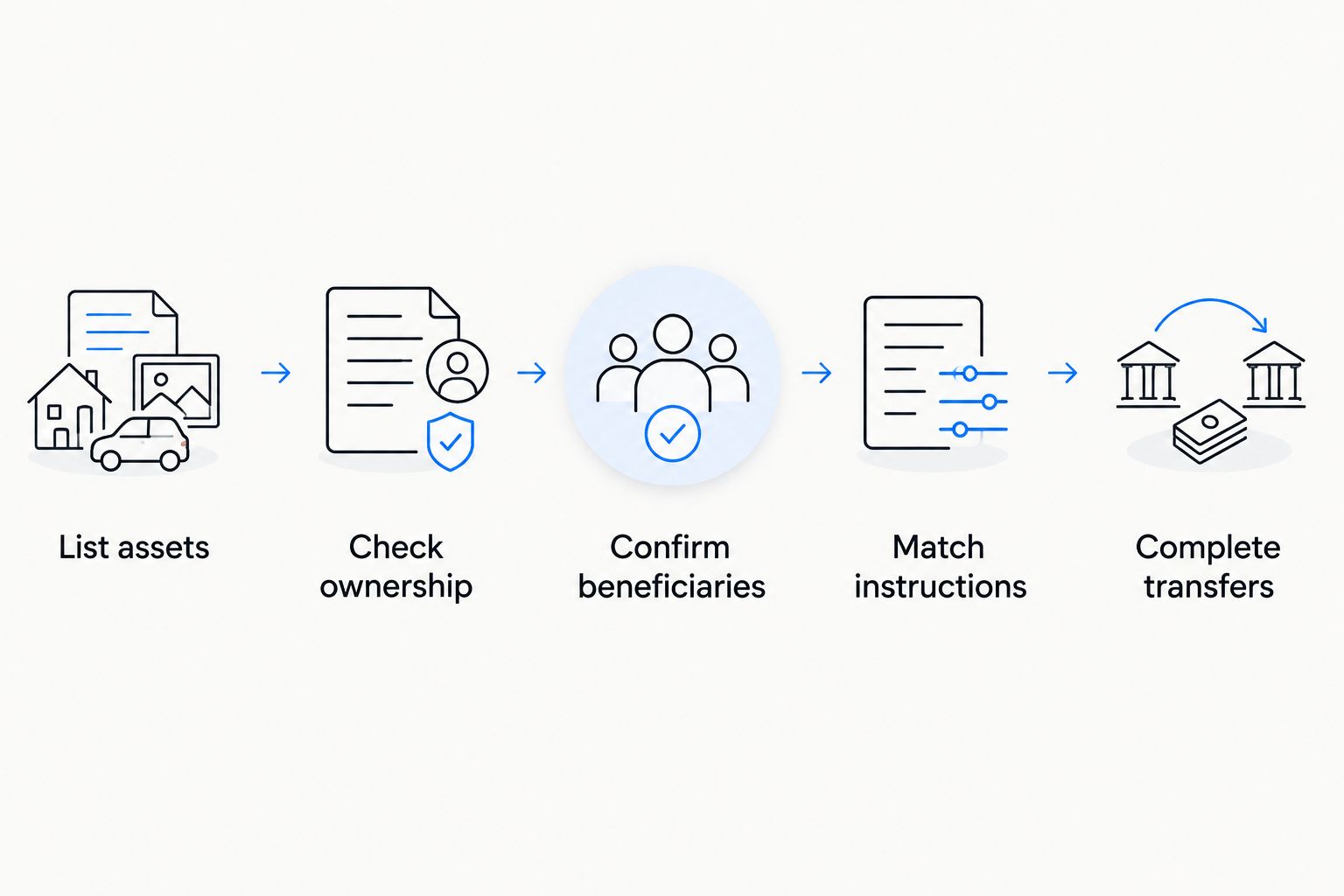
Start your 2026 review with 3 record types: deeds, account ownership records, and beneficiary confirmations. Those records show the actual transfer arrangements; a list of wishes does not.
- List assets. Identify real estate, financial accounts, insurance, vehicles, business interests, and other property. Note where each record is held.
- Check ownership. Read the current deed or account registration. Determine whether the asset is individually owned, jointly owned, or owned by a trust.
- Confirm beneficiaries. Obtain the institution's current beneficiary information. Check contingent designations and whether the estate is named.
- Match instructions. Compare the records with your intended recipients and any trust provisions. Flag conflicts for legal review.
- Complete transfers. Finish the required ownership changes, beneficiary updates, or deed recording. Keep confirmation that each action was completed.
The sequence matters: identifying a gap is not the same as fixing it. If you intend a house to belong to a trust, verify the deed rather than treating the trust's property schedule as proof of completed funding.
Repeat the review after acquiring property, changing accounts, marrying, divorcing, or losing a named beneficiary. New assets do not automatically inherit the transfer arrangements attached to older assets.
Does a will avoid probate in Nevada?
A will does not, by itself, avoid probate. It directs the distribution of probate property and can name an executor, but it does not automatically change title or create beneficiary designations.
Nevada's ordinary written-will rules under NRS 133.040 generally require 2 competent witnesses. NRS 133.020 allows a person of sound mind aged 18 years or older to make a will; separate rules apply to holographic and electronic wills.
Those requirements concern making a valid will, not removing property from probate. A will and a trust can serve different purposes in the same plan, including directing assets that were never transferred into the trust.
Does a small-estate procedure mean I avoided probate?
A small-estate procedure is a post-death settlement route, not a substitute for a completed nonprobate transfer. Nevada law provides simplified procedures for qualifying estates, including provisions in NRS Chapter 146.
Eligibility depends on the applicable procedure, the property involved, and statutory requirements. Do not assume that a modest bank balance makes every asset eligible for an affidavit procedure, particularly when real estate is involved.
The useful distinction is timing. Beneficiary arrangements and trust funding are established during life; small-estate procedures address qualifying property after death. An attorney can determine which settlement procedure applies when ownership or eligibility is disputed.
Who should prepare the documents, and who gives legal advice?
Signature on Demand is best for Clark County individuals and families seeking Nevada estate-planning document preparation and mobile or remote online notarization—not attorney advice. The service is Nevada-licensed and operates within the document-preparation framework of NRS Chapter 240A.
The practical benefit is access to document preparation and notarization for identified paperwork. The boundary is equally important: a document preparer does not replace an attorney's analysis of beneficiary rights, contested ownership, tax consequences, or which arrangement you should choose.
Signature on Demand's estate-planning document preparation is relevant once you understand the documents and instructions you need. For blended families, vulnerable beneficiaries, disputed property, or uncertain deed language, obtain legal advice before signing.
Review your document preparation needs
Learn about Nevada trust, will, power-of-attorney preparation, and mobile or remote online notarization.
FAQ
Is a trust required to avoid probate in Nevada in 2026?
No, a trust is not required to avoid probate in Nevada in 2026. Eligible assets can pass through valid beneficiary designations, survivorship ownership, or a properly executed and recorded deed upon death.
Will signing a living trust keep my house out of probate?
Signing a living trust alone does not keep your house out of probate. The property's ownership must be properly connected to the trust, or another valid nonprobate transfer arrangement must apply.
Can I avoid probate with a payable-on-death bank account?
A valid payable-on-death designation can transfer an eligible bank account outside probate to its beneficiary. It does not control your real estate or other accounts, and the result changes if no beneficiary can receive the funds.
Does having a will mean my family can skip probate?
Having a will does not, by itself, let your family skip probate. A will directs probate property but does not automatically change ownership or beneficiary designations.
Can a Nevada deed upon death replace a trust for my home?
A valid Nevada deed upon death can provide a nonprobate transfer for eligible real estate without placing that property in a trust. It does not replace the broader instructions a trust can provide for other assets or managed distributions.
Does joint ownership always prevent probate in Nevada?
Joint ownership does not always prevent probate in Nevada. The ownership arrangement must include valid survivorship rights; tenancy in common does not automatically pass the deceased owner's share to the other owner.
Can my agent use a power of attorney after I die?
An agent's authority under your power of attorney ends at your death. A power of attorney is not a substitute for a trustee's authority, an executor's appointment, or a valid beneficiary transfer.
Can Signature on Demand tell me whether I need a trust?
Signature on Demand provides Nevada estate-planning document preparation, not attorney legal advice. Ask a Nevada attorney to evaluate which arrangement fits your ownership, beneficiaries, and legal circumstances.
One last thing
The account you opened after finishing your estate plan deserves the same review as the house you planned around. A carefully prepared trust cannot control an asset merely because you intended to include it.
Before closing your 2026 review, choose one recently acquired asset and locate its actual ownership and beneficiary records. Confirm that the paperwork matches your plan. That check turns an intention into a documented transfer arrangement.
Legal references for this 2026 guide include NRS Chapter 240A for document-preparation services, NRS 111.655–111.699 for deeds upon death, NRS 133.020 and 133.040 for wills, and NRS Chapter 146 for estate-settlement procedures. This article provides general information, not legal advice about your estate.


