
Yes, a notary can perform a lawful notarial act connected with a Nevada will, most commonly administering oaths for witness affidavits used to make the will self-proving. A notary’s stamp does not replace the 2 witnesses required for an ordinary written will or establish that the will’s terms are legally valid.
- Can a notary notarize a will in Nevada? Yes, but notarization does not replace ordinary will-signing requirements.
- Nevada ordinarily requires 2 competent witnesses for a written will; holographic and electronic wills have separate rules.
- Self-proving witness affidavits help establish proper execution without requiring live witness testimony in the ordinary probate process.
- Signature on Demand provides Nevada document preparation and mobile notary services, not attorney advice about inheritance disputes.
Can a notary notarize a will in Nevada?
Yes—but distinguish notarizing a signature or affidavit from properly executing the will. For an ordinary written Nevada will, NRS 133.040 requires the testator’s signature, or a qualifying signature made at the testator’s direction, and at least 2 competent witnesses who subscribe their names in the testator’s presence.
A notary performs the notarial act described in the document’s certificate. The notary does not approve your beneficiaries, decide whether your estate plan works, or certify that the document satisfies every requirement of Nevada probate law.
If you are still preparing the document, start with the separate question of writing your own will in Nevada without a lawyer. Preparing a will and notarizing an accompanying affidavit are different tasks.
The following comparison summarizes Nevada will categories under NRS Chapter 133 for a 2026 signing decision. It does not treat an electronic will as an ordinary paper will with an electronic signature added.
| Will category | Signing requirements to distinguish | Notary’s role | Best for | Main limitation |
|---|---|---|---|---|
| Ordinary written will | Generally requires the testator’s signature and at least 2 competent witnesses | Can administer oaths for properly prepared self-proving witness affidavits | Someone using a conventional paper will | A stamp cannot replace required witnesses |
| Holographic will | Signature, date, and material provisions must be in the testator’s handwriting under NRS 133.090 | Notarization is not a statutory requirement for this category | Someone deliberately using Nevada’s handwritten-will rules | A handwritten signature on a typed form does not satisfy the handwriting requirement |
| Electronic will | Must meet the separate requirements of NRS 133.085 | Any electronic notarization must fit the applicable execution process | Someone using a Nevada-compliant electronic-will process | An ordinary video call or electronic signature alone does not establish compliance |
Why this matters
A family can mistake a formal-looking stamp for proof that every signing requirement was met. That mistake becomes harder to address after the person who made the will has died.
For an ordinary written will, the witnesses and the notary serve different functions. Witnesses attest to execution; a notary administering an oath supports the sworn statements in an affidavit. Treating those roles as interchangeable creates avoidable problems.
Arrange the correct execution process before arranging the stamp. If your document lacks witness lines, contains conflicting instructions, or uses an unfamiliar electronic process, resolve that issue before signing.
Ordinary written wills: at least 2 competent witnesses
Nevada’s ordinary written-will requirements appear in NRS 133.040. The testator is the person making the will; the witnesses subscribe their names in that person’s presence.
NRS 133.020 generally permits a person who is at least 18 years old and of sound mind to make a will. Age alone does not resolve capacity questions. If there is a concern about understanding, coercion, or a likely challenge, get an attorney involved before the appointment.
Use competent, disinterested witnesses where possible. Nevada law addresses gifts to subscribing witnesses in NRS 133.060, so naming a beneficiary as a witness introduces a separate legal issue. A convenient relative is not automatically the right witness.
The advantage of an ordinary witnessed will is a clearly defined execution framework. The limitation is equally clear: everyone must follow that framework. Notarizing the testator’s signature does not supply missing witness signatures.
Before your 2026 appointment, check these practical points:
- The final document identifies the person making the will.
- The signature and witness sections match the intended execution process.
- The required participants can attend under that process.
- Any self-proving affidavit is attached and ready for the appropriate oath and signatures.
- Questions about beneficiaries, capacity, or execution instructions have been resolved with an attorney.
Do not assume the notary will bring witnesses. Ask who is responsible for arranging them when you book.
Self-proving affidavits: evidence, not a replacement will
A self-proving affidavit supports proof that a will was properly executed. Under NRS 133.050, Nevada provides for qualifying witness declarations under penalty of perjury or affidavits made before a person authorized to administer oaths.
For the notarized-affidavit route, the notary administers the required oath or affirmation and completes the appropriate certificate. The witnesses make the statements required by the statute. The affidavit supports the will; it does not rewrite or repair it.
This distinction also explains why saying that every Nevada will needs notarization is incorrect. The ordinary will-execution requirements and the evidence used to prove execution are related, but they are not identical. Nevada’s declaration option is another reason not to describe a notarized affidavit as universally mandatory.
The benefit of proper self-proof is reducing the need to locate witnesses for live testimony during the ordinary probate process. The limitation is that self-proof does not prevent a challenge based on capacity, undue influence, fraud, or other legal grounds.
It also does not keep a will out of probate. A sworn witness statement concerns execution, not whether particular assets pass through an estate proceeding.
What if the will is already signed?
A signed will is not automatically unsuitable for an accompanying witness affidavit. NRS 133.050 allows qualifying witness statements concerning execution; an attorney can determine the appropriate approach for your document and circumstances.
Do not add an affidavit, change dates, or recreate a signing event on your own. Give the attorney the original will and a factual account of who signed, who witnessed, and how the signing occurred. The notary cannot supply facts that a witness does not know.
Handwritten wills: notarization is not the qualifying feature
A Nevada holographic will must have its signature, date, and material provisions in the testator’s handwriting under NRS 133.090. That statute does not require attesting witnesses or notarization for a qualifying holographic will.
The important distinction is the handwriting requirement—not whether the paper has a notary seal. A printed template with handwritten names, a date, and a signature does not automatically qualify as a holographic will.
The advantage of this category is that Nevada recognizes a qualifying handwritten will without the ordinary attesting-witness requirement. Its limitation is that unclear language and incomplete handwriting can create questions about whether the document qualifies and what it means.
Do not choose a handwritten will simply to avoid arranging witnesses. If you want a particular inheritance result, an attorney can explain whether your wording accomplishes it and whether another document is needed.
Electronic wills: a separate execution process
Nevada recognizes electronic wills under NRS 133.085, but that does not turn every electronically signed document into a valid will. Electronic-will execution has its own statutory requirements.
Remote online notarization and electronic wills are separate legal concepts. A service that can notarize a document remotely does not, by that fact alone, provide a compliant electronic-will execution process.
For a 2026 electronic signing, ask which Nevada will-execution requirements the proposed process satisfies. Confirm the required participants, identity-verification process, electronic record requirements, and handling of the completed will with the provider and your attorney.
The benefit is an electronic execution route when the statutory requirements are met. The limitation is that substituting a familiar electronic-signature tool or ordinary video meeting for that process leaves the central compliance question unanswered.
If you already have a conventional paper will, do not assume scanning it and signing the scan produces a valid electronic replacement.
Why the notarization process varies
The correct appointment depends on the document and the act requested—not simply on the word will at the top of the page.
- Will category: Ordinary written, holographic, and electronic wills have different execution requirements.
- Document stage: An unsigned will and an already executed will require different planning.
- Supporting statement: A sworn affidavit and a qualifying declaration under penalty of perjury are different routes under NRS 133.050.
- Participant roles: The testator, attesting witnesses, and notary have distinct responsibilities.
- Appearance method: In-person notarization and remote online notarization have different procedures; neither overrides will law.
- Legal concerns: Capacity, beneficiary-witness issues, and disputed instructions require legal advice rather than a notarial solution.
Tell the provider exactly what needs notarization. An appointment for a witness affidavit is more specific than an appointment to “make a will official.”
How do I prepare for a Nevada will-notarization appointment?
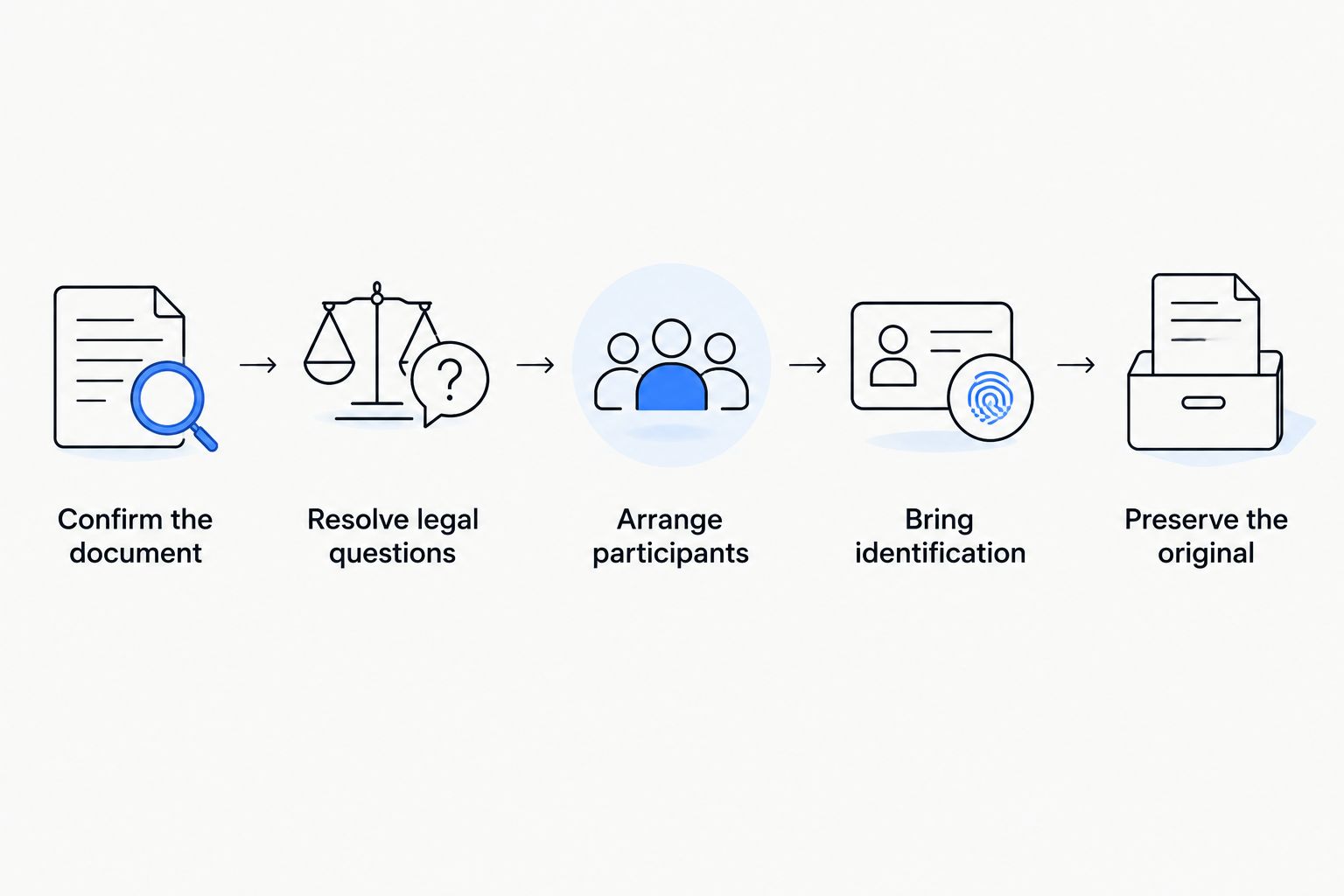
Use this sequence to separate legal decisions from appointment logistics. Do not sign a sworn statement in advance when the requested notarial act requires signing under an oath before the notary.
- Confirm the document. Determine whether you have an ordinary written will, a holographic will, or an electronic will. Ask an attorney if the category or execution instructions are unclear.
- Resolve legal questions. Settle questions about beneficiaries, capacity, witness eligibility, and disputed wording before the notary appointment.
- Arrange participants. Confirm who must attend and who will provide any required witnesses. Do not assume the notary supplies them.
- Bring identification. Ask the notary which identification and supporting materials the requested act requires. Bring the complete document, not just its signature page.
- Preserve the original. Keep the completed will and related statements together, and tell the appropriate trusted person how to locate them.
Signature on Demand is best for Clark County residents seeking Nevada document preparation and mobile notary services rather than legal advice. The service is Nevada-licensed for document preparation and serves Las Vegas, Henderson, North Las Vegas, and Summerlin. Its document preparation role is distinct from its notarial role.
A standard notary commission alone does not authorize someone to provide legal document preparation or legal advice. Signature on Demand’s Nevada document preparation services operate within the framework of NRS Chapter 240A; legal advice about inheritance choices belongs with an attorney.
You can review Signature on Demand when arranging document preparation or a mobile notary appointment. Describe the document and requested act before booking, especially if witnesses or a remote signing process are involved.
Can a notary act as one of the will’s witnesses?
A notary commission does not automatically make the notary your attesting witness. Witness eligibility and the notarial assignment are separate questions.
Do not ask the notary to notarize the notary’s own witness signature. Arrange separate witnesses unless an attorney has confirmed an appropriate execution arrangement and the notary has confirmed the permitted notarial role.
Does a notarized will avoid probate in Nevada?
No. Notarization does not determine whether an estate needs probate, and a self-proving affidavit does not move assets outside the estate.
If avoiding probate is your goal, ask an attorney about how asset ownership, beneficiary designations, and estate-planning documents work together. A notary stamp is not an asset-transfer plan.
FAQ
Can a notary notarize a will in Nevada in 2026?
Yes, a notary can perform a lawful notarial act connected with a Nevada will, including administering oaths for self-proving witness affidavits. Notarization does not replace the execution requirements for the type of will involved.
Does an ordinary Nevada will need 2 witnesses even if it is notarized?
Yes, an ordinary written Nevada will generally requires at least 2 competent witnesses under NRS 133.040. A notary stamp does not replace those witness signatures.
Does every Nevada will need a notarized self-proving affidavit?
No, a notarized self-proving affidavit is not universally required for a Nevada will. NRS 133.050 also provides for qualifying witness declarations under penalty of perjury.
Can I notarize my Nevada will without witnesses?
Notarizing a signature does not satisfy the witness requirements for an ordinary written Nevada will. Qualifying holographic wills have different requirements, including handwritten material provisions, a handwritten date, and the testator’s handwritten signature.
Can a mobile notary come to my home for a will signing?
A mobile notary can attend a home appointment to perform an authorized notarial act. Confirm the requested act, identification requirements, and responsibility for witnesses before booking; Signature on Demand offers mobile notary services in Clark County.
Does remote online notarization make an electronic will valid?
No, remote online notarization alone does not establish that an electronic will meets Nevada law. Electronic wills must satisfy their separate requirements under NRS 133.085.
Can a document preparation service tell me who should inherit?
No, a document preparation service does not provide legal advice about who should inherit or how to resolve an inheritance dispute. Take those questions to a Nevada attorney before preparing or signing the final documents.
Is a self-proving will impossible to challenge?
No, self-proof does not prevent a will contest. It addresses evidence of execution, not every potential dispute about capacity, undue influence, fraud, or the will’s meaning.
One last thing
The most useful question is not “Will you stamp this?” It is “What act does this document require?” That wording separates a notarial appointment from witness arrangements, document preparation, and legal advice.
For your 2026 estate-planning file, preserve the original will and its supporting statements together. Tell your chosen trusted person where the original is stored. A properly completed document still needs to be found when it is needed.
This page provides general Nevada information, not legal advice for your estate or a determination that a particular will is valid.


