
Yes, a notary can notarize for someone who cannot sign their name, provided the signing method complies with the applicable state law. In Nevada in 2026, a physical disability does not remove the requirements for identity verification, personal appearance, and a voluntary act. A relative cannot simply sign the person's name because holding a pen is difficult, and notarization does not resolve questions about legal capacity.
- Nevada allows signing accommodations; physical inability alone does not prevent notarization.
- To notarize for someone who cant sign, confirm the lawful method before the appointment.
- A signature by mark and signing under a power of attorney are different procedures.
- Signature on Demand offers mobile notary services for Las Vegas-area individuals and families.
Why this matters
A person with limited hand movement still makes their own decisions. The appointment must distinguish difficulty writing from difficulty understanding or communicating a decision. Those are different problems, and they require different responses.
Signature on Demand is best suited to Las Vegas-area individuals and families seeking mobile notarization and Nevada document preparation. Its mobile notary and document preparation services address appointment logistics and paperwork; legal advice about authority or capacity belongs with an attorney.
For a hospital visit, start with the practical requirements in the guide to having a mobile notary come to a Las Vegas hospital. Booking someone to travel does not, by itself, establish that the signing can proceed.
Can a notary notarize for someone who can't sign their name?
Yes. The key question is what the person can do, not whether their signature looks familiar or legible. Someone who cannot write a full name might still make a deliberate mark. Someone unable to make any mark needs a different procedure.
For Nevada notarizations, NRS Chapter 240 governs the notary's duties. Nevada law provides a procedure for a notary to sign for a person physically unable to sign or make a mark, at that person's direction. The notary must follow that procedure rather than improvise a substitute signature.
These 3 signing situations require different preparation:
| Signing situation | Best for | What it accomplishes | Limit or concern |
|---|---|---|---|
| Signature by mark | A person who can deliberately make a mark but cannot write their name | Allows the person's own mark to serve as a signature when the applicable requirements are met | The notary must confirm the required procedure and any witness requirements |
| Notary signs at the person's direction | A person physically unable to sign or make a mark | Uses Nevada's statutory accommodation for physical inability | The person must direct the act; the notary must follow the statutory requirements |
| Authorized agent signs in a representative capacity | A person whose existing power of attorney authorizes an agent to handle the transaction | Allows the agent to act under established authority | Being a spouse, child, caregiver, or emergency contact does not establish signing authority |
The first two methods accommodate the person's own act. The third involves another person's legal authority. Do not treat them as interchangeable shortcuts.
Signature by mark: when the person can make a mark
A deliberate mark is not the same as someone else writing the person's name. The person makes the mark as their signature. An ordinary signature also does not have to resemble neat handwriting to be genuine.
Tell the notary exactly what the person can do: hold a pen briefly, write initials, make a deliberate mark, or use an ordinary signing aid. Do not decide in advance that an X is automatically acceptable for every document.
The notary must confirm the applicable signing and notarization requirements. That includes whether witnesses are necessary and how the mark must be identified. A witness requirement for the document itself is separate from a requirement associated with the signing method.
The advantage is direct participation: the person performs their own signing act. The limitation is procedural. A bank, title company, or other recipient can require clarification about how the document should be executed, so ask before marking the final document.
Directed signing: when the person cannot make any mark
Nevada's procedure for physical inability addresses a person who cannot sign or make a mark. It is not permission for a family member to write the person's name and then seek a stamp.
The direction must come from the person whose signature is being accommodated. A caregiver's explanation of what the person supposedly wants does not substitute for that direction. Explain communication needs before the visit so the notary can determine whether the act can be completed lawfully.
The notary must follow the required signature notation and notarial procedure. Do not prepare a homemade statement, copy another state's wording, or ask a witness to create an alternative procedure.
This method addresses a physical barrier. It does not establish that a document is appropriate, that the person has legal capacity for the transaction, or that the recipient will accept an incorrectly executed document.
An agent's signature: when a power of attorney applies
An agent acting under a power of attorney signs in a representative capacity. The agent is not pretending to be the principal, and the notary is not treating the agent's signature as the principal's handwriting.
Before arranging the appointment, confirm that the existing power of attorney covers the intended transaction and remains effective. The document recipient can explain its submission requirements. An attorney should address disputes or uncertainty about the agent's authority.
Family relationship is not signing authority. A daughter who helps with appointments does not automatically have permission to sign a deed. A spouse who manages household tasks does not automatically have permission to execute every financial document.
An existing, applicable power of attorney can provide a separate path for an authorized transaction. Its limitation is equally important: it does not authorize every act, and it cannot be treated as a universal replacement for the principal's personal signature.
Why the signing procedure varies
The signing method depends on facts that affect the notarial act and the document's execution:
- Physical ability: Being unable to write a full name differs from being unable to make any mark.
- Communication: The notary needs to communicate with the person, not rely solely on a relative's account.
- Document requirements: A will, deed, affidavit, and power of attorney have different execution considerations.
- Notarial act: An acknowledgment and a jurat involve different duties; an oath or affirmation is not interchangeable with acknowledging a signature.
- Representative authority: An existing power of attorney requires a different analysis from accommodating the principal's own signature.
- Appointment format: An in-person visit and remote online notarization have different identity and participation procedures.
Do not choose a method solely because it seems easiest. Choose the lawful method that matches the person's abilities, the document, and the required notarial act.
How do I arrange the appointment without wasting a visit?
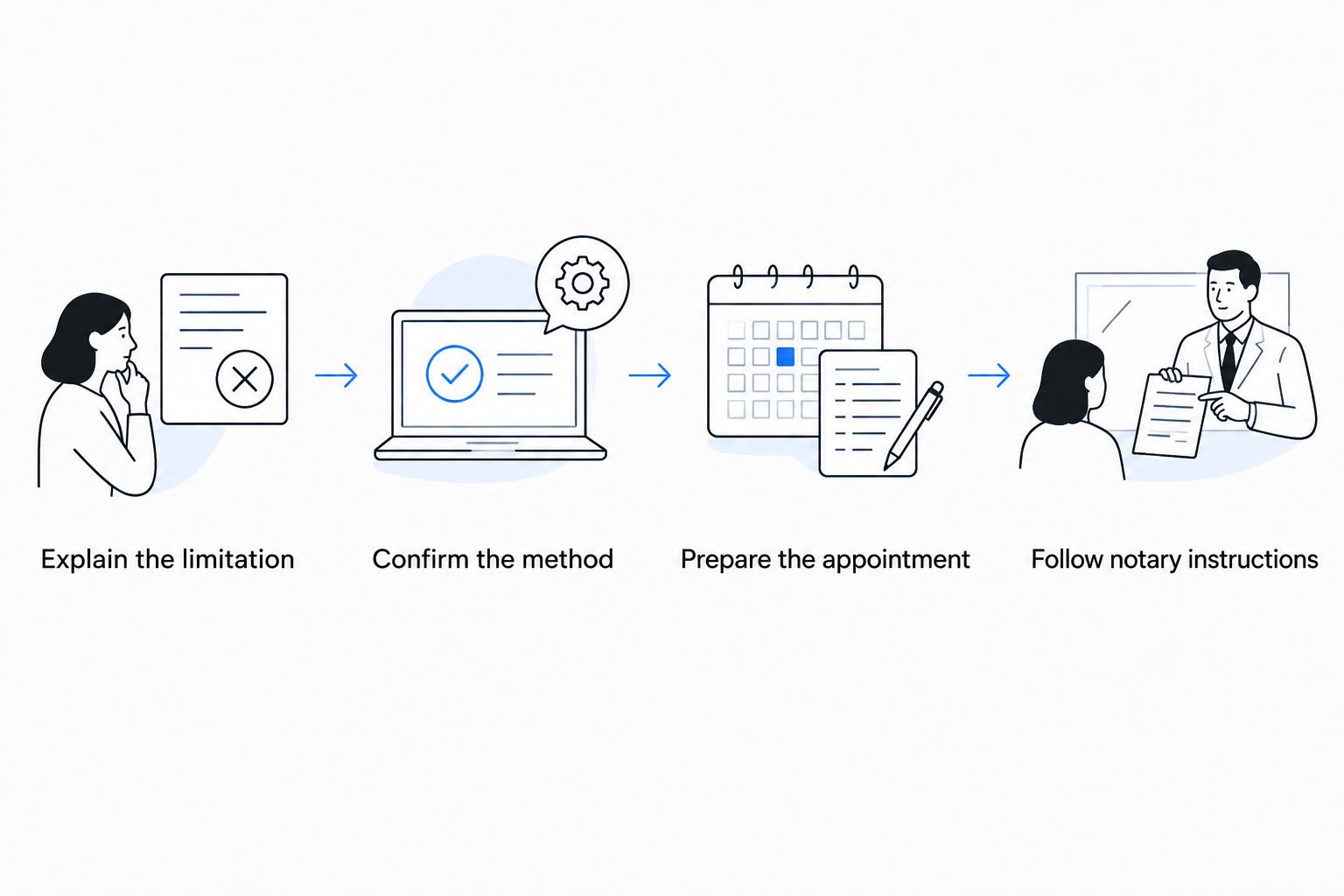
Use these 4 appointment steps for a Nevada signing in 2026. The goal is to settle the procedure before anyone writes on the final document.
- Explain the limitation. Describe the physical difficulty and what the person can still do. State whether the person can communicate directly and whether a hospital or care facility is involved.
- Confirm the method. Ask the notary which Nevada procedure applies. Separately ask the document recipient about execution instructions, required witnesses, and its submission requirements.
- Prepare the appointment. Gather the document, identification, and any existing authority document relevant to an agent's signature. Arrange witnesses only after confirming who is required and who is eligible.
- Follow notary instructions. Do not substitute a family member's signature or add a mark without confirming the procedure. Follow the notary's directions about when signing, acknowledgment, or an oath must occur.
Before booking, provide these 5 booking details: the document type, the person's physical limitation, their communication needs, the available identification, and the appointment location. These details let the notary address procedural questions before traveling.
If instructions conflict, pause. Ask the recipient to clarify what it needs, and ask an attorney to resolve legal questions rather than expecting the notary to choose a workaround.
Arrange a mobile notary appointment
Explain the signing limitation, document type, and Las Vegas-area location before scheduling.
Can my parent sign if they have dementia?
A diagnosis does not answer whether a particular document can be validly executed. Physical ability, present understanding, voluntariness, and the legal capacity required for the document are separate issues.
Do not describe a capacity concern as merely a handwriting problem. Explain the situation honestly, and seek an attorney's advice when understanding or authority is uncertain. A notary's stamp is not a medical assessment or a legal opinion about capacity.
Can I hold the pen or guide their hand?
Do not guide another person's hand without first discussing the signing procedure with the notary. Assistance that changes who controls the mark raises a different question from providing a pen grip or positioning paper.
Explain the proposed assistance before the appointment. The notary must determine whether the person is performing their own signing act or whether the statutory procedure for physical inability is needed.
Can remote online notarization solve the problem?
Remote online notarization does not automatically solve an inability to sign. A Nevada remote appointment in 2026 still requires compliance with the applicable identity, appearance, communication, and electronic notarization procedures.
Ask whether the proposed signing method is permitted in that format. Do not assume a mouse click, a typed name, or a relative operating the device substitutes for the person's required participation.
Signature on Demand offers mobile and remote online notary services. That choice concerns appointment format; it does not eliminate the need to confirm a lawful signing method for the specific document.
When should the appointment stop?
Stop when the proposed procedure depends on someone pretending to be the signer, directing the act without authority, or concealing the person's condition. A deadline does not make those actions acceptable.
Pause when identity cannot be established, direct communication is inadequate, or there are unresolved concerns about willingness or understanding. Bring authority and capacity questions to an attorney. Bring document acceptance questions to the recipient.
Keep the roles distinct: the notary performs the notarial act, the recipient states its acceptance requirements, and an attorney addresses legal rights and disputed authority. A document preparation service does not replace legal advice.
FAQ
Can a notary notarize for someone who can't sign their name in Nevada?
Yes, Nevada provides signing accommodations for physical inability, subject to the applicable statutory procedure. The notary must still satisfy identity, personal appearance, and other requirements for the notarial act.
Can someone sign with an X instead of their full name?
A deliberate mark can serve as a signature when the applicable requirements are met. Confirm the procedure, any witness requirements, and the document recipient's instructions before making the mark.
Can I sign my mother's name because she cannot hold a pen?
You cannot sign your mother's name merely because you are her child. Ask about the lawful accommodation for her own signing act or obtain legal advice about existing representative authority.
Does a person who cannot sign always need a power of attorney?
No, physical inability to sign does not automatically require a power of attorney. Nevada's signing accommodation and an agent's use of existing authority are different procedures.
How many witnesses are needed when someone signs by mark?
The witness requirement depends on the applicable signing procedure and the document's execution requirements. Ask the notary to confirm the Nevada procedure and ask the recipient about separate document requirements.
Can a notary sign for a person who is unconscious?
A notary cannot use a directed-signing accommodation when an unconscious person cannot direct the act. An attorney must address whether another lawful authority or process applies.
Can Signature on Demand help arrange a signing for someone with limited hand movement?
Signature on Demand provides mobile notary services in the Las Vegas area. Explain the person's physical ability, communication needs, document type, and location so the signing procedure can be discussed before booking.
One last thing
Notarizing a signature and correctly executing a document are different tasks. A valid notarial certificate does not supply a missing document witness, create an agent's authority, or fix an unsuitable legal document.
For your 2026 appointment, ask two separate questions: what must the notary do, and what must the document's signer do? Keeping those questions separate prevents a physical signing accommodation from being mistaken for permission to bypass the document's other requirements.


