
Yes, you can notarize a document for someone who lives out of state if you hold a valid notary commission, act within your authorized jurisdiction, and follow the required appearance and identification rules. The signer’s home address does not determine your authority; your location and the notarization method do. For Nevada notarizations in 2026, distinguish an out-of-state resident visiting Nevada from someone signing remotely while physically elsewhere.
- Can I notarize a document for someone out of state? Yes, when jurisdiction, identification, and appearance requirements are satisfied.
- Nevada notaries can notarize for visiting out-of-state residents; residency does not replace required identification.
- Remote online notarization requires specific authorization and compliant technology, not an ordinary video call.
- Signature on Demand provides mobile notary and remote online notary services; confirm the method your recipient accepts.
Can I notarize a document for someone who lives out of state?
Yes. An out-of-state address alone does not disqualify a signer. For a Nevada notary, Nevada Revised Statutes Chapter 240 governs notarial authority and procedures. Before arranging a Signature on Demand appointment, separate residence, physical location, and document destination: they answer different questions.
| Situation | Is notarization possible? | What controls the answer? |
|---|---|---|
| An Arizona resident meets a Nevada notary in Las Vegas | Yes, if the ordinary requirements are met | The notary acts in Nevada and verifies the signer’s identity |
| A Nevada resident asks a Nevada notary to meet in Arizona | Not under the Nevada commission alone | A Nevada commission does not authorize in-person acts in Arizona |
| A signer in another U.S. state uses a Nevada remote online notary | Yes, if the electronic notary and transaction meet Nevada requirements | Remote authorization, identity verification, and compliant audio-video technology |
| A document will be submitted outside Nevada | Often possible, subject to applicable requirements | The receiving jurisdiction’s execution rules and the recipient’s submission requirements |
The first situation is ordinary in-person notarization. The third uses a separate electronic notarization process. Do not treat them as interchangeable simply because both involve an out-of-state person.
Why this matters
A document can involve several places: where the signer lives, where the notary performs the act, and where the document will be used. Confusing those locations leads to incorrect certificates, unsuitable signing methods, and rejected submissions.
For your 2026 appointment, start with the recipient’s instructions rather than the signer’s mailing address. A bank, court, title company, or other receiving organization can specify the document format and supporting materials it needs. Notarization does not replace those requirements.
Signature on Demand is best for Clark County individuals and families who need mobile notarization or Nevada document preparation, not legal advice. The service offers both mobile and remote online notarization; the right method depends on the document and the signer’s circumstances.
In-person notarization: the signer comes to Nevada
A person who lives in another state can appear before a Nevada notary while visiting Nevada. The notary must still establish identity, perform the requested notarial act, and complete the certificate and required records correctly.
An out-of-state driver’s license is not automatically unacceptable because another state issued it. The notary must determine whether the identification satisfies Nevada’s requirements, including the applicable validity and identifying-information requirements. Ask about identification before the appointment, especially if names differ across the document and ID.
The document does not need to concern Nevada property or a Nevada transaction merely because a Nevada notary performs the act. However, its governing law can impose additional execution requirements. A notary’s authority to notarize and a document’s legal effectiveness are separate issues.
For example, notarizing a signature does not establish that a power of attorney contains the right powers or that a deed meets recording requirements. Those questions belong with the recipient or an attorney qualified to advise on the document.
Remote online notarization: the signer is elsewhere
Nevada permits remote online notarization under Chapter 240’s electronic notarization provisions. An appropriately authorized Nevada electronic notary can perform eligible notarizations for a signer located elsewhere, using the required remote process while the notary is physically in Nevada.
A standard notary commission does not, by itself, authorize remote online notarization. The notary needs the required electronic-notary authorization and must use compliant technology and procedures. An ordinary video call does not satisfy that framework.
Remote identity verification also differs from showing a driver’s license across a desk. The process must meet Nevada’s electronic notarization requirements, including applicable identity-proofing and credential-analysis requirements. Sending an ID photograph by email is not a substitute.
Before choosing remote signing in 2026, ask the receiving organization whether it accepts the resulting electronic document. A legally authorized remote notarization does not settle every question about recording, submission format, witnesses, or the underlying transaction.
For the distinction between legal authorization and a standard video call, see whether remote online notarization is legal in Nevada.
Which notarization method fits your situation?
Choose the signing method around the signer’s location and the recipient’s requirements. Convenience matters only after those conditions are satisfied.
| Method | Best for | Main advantage | Main limitation |
|---|---|---|---|
| In-person appointment | A signer who can meet a notary within the notary’s jurisdiction | Direct appearance and physical ID inspection | Requires travel to the appointment location |
| Mobile notary | A signer who needs an in-person visit at a suitable location | The notary travels to the signer | Travel does not extend the notary’s jurisdiction |
| Remote online notarization | A remote signer whose document and recipient permit electronic notarization | Appearance occurs through compliant audio-video technology | Requires electronic-notary authorization, identity verification, and an acceptable electronic workflow |
Mobile notarization remains in-person notarization. A Nevada mobile notary cannot cross a state line and use a Nevada commission as if the appointment were still in Nevada.
Remote online notarization changes the appearance method, not the need for legal authority. It also does not eliminate separate witnesses or execution requirements that apply to the particular document.
If a recipient insists on an original paper submission, clarify the complete delivery process before choosing remote signing. Do not assume that printing an electronically notarized file produces the original the recipient requested.
How do I prepare for an out-of-state signer?
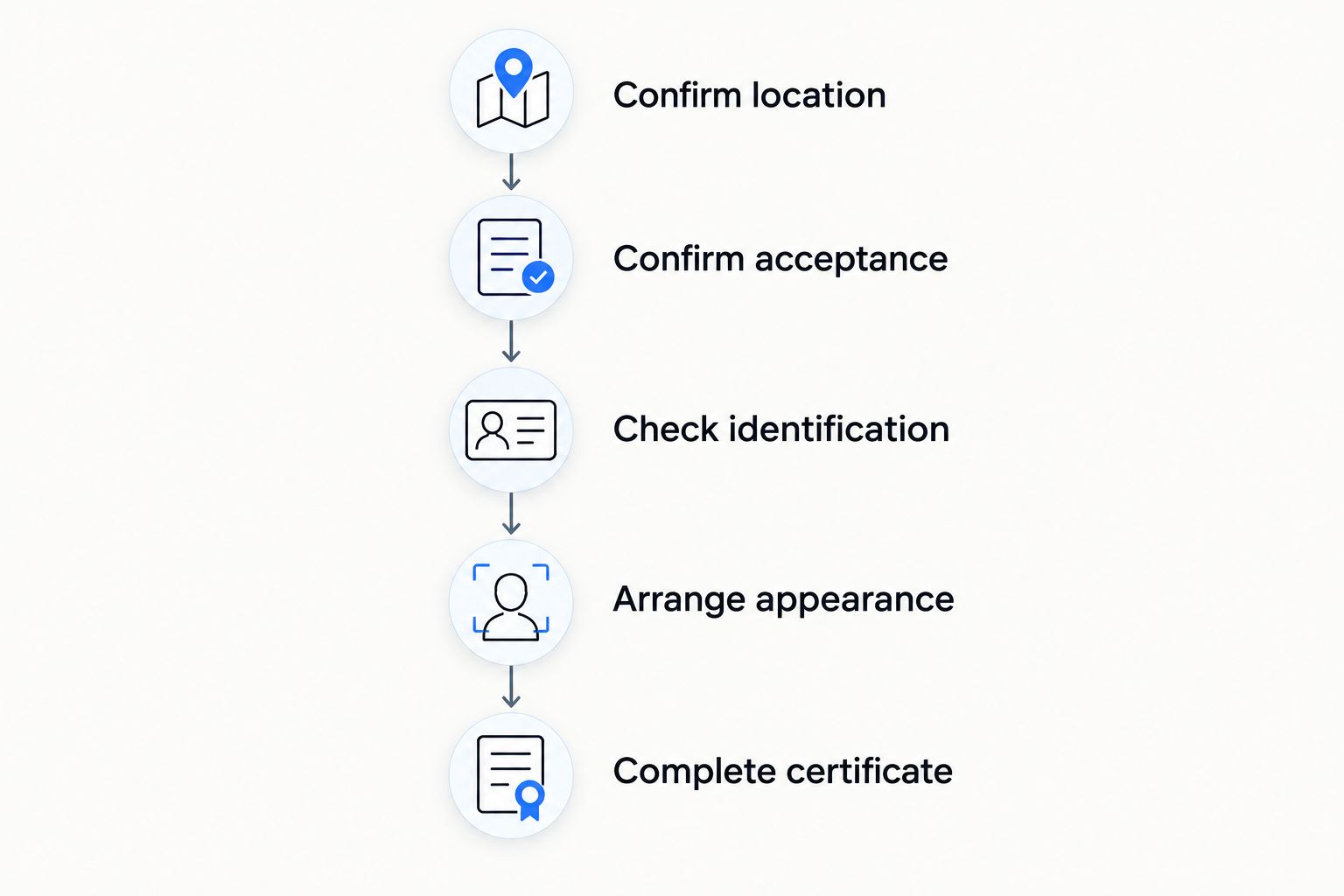
Use this sequence before scheduling. It separates the notary’s responsibilities from decisions the signer or recipient must make.
- Confirm location. Establish where the signer and notary will physically be during the act. For an in-person appointment, both must meet within the notary’s authorized jurisdiction.
- Confirm acceptance. Ask the recipient which notarial act, document format, and submission method it requires. Identify any separate witness or recording requirements.
- Check identification. Give the notary advance notice of the identification available and any name differences. Follow the required identity-verification process for the chosen method.
- Arrange appearance. Schedule an in-person meeting or a compliant remote session. Do not replace required appearance with an emailed signature page or a telephone conversation.
- Complete certificate. The notary completes the certificate for the act actually performed, using the correct venue and other required information.
For 2026 bookings, keep the recipient’s written instructions with the document. This gives the signer and notary something concrete to check instead of relying on an informal description such as “just get it stamped.”
Do not sign early without checking the requested notarial act. For an acknowledgment, a signer can acknowledge a signature already made; for a jurat, the signer must sign in the notary’s presence and take the required oath or affirmation. Remote acts must follow the corresponding electronic procedures.
Arrange your notarization
Ask about mobile or remote online notarization and the requirements for your document.
Why the requirements vary
The answer changes with the circumstances of the act, not simply with residency. These factors determine what you need to arrange:
- Notary jurisdiction. The commission establishes where the notary can act. An in-person Nevada appointment must occur within the authority of the Nevada commission.
- Appearance method. Physical appearance and remote online appearance follow different procedures. Electronic authorization is required for the remote route.
- Identification. The notary must establish identity using a legally acceptable method. An address or a familiar name does not prove identity.
- Notarial act. An acknowledgment and a jurat have different requirements. The notary cannot choose the act as legal advice for the signer.
- Document execution rules. Witnesses, signature requirements, and recording formalities can depend on the document and governing law.
- Recipient instructions. The organization receiving the document can require a particular submission format or supporting material. Resolve those details before signing.
The practical rule for 2026 is straightforward: verify authority, appearance, and acceptance separately. Passing one check does not automatically satisfy the others.
Does the certificate use the signer’s home state?
No. For an in-person notarization, the venue identifies where the notarial act occurs, not where the signer lives or where the document will be sent. A California resident signing before a notary in Las Vegas does not make California the venue.
Remote certificates must reflect the applicable electronic-notarization requirements, including required information about the remote act. Do not copy the signer’s address into the venue or assume a preprinted state is correct.
Can I notarize a document that will be used in another state?
Yes, provided the notarization follows the notary’s governing law and the document satisfies the applicable execution and submission requirements. A destination outside Nevada does not, by itself, prevent a Nevada notarization.
Ask the recipient about certificates, witnesses, originals, and delivery format before the appointment. The notary verifies and certifies the notarial act; the notary does not guarantee that the document accomplishes its intended legal purpose.
Can someone email me a signed document to notarize?
No, an emailed document alone does not satisfy a signer’s required appearance. The signer must appear in person or through an authorized remote online notarization process.
A scanned signature and an attached ID photograph do not turn email into notarization. For an acknowledgment of an existing signature, the signer still must appear and acknowledge that signature using the legally permitted procedure.
What notarization does not establish
Notarization does not prove that every statement in a document is true, that the agreement is enforceable, or that the signer selected the right form. The certificate records the specific notarial act, not a legal opinion about the entire transaction.
Nevada document preparation is also distinct from legal representation. Chapter 240A regulates document preparation services; Chapter 240 governs notaries. A provider offering both services still must keep those roles separate.
If you need advice about which state’s law controls a trust, deed, divorce filing, or power of attorney, consult an attorney. Do not ask a notary stamp to solve a legal drafting problem. Settle the document’s legal requirements before arranging its execution.
FAQ
Can a Nevada notary notarize for someone with an out-of-state driver’s license?
Yes, an out-of-state driver’s license can be acceptable if it meets Nevada’s identification requirements. The notary must assess the identification; the issuing state alone does not decide the answer.
Can a Nevada mobile notary meet me in another state?
A Nevada commission alone does not authorize an in-person notarization in another state. The notary needs authority to perform the act in the location where the meeting occurs.
Can I use remote online notarization while I am in another U.S. state?
Yes, an authorized Nevada electronic notary can notarize remotely for an eligible signer in another U.S. state when Nevada’s requirements are met. Confirm that the document and its recipient permit the electronic process.
Is a video call enough to notarize a document in 2026?
No, a standard video call is not a compliant remote online notarization process in 2026. The notary must have the required authorization and use procedures and technology that meet Nevada law.
Do I have to sign the document in front of the notary?
For a jurat, you must sign in the notary’s presence and take the required oath or affirmation. For an acknowledgment, you can acknowledge a previously made signature, but you still must satisfy the appearance requirement.
Does notarization guarantee that another state will accept my document?
No, notarization does not guarantee acceptance of the underlying document. Check applicable execution rules and the recipient’s requirements for witnesses, certificates, originals, and electronic submissions.
Can Signature on Demand help with an out-of-state signer?
Signature on Demand offers mobile notary and remote online notary services. Confirm the signer’s location, identification, document requirements, and recipient’s acceptance before choosing the service.
One last thing
Check the venue before the appointment, not after the document is returned. A form prepared elsewhere can arrive with a preprinted state and county that do not match where the notarization will occur.
For your 2026 signing, flag that mismatch to the notary rather than changing the certificate yourself. The signer’s residence is not the venue, and a correct signature does not cure an incorrectly completed notarial certificate.


