
Yes, a notary can notarize a document for some family members, but the answer depends on the notary’s state rules and involvement in the document. In Nevada, a notary cannot notarize a spouse’s or domestic partner’s signature, and other family relationships do not remove restrictions involving the notary’s own signature, participation in the document, or direct beneficial interest.
- Can a notary notarize a document for a family member? In Nevada, some relatives qualify; spouses and domestic partners do not.
- Nevada’s NRS 240.065 restricts notarization when the notary is involved in the document or has a direct beneficial interest.
- Signatureondemand provides mobile and remote online notary services for Las Vegas families seeking a notary outside the family.
- Notarization does not replace legal advice, document-specific witnesses, or the signer’s required appearance.
Can a notary notarize a document for a family member?
In Nevada, being related does not automatically disqualify a notary, but being the signer’s spouse or domestic partner does. Nevada Revised Statutes, NRS 240.065, also restrict a notary who executed or is named in the instrument, or who has a direct beneficial interest, subject to statutory exceptions.
For your 2026 appointment, separate the relationship question from the conflict question. A parent-child relationship is not the same issue as a deed that transfers property to the notary.
| Situation | Nevada rule or concern | Next move |
|---|---|---|
| Your spouse is the notary | The spouse restriction applies | Use another notary |
| Your domestic partner is the notary | The domestic partner restriction applies | Use another notary |
| Your parent, child, or sibling is the notary | Relationship alone is not the spouse or domestic partner prohibition | Check the document and the notary’s involvement |
| The notary signs the same instrument | The notary’s execution of the instrument creates a restriction | Arrange an independent notary |
| The document names or directly benefits the notary | NRS 240.065 requires scrutiny; statutory exceptions exist | Resolve eligibility before signing |
Signatureondemand provides mobile and remote online notary services in Las Vegas. An appointment outside the family removes the need to rely on a relative whose eligibility is in question.
Why this matters
A familiar face does not replace a valid notarial act. Your relative still needs to satisfy the applicable appearance, identification, certificate, and recordkeeping requirements.
Notarization also has a limited purpose. An acknowledgment concerns the signer’s acknowledgment of execution; a jurat involves an oath or affirmation and signing under the applicable procedure. Neither makes the notary your lawyer or proves that every statement in the document is true.
For a family transaction in 2026, settle the notary’s eligibility before anyone signs. That is especially important when the same document gives someone authority, transfers property, or affects an estate.
Parent, child, or sibling: check the document, not just the relationship
A Nevada notary is not automatically barred merely because the signer is a parent, child, or sibling. The document still controls whether another restriction applies.
Consider a parent signing an affidavit that does not name or benefit the adult child who holds the notary commission. That relationship presents a different eligibility question from a parent signing a deed transferring property to that child. The second example involves the notary’s direct participation or benefit, not simply kinship.
The advantage of using a relative is familiarity. The limitation is that familiarity does not establish legal eligibility, and family roles can overlap with roles in the transaction.
Best for a routine, nonconflicting document: a legally eligible relative who follows the full notarial procedure. Best for a document involving family property or authority: an independent notary, with legal advice when the document itself raises questions.
Do not treat these examples as approval of a particular instrument. Review the actual names, signatures, and interests involved rather than applying a rule based only on the document’s title.
Spouse or domestic partner: use another Nevada notary
Nevada’s spouse and domestic partner restriction does not depend on whether the document seems harmless. A spouse’s routine signature is still a spouse’s signature.
An acknowledgment, affidavit, or permission form does not create an exception merely because the transaction is small or the signer’s identity is obvious. Knowing the signer addresses identification; it does not remove a statutory disqualification.
Best for a spouse or domestic partner’s document: a notary outside that relationship. The benefit is a clear separation between the signer and the commissioned official. The practical limitation is arranging another appointment and following that notary’s identification requirements.
If your spouse has already notarized your signature, do not add another stamp or alter the certificate yourself. Explain what happened to the receiving organization and an independent notary so they can identify the appropriate next step.
Named or benefiting relatives: stop before the certificate
Family documents often give the notary a second role. A relative might be a buyer, recipient, agent, beneficiary, or signer elsewhere in the instrument.
Under NRS 240.065, the fact that the notary executed or is named in the instrument matters independently of family status. Direct beneficial interest matters too, although the statute contains exceptions that require attention to the actual circumstances.
A power of attorney naming the commissioned relative as agent is not just a parent asking a child for help. A property document transferring ownership to the commissioned relative is not just a sibling doing a favor.
Use an independent notary when your relative’s role in the document creates an eligibility problem. A neutral appointment separates the notarial act from the family transaction. It does not resolve whether the underlying document is legally appropriate; that question belongs with a qualified attorney.
Why the answer varies
The answer changes because notarization depends on more than the signer’s relationship to the notary. These are the main drivers:
- Commission jurisdiction: The rules governing the notary’s commission control eligibility. Do not apply Nevada’s family rules automatically to another state.
- Relationship: Nevada expressly restricts notarizing a spouse’s or domestic partner’s signature.
- Document involvement: A notary who executed or is named in the instrument faces a separate restriction, subject to applicable exceptions.
- Direct beneficial interest: A transaction that directly benefits the notary requires a conflict review.
- Required procedure: Identification, appearance, an oath when required, and the correct certificate remain necessary.
- Document-specific requirements: Witnesses and execution rules are separate from the notary’s family eligibility.
For a 2026 Nevada signing, start with NRS 240.065 for the conflict question and the document’s applicable execution rules for the signing question. A relative’s commission answers neither question by itself.
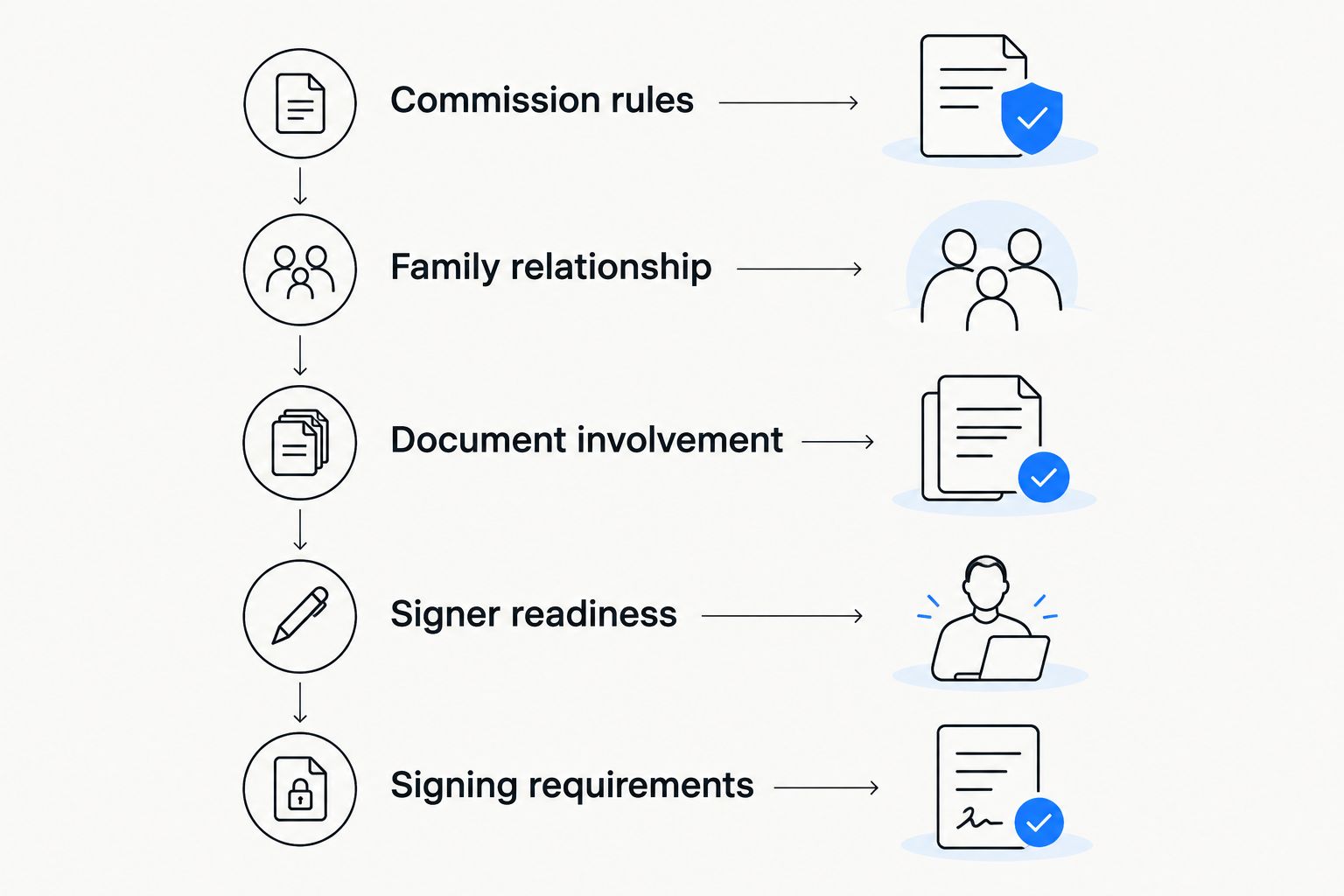
Run these 5 checks before asking a relative
A family appointment needs the same procedural discipline as any other notarization. Use these checks before choosing who will handle it.
- Commission rules: Identify the state that commissioned the notary. If the appointment is in Nevada, confirm that the notary is authorized to perform the act there.
- Family relationship: Determine whether the signer is the notary’s spouse or domestic partner. If so, select another Nevada notary.
- Document involvement: Read the entire instrument for the notary’s name, signature, role, and direct benefit. Do not inspect only the signature page.
- Signer readiness: Confirm that the signer can appear through an authorized method, establish identity, and participate willingly. Raise communication or capacity concerns before the appointment.
- Signing requirements: Confirm the required notarial act, any witness requirements, and whether signing must occur during the appointment. Do not choose a certificate based on guesswork.
Ask the receiving organization to clarify its document instructions before the appointment. If choosing a notarial act requires legal interpretation, get qualified legal guidance rather than asking a standard notary to decide for you.
A refusal is not proof that the document is fraudulent. It can mean the notary cannot lawfully complete the requested act; the guide to when a Nevada notary can refuse notarization explains that separate question.
Choose an independent appointment that fits the signer
An independent notary is the practical choice when a spouse restriction, document role, or direct benefit rules out your relative. You can then choose the appointment format around the signer’s needs.
These 3 appointment routes address location and appearance differently. None removes the requirement for a lawful notarial act.
| Appointment route | Best for | Advantage | Limitation |
|---|---|---|---|
| In-person appointment at a notary’s location | A signer who can travel | Keeps the appointment outside the family | Requires travel and scheduling |
| Mobile notary | A signer who needs an in-person visit | Brings the notary to the signer | Requires a suitable location and coordinated attendance |
| Remote online notarization | A signer seeking an authorized online process | Uses remote appearance through the required process | Requires suitable technology and document acceptance |
Signatureondemand is best for Las Vegas families seeking mobile or remote online notarization outside the family. Its services include both formats; the appropriate route depends on the document, signer, and receiving organization.
Remote online notarization is not an ordinary video call followed by an emailed stamp. It uses an authorized process. Before your 2026 appointment, confirm that the receiving organization accepts that format and that the signer can complete its identity and technology requirements.
Arrange a notary outside the family
Ask about mobile or remote online notarization for your Las Vegas family document.
Can my child notarize my power of attorney in Nevada?
Your child’s relationship alone does not create Nevada’s spouse or domestic partner prohibition. But if the power of attorney names your child as agent, that named role creates a separate eligibility issue under NRS 240.065; use an independent notary rather than assuming the family relationship settles it.
Can my spouse notarize a routine form in Nevada?
No. Nevada prohibits a notary from notarizing a spouse’s signature, even when the form is routine and the notary knows the signer personally.
Does a notary stamp make a family agreement legally valid?
No. Notarization addresses the required notarial act, not every legal requirement of the agreement; legal validity can also depend on the document’s terms, execution, witnesses, and applicable law.
Keep document preparation and notarization separate
There are 2 separate roles here: preparing the document and performing the notarial act. A notary commission alone does not authorize someone to provide legal advice or prepare legal documents as a regulated service.
Nevada regulates document preparation services under NRS Chapter 240A. That credential is distinct from a Notary Public commission, and neither credential is a license to practice law.
Signatureondemand provides Nevada-licensed document preparation as well as notary services. For your family, the practical distinction is deciding whether you need an existing document notarized, a document prepared from your instructions, or an attorney to advise on legal rights and choices.
Use an attorney for legal advice; use an eligible notary for the notarial act. One appointment does not erase those boundaries.
FAQ
Can a notary notarize a document for a family member in Nevada?
Yes, for some relatives, provided no other restriction applies. Nevada prohibits notarizing a spouse’s or domestic partner’s signature and separately restricts certain document involvement and direct beneficial interests under NRS 240.065.
Can my husband or wife notarize my signature?
No, not under Nevada’s spouse restriction. Use a different notary even if your spouse knows your identity and the document appears routine.
Can my sibling notarize my document in Nevada?
A sibling relationship alone does not trigger Nevada’s spouse or domestic partner prohibition. The notary must still check involvement in the instrument, direct beneficial interest, and all required procedures.
Can a notary notarize their own signature?
No, a notary cannot notarize their own signature. Arrange another eligible notary for the required act.
Can a relative notarize a power of attorney that names them as agent?
Use an independent notary rather than assuming the relative is eligible. Being named in the instrument raises a restriction separate from the family relationship under Nevada’s NRS 240.065.
Can we use a video call instead of meeting a notary?
An ordinary video call is not a substitute for authorized remote online notarization. Use an authorized process and confirm that the receiving organization accepts the format.
Does notarization replace witnesses on a family document?
No, notarization does not automatically replace required witnesses. Check the execution rules for the specific document before scheduling the signing.
One last thing
The name elsewhere in the document can matter more than the relationship on the signature page. Before a family signing in 2026, read the entire instrument for the proposed notary’s role—not just the space beside the stamp.
If your relative is disqualified, changing the appointment format does not fix it. Choose a different notary first; then decide whether an in-person, mobile, or authorized remote appointment fits the signer.


